

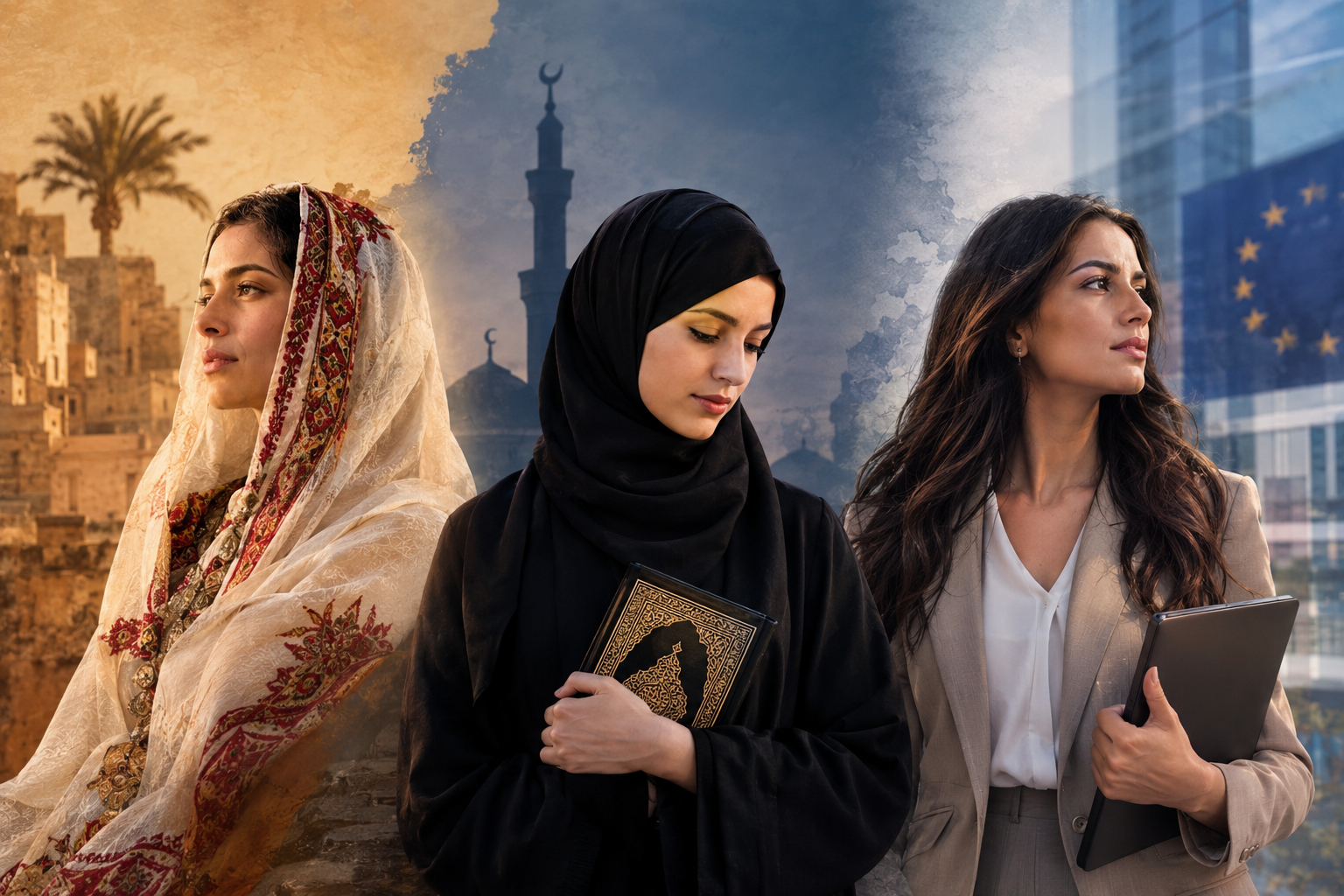
From Oriana Fallaci to Bourguiba: the female body between emancipation, religious identity, modernisation and power

Abstract: For centuries, the female body has constituted one of the principal sites through which societies express, negotiate and, at times, impose moral, religious, cultural and political norms. Women’s clothing, apparently belonging to the private sphere, can thus become a powerful symbolic device through which freedom, emancipation, belonging and conformity are defined. Oriana Fallaci’s gesture in 1979, when she removed the chador during her interview with Ayatollah Ruhollah Khomeini, has progressively entered the Western imaginary as the representation of a woman capable of challenging authority and asserting her autonomy. Yet this very interpretation raises a sociological question: if the positive meaning of that gesture lies in a woman’s capacity to make autonomous decisions about her own body, why is the same capacity called into question when a Muslim woman voluntarily chooses to cover herself as an act of worship? Comparison with Habib Bourguiba’s Tunisia allows the analysis to be broadened further. Bourguiba’s reforms produced major transformations in family law, education and the construction of the modern Tunisian state; nevertheless, the modernisation project may also be critically examined in relation to its component of cultural transformation and its relationship with the Francophone and colonial legacy. The symbolic treatment of the sefsari, associated with the traditional woman and with a past to be overcome, illustrates how women’s clothing can be used to represent the transition from a society regarded as traditional to one defined as modern. The article therefore proposes a fundamental distinction between religious obligation and coercion, between theological prescription and practical enforcement, and between social conditioning and the absence of agency. Its central argument is that a coherent conception of women’s freedom—assuming that such a single conception exists—should not determine in advance which choice makes a woman free. Rather, it should guarantee the possibility of choosing, protecting the individual from coercion regardless of the direction from which that coercion is exercised.
Keywords: #OrianaFallaci #WomensFreedom #WomensEmancipation #Hijab #Niqab #Aqida #Fiqh #Agency #FreeWill #Coercion #ReligiousIdentity #CulturalIdentity #Islam #StateFeminism #Bourguiba #Sefsari #Tunisia #Modernisation #Westernisation #Colonialism #Decolonisation #Tradition #Modernity #FemaleBody #ReligiousPluralism #ReligiousMinorities #Power #ElhemBeddouda #EthicaSocietas #EthicaSocietasReview #ScientificJournal #Humanities #SocialSciences #EthicaSocietasUPLI
Oriana Fallaci and the Western construction of the woman who challenges power
The episode involving Oriana Fallaci and Ruhollah Khomeini has, over time, become much more than a journalistic episode. In 1979, Fallaci attended the interview wearing the chador required by the circumstances and, during the encounter, openly challenged the conception of women’s dress upheld by Iran’s new political order. When Khomeini told her that, if she did not like it, she was under no obligation to wear it, Fallaci removed the chador and left the room.
The episode was subsequently interpreted as an exemplary manifestation of courage, freedom and individual autonomy. Such an interpretation is not without foundation. Fallaci was confronting an extraordinarily powerful political and religious authority and used her own body as an instrument of dissent. Her gesture therefore acquired political significance because it took place within an asymmetrical relationship of power and because it challenged a norm represented by the person before her.
From a sociological perspective, however, the significance of the episode lies not simply in the fact that Fallaci uncovered herself, but in the fact that she asserted her right to determine personally the meaning of her own body. It is precisely this element that allows us to pose a question extending beyond Fallaci and beyond Iran in 1979: if what makes that gesture worthy of celebration is the refusal to allow an authority unilaterally to determine how a woman should dress, then the same principle should also apply to a woman who, in an entirely different context, autonomously decides to cover herself.
Otherwise, a problematic distinction is introduced: freedom is fully recognised when it produces a choice consistent with the cultural expectations of the majority, but is treated with suspicion when it leads to a minority religious choice.
The issue, therefore, is not to determine whether Fallaci was right or wrong to remove the chador. The sociological question is whether the criterion used to recognise her agency can be applied consistently to women whose decisions produce outcomes that the Western majority—and not only the Western majority—interprets negatively.
How many “Oriana Fallacis” are we willing to recognise?
My question is this: how many Oriana Fallacis are there in Europe today?
This question should not be interpreted as implying an equivalence between revolutionary Iran and contemporary European societies. The historical, political and institutional differences are far too profound for such a parallel to be seriously sustained. The comparison instead has analytical value in examining the relationship between body, power, identity and agency.
A woman who removes a religious garment before an authority that regards it as compulsory may be perceived as asserting her individuality against a collective norm. Yet if autonomy is the central value, the same autonomy should be recognised in the woman who makes the opposite choice: a woman who, in a context where the religious majority is not imposing the veil, chooses to wear it out of personal conviction.
The distinction is particularly significant because Muslim women in Europe often belong to a religious minority. Their behaviour is not always interpreted as an individual choice, but rather as the expression of a group, a religion or a cultural system. Their bodies thus become objects of social interpretation: the veil is read as an indicator of patriarchy, subordination, failed integration or rejection of Western values, and the risk is that the individual is deprived of the possibility of assigning her own meaning to her choice.
The issue is not to deny that some Muslim women are forced to cover themselves. Denying that reality would be as ideological as claiming that every veiled woman is necessarily coerced. Social research should instead distinguish among different situations, because coercion, family pressure, community conformity, religious conviction, cultural identity and personal choice are not equivalent categories, even though they may intersect.
When the female body becomes a symbolic battleground
History demonstrates that the female body has frequently become a site where political, religious and cultural interests converge. Women have been told how to dress, which parts of their bodies to cover, which to reveal, what image of femininity to embody and what behaviour should be regarded as respectable.
What distinguishes contemporary society is therefore not that it has politicised women’s bodies for the first time, but that this politicisation continues to assume different forms, even when expressed through the language of freedom.
The central point is to distinguish between a society that protects a woman from coercion and one that determines in advance which behaviour is compatible with freedom. The former protects agency; the latter risks replacing one norm with another.
If a woman is forced to cover herself, that coercion must be opposed. But if a woman autonomously chooses to cover herself, automatically interpreting her decision as evidence of subordination means denying the possibility that she may possess a religious conscience, decision-making capacity and her own interpretation of freedom.
The issue becomes even clearer when we observe the asymmetry with which opposite choices are interpreted. A woman who abandons the veil may be described as emancipated because she has broken with a traditional norm; a woman who wears it may be described as unemancipated precisely because she adheres to a religious norm.
In both cases, however, the observer risks assigning meaning to the choice before listening to the person who made it. A rigorous conception of women’s freedom should instead begin with the simplest question: “Was this woman free to choose?” Only after answering that question does it become possible to ask why she chose a particular path.
Bourguiba and Tunisia: modernisation and the transformation of identity
The case of Habib Bourguiba introduces a second dimension to the analysis. Postcolonial Tunisia represents one of the most significant examples of the construction of national modernity through profound social, legal and cultural reforms.
The 1956 Code of Personal Status radically transformed family law, abolishing polygamy and introducing rules governing marriage and divorce that were highly innovative within the regional context. At the same time, the state invested in education, healthcare and the construction of national institutions. These achievements should be acknowledged without hesitation.
Criticising Bourguiba does not mean denying the positive effects of his reforms. Serious historical analysis cannot be reduced to an ideological opposition in which every innovation is automatically regarded as negative merely because it originated from a leader whose cultural policies are being questioned.
It is nevertheless possible to advance a different argument: individual reforms may have been fundamental while the broader project of modernisation may simultaneously be criticised for the way in which it approached tradition, cultural identity and the Francophone legacy.
From this perspective, the relevant question is not whether Tunisia needed to modernise, but what meaning was attributed to modernisation and how much space remained for the possibility of constructing a specifically Tunisian form of modernity.
The sefsari and the symbolic politics of clothing
The case of the sefsari is particularly significant because it illustrates how a garment can become a symbol of national transformation.
The sefsari formed part of Tunisia’s social and cultural history and cannot be reduced to a purely religious category. It belonged to a particular conception of women’s presence in public space, respectability and social identity.
When Bourguiba’s government began to present abandonment of the sefsari as part of the modernisation of Tunisian women, clothing ceased to be merely a social practice and became a political issue as well. The woman who covered herself could be associated with the past; the woman who abandoned the veil could become the image of the new, modern Tunisia.
It is precisely this dimension that makes the phenomenon problematic—not because every tradition must be preserved, nor because every woman who wore the sefsari was necessarily free. The issue lies in the possibility that the state transformed a particular aesthetic and cultural choice into a symbolic criterion for distinguishing the modern woman from the traditional woman.
In my view, it is here that the concept of cultural uprooting becomes analytically useful. Not in order to argue that Tunisia should have remained static, but to question the assumption that a society must necessarily distance itself from its own cultural symbols in order to become modern.
Social transformation is a normal process. The systematic delegitimisation of one’s own cultural memory is something different.
Modernisation and Westernisation are not synonymous
The Tunisian case allows us to question one of the most problematic equivalences in the history of modernity: the equation of modernisation with Westernisation.
A society may become better educated, improve healthcare, reform its legal system and expand women’s social participation without necessarily adopting the European cultural model as the only legitimate one.
The question becomes particularly sensitive in the postcolonial context. Political independence does not automatically erase the cultural hierarchies produced by colonialism. Formerly colonised societies may continue to regard the former coloniser’s model as an implicit benchmark of progress and may come to perceive aspects of their own culture as obstacles to be removed.
In the Tunisian case, the continuing importance of the French language and French culture in elite formation, education and representations of modernity constitutes an important element of this discussion. This does not mean that using French is inherently a form of colonialism, nor that every European influence should be rejected. Rather, it means examining the cultural hierarchy that may emerge when one language, culture or social model becomes associated with modernity while indigenous culture is progressively associated with the past.
The criticism, therefore, should not be directed at modernity itself, but at a conception of modernity that fails to recognise the possibility of different paths. Tunisia could modernise without necessarily becoming culturally Francophone; it could develop its institutions without treating its own identity as a residue to be overcome or erased.
State feminism and women as symbols of the new nation
The concept of state feminism helps us understand this dynamic more clearly.
In Tunisia, the transformation of women’s status was not simply a bottom-up social process, but one strongly supported and directed by the state. Women consequently also became symbols through which the new national state represented itself as modern, progressive and distinct from the past.
This does not automatically make the reforms negative. It does, however, require us to distinguish between women’s emancipation and the political use of the image of the emancipated woman.
When the state determines which clothing, behaviour or role represents the modern woman, the question of autonomy inevitably returns to the centre of the debate. Emancipation should increase women’s capacity to choose, not merely replace one norm with another.
If a society tells a woman, “You must not be forced to dress this way”, it is protecting freedom. If, however, it says, “A truly free woman cannot choose to dress this way”, it has taken a further and problematic step: it has predetermined the content of freedom.
The hijab: between religious prescription and individual choice
This distinction is essential to understanding the hijab from an Islamic perspective.
From the standpoint of ʿaqīda, the believer recognises the normative authority of God; from the standpoint of fiqh, the legal tradition elaborates religious prescriptions through specific interpretative methodologies. In Sunni jurisprudence, the prescribed covering for an adult Muslim woman is generally regarded as a religious obligation.
Acknowledging this does not, however, mean asserting that a woman who wears the hijab is necessarily subject to coercion by another person.
Here it is essential to distinguish between religious obligation and human coercion. The former concerns the relationship between the believer and the religious norm; the latter concerns a relationship of power in which one person prevents another from exercising her will through threats, violence, blackmail or other forms of pressure.
The distinction is also important in relation to free will. A believer may regard a form of conduct as obligatory and nevertheless choose whether to observe it. The fact that an individual perceives a religious norm as binding does not imply that another person is forcing her to comply with it. On the contrary, moral responsibility itself presupposes the possibility of choosing between obedience and disobedience to God.
Naturally, this does not mean that every Muslim woman who wears the hijab is necessarily free from social conditioning, just as in every other sphere of life involving family, community and the broader social environment. The presence of conditioning does not automatically eliminate agency, just as the existence of a religious norm does not automatically demonstrate coercion.
Why the distinction between obligation and coercion is crucial
Confusing these two levels fuels one of the principal misunderstandings in Western debates about Islam.
If one says that “the hijab is obligatory”, an external observer may immediately transform that theological proposition into “therefore someone forces women to wear it”. But the logical transition is not automatic.
A religious individual may voluntarily adopt a prescription that she regards as obligatory. In this sense, obligation does not necessarily eliminate freedom; it may become part of the moral framework through which the individual exercises freedom.
This principle does not apply exclusively to Islam. People continually structure their lives through moral, religious, family and professional obligations that they consider meaningful. Freedom cannot simply be defined as the complete absence of norms, because such a definition would make it virtually impossible to speak meaningfully of moral freedom.
The sociologically relevant question is therefore whether the norm is internalised and embraced by the individual or imposed through a coercive relationship. The two dimensions may overlap, but they should not be confused.
The niqab and Islamic legal pluralism
The niqab requires an even more careful distinction.
Contrary to what often emerges in public debate, it is inaccurate to present face covering as a prescription on which the entire Islamic tradition has adopted a single position. Sunni schools of jurisprudence have developed different interpretations regarding the covering of the face and the circumstances in which it may be practised.
Some positions regard the niqab as obligatory under particular conditions or according to particular interpretations; others consider it recommended rather than universally obligatory.
This legal plurality is important because it prevents the niqab from being treated as though it were simply the automatic consequence of a single Islamic rule.
A woman who wears it may adhere to a specific legal interpretation, may regard it as a recommended practice or may experience it as a personal form of greater devotion to her Creator.
Particularly in a European context in which the niqab constitutes a minority practice, choosing to wear it can provide an interesting case of religious agency. Not because every woman who wears the niqab is necessarily more courageous than others, but because sociological analysis should also take account of the social cost of a minority choice rather than automatically interpreting that choice as passivity.
The Muslim woman as a subject, not an object of interpretation
One of the most significant problems in European debate is that Muslim women are frequently transformed from subjects into objects.
Others speak about them, interpret their clothing, discuss their religion and decide what their bodies represent. Their personal experience, as so often happens, risks becoming secondary to the narrative constructed around them.
This dynamic produces a particular form of paternalism. When a woman states that she has been coerced, her testimony is regarded as credible and used to denounce oppression. When, however, she states that she has autonomously chosen her religious clothing, the same testimony may be relativised on the grounds that she is not truly aware of her own condition.
This is epistemologically problematic because it makes the woman, by definition, incapable of providing valid testimony about her own experience. If she says, “I am oppressed”, she is heard; if she says, “I am free”, it is assumed that she does not realise that she is not.
Her agency is therefore recognised only when it confirms the observer’s diagnosis.
The freedom to cover oneself is not the opposite of the freedom to uncover oneself
A coherent conception of women’s freedom should not determine which of these two choices is morally superior before recognising the decision-making capacity of the person concerned.
One woman may decide not to wear the hijab and experience that choice as emancipation; another may wear it and experience the same decision as an expression of faith and a source of pride. Their experiences are not identical, but both may be authentic.
The role of institutions should not be to determine which woman has interpreted freedom correctly, but to ensure that neither is subjected to coercion.
If a woman is forced to cover herself, she should be protected. Equally, if a woman is forced to uncover herself, she should be protected in the same way.
This symmetry is fundamental because it prevents freedom from becoming a selective criterion. If we defend a woman’s right to reject the veil, consistency requires us also to defend her right to wear it when that decision is genuinely her own.
Genuine emancipation should not require uprooting
It is precisely here that Bourguiba’s case becomes relevant again.
If emancipation is defined as a progressive distancing from tradition, culture itself risks being transformed into an obstacle. Yet a woman can be educated without becoming Westernised, professionally autonomous without renouncing her identity, and fully entitled to her rights without regarding her religious belonging as a remnant of the past.
Women’s emancipation should not require a particular aesthetic, language, culture or relationship with religion. It should concern women’s concrete capacity to exercise rights, assume responsibilities and make decisions about their own lives free from coercion, regardless of the direction from which that coercion comes.
From this perspective, criticism of Bourguiba’s cultural policy is not equivalent to an uncritical defence of tradition. A tradition may be changed, rejected or overcome, but ideally through social and individual processes rather than through the state declaring that part of a collective identity must necessarily be regarded as incompatible with modernity.
Modernity should not have a single form
Modernity is not a single, universal culture. It is a set of transformations that can be interpreted and incorporated in different ways.
To assume that there is only one path leading from tradition to modernity often means confusing one specific historical experience—that of the West—with a general law of human development.
A society may become modern while retaining a strong religious identity, as can be observed, for example, in Gulf countries. It may develop democratic institutions without abandoning its cultural traditions. It may guarantee women’s rights without requiring women to assimilate to a predetermined aesthetic or behavioural model.
The real question, therefore, is not whether a society should change, but whether it can change without ceasing to recognise itself.
Decolonisation should not be limited to the achievement of political independence; it should also include the capacity of each country to formulate autonomously the meaning of development, progress and modernity.
The paradox of the “liberated” woman
At this point, the central paradox of the entire argument becomes apparent.
It is possible, in attempting to liberate women from one norm, to establish a new norm to which women must conform in order to be regarded as free.
The mechanism is subtle because it employs positive language. One does not necessarily tell a woman, “You must uncover yourself.” Instead, one may say: “A truly free woman would not need to cover herself.”
The result, however, may be similar: freedom becomes associated with a predetermined direction of choice.
This is the point at which Fallaci’s figure paradoxically becomes an instrument of criticism towards the West as well. If we celebrate her gesture because a woman asserted her right to decide what to do with her own body, then we must be willing to recognise the same right when a decision appears culturally distant from or even opposed to our own expectations, yet rests on the same principle.
Otherwise, we are not defending a universal principle. We are defending a particular cultural conception of freedom.
The problem is not the veil: it is who decides
Reducing the entire debate to the veil means losing sight of the deeper problem.
The hijab may be discussed theologically, legally, sociologically and politically, but none of these perspectives automatically authorises us to disregard the individual who wears it.
The fundamental question should not be “Why do Muslim women cover themselves?”, as though the answer were already contained in the garment itself. It should be: “Why has this particular woman chosen to cover herself?” and, above all, “Was she able to choose freely?”
The same question should be asked of a woman who does not cover herself, whenever there is any reason to ask it at all.
In this way, freedom becomes a genuinely universal criterion rather than an instrument through which people are classified according to their distance from the dominant culture.
Two women, two choices, the same dignity
The symbolic comparison between Fallaci and the contemporary Muslim woman can therefore be reduced to a very simple principle.
It is not necessary to establish that their choices are equivalent, because they are not. Nor is it necessary to claim that they have the same historical, political or religious meaning.
It is sufficient to recognise that both may be subjects endowed with agency.
Fallaci may have been courageous in rejecting clothing that she did not wish to wear. A Muslim woman may be equally capable of self-determination and courage when she chooses to wear clothing that she regards as part of her faith.
The first should not be diminished because she uncovers herself; the second should not be diminished because she covers herself.
A person’s value cannot depend on the direction in which her body moves in relation to the expectations of the majority.
Conclusion
The question raised by Oriana Fallaci before Khomeini should not be confined to an episode belonging exclusively to the history of Iran. Viewed through the categories of the social sciences, it can become an opportunity to interrogate our own conception of freedom.
Fallaci became a symbol of a woman refusing to allow an authority to determine how she should dress. Precisely for this reason, her story should lead us to a further reflection: if freedom consists in the possibility of determining the meaning of one’s own body, then that possibility must also be recognised when a woman chooses to cover herself. Perhaps today we might say that there are many “Oriana Fallacis” struggling for their faith and their self-determination within societies that can themselves become increasingly discriminatory.
The Bourguiba case adds another dimension. Tunisia’s modernisation produced reforms of enormous importance, particularly in education, healthcare, family law and the construction of the national state. It would be intellectually dishonest to deny those achievements.
Yet it would be equally reductive to assume that every component of the Bourguibian project must automatically be regarded as emancipatory. The transformation of the sefsari into a symbol of the past and the construction of the modern woman through a state-led project can be critically examined as part of a broader transformation of Tunisian cultural identity, within a society deeply shaped by colonial and Francophone legacies.
The point is therefore not to defend tradition against modernity. It is to challenge the idea that modernity has only one form and that becoming modern necessarily requires becoming culturally similar to an external and dominant model.
The same distinction must be applied to Islam. To state, from the standpoint of fiqh, that the hijab constitutes a religious obligation is not equivalent to stating that every Muslim woman who wears it has been coerced by a man, her family or her community.
Religious obligation belongs to the individual normative dimension of faith; coercion belongs to the realm of power relations between people. Confusing the two means transforming a religious prescription into an automatic sociological explanation.
Even greater caution is required in relation to the niqab, on which the Islamic legal tradition encompasses a plurality of positions. In a European context where it constitutes a minority practice, studying it may be particularly useful for understanding how a religious practice can become a form of identity and agency, without eliminating the need to examine, on a case-by-case basis, whether coercion is present.
A free society need not approve every individual choice. It must, however, be capable of distinguishing between disagreeing with a choice and denying a person’s capacity to make that choice within the framework of the law.
If we genuinely wish to take Oriana Fallaci’s symbolic legacy seriously, we should therefore go beyond applauding the moment in which a woman removed a garment before an authority.
We should recognise the principle that gesture represented: no one should be able to appropriate a woman’s will and decide in her place what her body is supposed to mean.
This applies to Khomeini, to the state, to the family, to the religious community—and also to the cultural majority.
Because there is a form of paternalism that does not order a woman to cover herself, but explains to her that, if she wishes to be truly free, she must necessarily uncover herself.
And when a woman responds that the veil is, for her, a religious choice, an act of worship and part of her identity, the automatic response cannot be that “she does not realise that she is oppressed”.
A pluralistic society must be capable of listening even to what it does not share. It must oppose coercion, not replace it with another form of cultural pressure. It must protect the woman who wishes to remove the veil from those who would prevent her from doing so, but it must be equally consistent in protecting the woman who wishes to wear it from those who would prevent her from doing so.
Ultimately, the most important question is not whether a woman should cover or uncover herself. It is whether we are genuinely prepared to recognise her as a moral subject capable of choosing, even when her choice does not coincide with our own conception of emancipation.
If we celebrate Oriana Fallaci for having said through her gesture, “My body and my identity do not belong to the power standing before me”, then consistency requires us to be able to say the same to a Muslim woman:
your freedom does not depend on whether you choose to cover or uncover yourself. It depends on whether that choice is genuinely yours.
It is precisely in this symmetry that women’s freedom ceases to be an ideological category and becomes an authentic principle of pluralism, dignity and self-determination.
Essential bibliography
Ahmed, Leila, Women and Gender in Islam: Historical Roots of a Modern Debate, Yale University Press, 1992.
Ahmed, Leila, A Quiet Revolution: The Veil’s Resurgence, from the Middle East to America, Yale University Press, 2011.
Bourdieu, Pierre, Masculine Domination, Stanford University Press, 2001.
Butler, Judith, The Psychic Life of Power: Theories in Subjection, Stanford University Press, 1997.
Fallaci, Oriana, interview with Ruhollah Khomeini, Corriere della Sera, 26 September 1979.
Fraser, Nancy; Honneth, Axel, Redistribution or Recognition? A Political-Philosophical Exchange, Verso, 2003.
Kallander, Amy Aisen, Tunisia’s Modern Woman: Nation-Building and State Feminism in the Global 1960s, Cambridge University Press, 2021.
Kallander, Amy Aisen, “Miniskirts and ‘Beatniks’: Gender Roles, National Development, and Morals in 1960s Tunisia”, International Journal of Middle East Studies.
Mahmood, Saba, Politics of Piety: The Islamic Revival and the Feminist Subject, Princeton University Press, 2005.
Scott, Joan Wallach, The Politics of the Veil, Princeton University Press, 2007.
Taylor, Charles, Multiculturalism: Examining the Politics of Recognition, Princeton University Press.
Al-Zuhayli, Wahbah, Al-Fiqh al-Islami wa Adillatuhu, Dar al-Fikr.
Stevens, Paul B., “Ambivalence, Modernisation and Language Attitudes: French and Arabic in Tunisia”, Journal of Multilingual and Multicultural Development.
Jebari, Idriss, “Tradition and the Cultural Turn in Tunis”, in Leaping Decolonization: North Africa in the Global 1960s and 1970s, Cambridge University Press.
LATEST FIVE CONTRIBUTIONS BY THE SAME AUTHOR
The World Nomad Games and the hierarchies of the global narrative
Beyond Courtship: Intentionality, Gift, and Gratuitousness in Love
Beyond Courtship: Intentionality, Gift, and Gratuitousness in Love
FIVE LATEST CONTRIBUTIONS ON SOCIOLOGY
Free to Offend or Free from Offence?
Emotions in the Age of Social Media
Sacred Disintermediation and Religious Control
The Drama of Loneliness in Contemporary Societies
Five latest contributions
International Week of Deaf People: From Accessibility to Full Citizenship
Emma Bonino: Freedom Against the Morality Imposed by Others
From Rights to Practice: When the Community Takes Responsibility for the Future
2001–2026: Twenty-Five Years of the War on Terror
Ethica Societas is a free, non-profit news publication published by a non-profit social cooperative
Copyright Ethica Societas, Human&Social Science Review © 2026 by Ethica Societas UPLI onlus.
ISSN 2785-602X. Licensed under CC BY-NC 4.0