

From Inclusive Sport to Social Reciprocity: A Welfare Model That Restores People with Disabilities to Their Role as Active Members of the Community

Abstract: The formal recognition of the rights of people with disabilities is a necessary, but not sufficient, condition for building a genuinely inclusive society. The effective exercise of rights depends on communities’ capacity to translate principles, services and social policies into relationships, opportunities for participation and spaces in which every person can play an active role. The experiences promoted by Rete Italiana Disabili APS—from the inclusive sports activities of the A Tutto Campo project to reciprocity initiatives carried out within Caritas services—illustrate a possible transition from a predominantly assistance-based welfare system towards a regenerative model, in which people with disabilities are not merely recipients of support but active agents capable of generating social value. Inclusion, universal accessibility, participation and shared responsibility thus become components of substantive citizenship, in which institutions, Third Sector organisations, businesses and citizens contribute collectively to building the community.
Keywords: #Disability #Inclusion #Accessibility #UniversalAccessibility #Welfare #RegenerativeWelfare #ThirdSector #Citizenship #Participation #InclusiveSport #SocialResponsibility #Caregiver #Community #Rights #KatiusciaGirolametti #EthicaSocietas #EthicaSocietasReview #ScientificJournal #Humanities #SocialSciences #EthicaSocietasUPLI
From the Recognition of Rights to Their Effective Exercise
There is sometimes a considerable gap between the formal recognition of a right and the actual possibility of exercising it, and it is precisely within this gap that a society’s capacity to translate its principles into genuine conditions of citizenship can be measured. Speaking of inclusion, accessibility and participation therefore means going beyond the indispensable normative dimension and asking what actually happens when a person enters a school, a workplace, a sports facility, a social service or simply the everyday spaces of their community.
When, last April, I wrote in the pages of Ethica Societas about the need to move towards a “society of recognition”, this was precisely the central point: to move beyond a conception in which people with disabilities, their families and caregivers are predominantly positioned as recipients of assistance, and instead build a system of relationships in which they can be recognised as active subjects of citizenship and collective life. Today, that reflection can be examined through a number of concrete experiences in which these principles are progressively taking the form of projects, partnerships and spaces for participation.
The cultural change required is far from marginal, because it concerns the very way in which we interpret vulnerability. If we continue to regard vulnerability exclusively as a condition that generates need, the social response will inevitably be organised around assistance. If, on the other hand, we recognise that every person, despite differing support needs, retains relational capacities, desires, skills and the potential to contribute to collective life, welfare can become an instrument not only of protection but also of participation.
Sport as a Space of Citizenship
Sport is one of the areas in which this distinction becomes particularly evident, because sporting activity involving people with disabilities is still too often portrayed through an exceptional, paternalistic or heroic narrative, in which attention is focused on the individual who has supposedly succeeded in “overcoming” their condition rather than on the social environment that has finally removed the barriers preventing their participation.
This represents an important reversal of perspective: it should not be the individual who is continually required to prove that they can overcome the barrier; rather, the environment should be designed so that the barrier does not prevent participation in the first place.
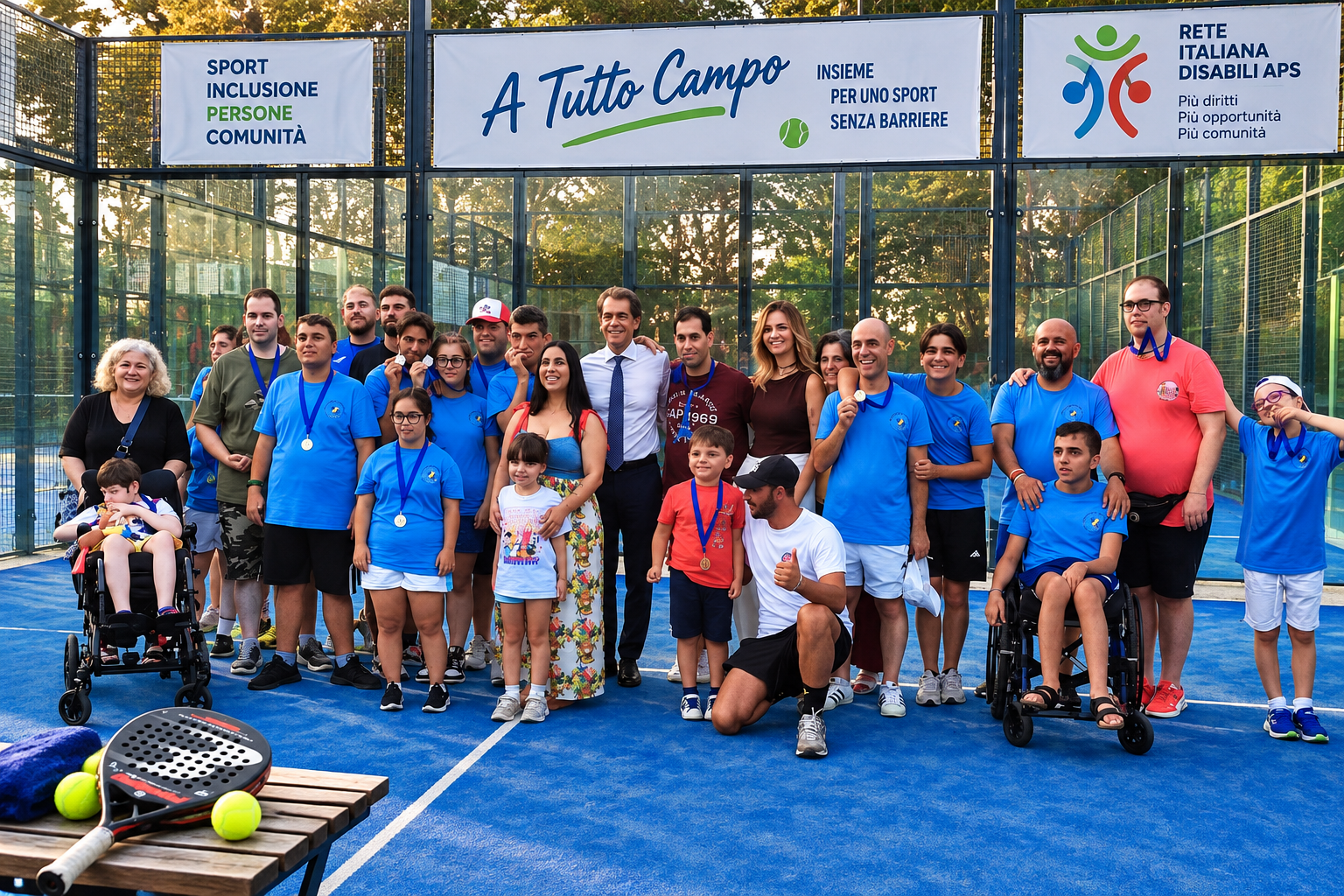
This approach underpins A Tutto Campo, the inclusive padel and tennis programme promoted by Rete Italiana Disabili APS, initially launched in Ciampino and subsequently extended across Rome and its surrounding province. The project brings together association volunteers, FISDIR coaches, health and social care professionals where the complexity of individual circumstances requires their involvement, sports clubs, amateur sports associations and instructors, creating programmes tailored to different needs and open also to people with more complex intellectual disabilities.
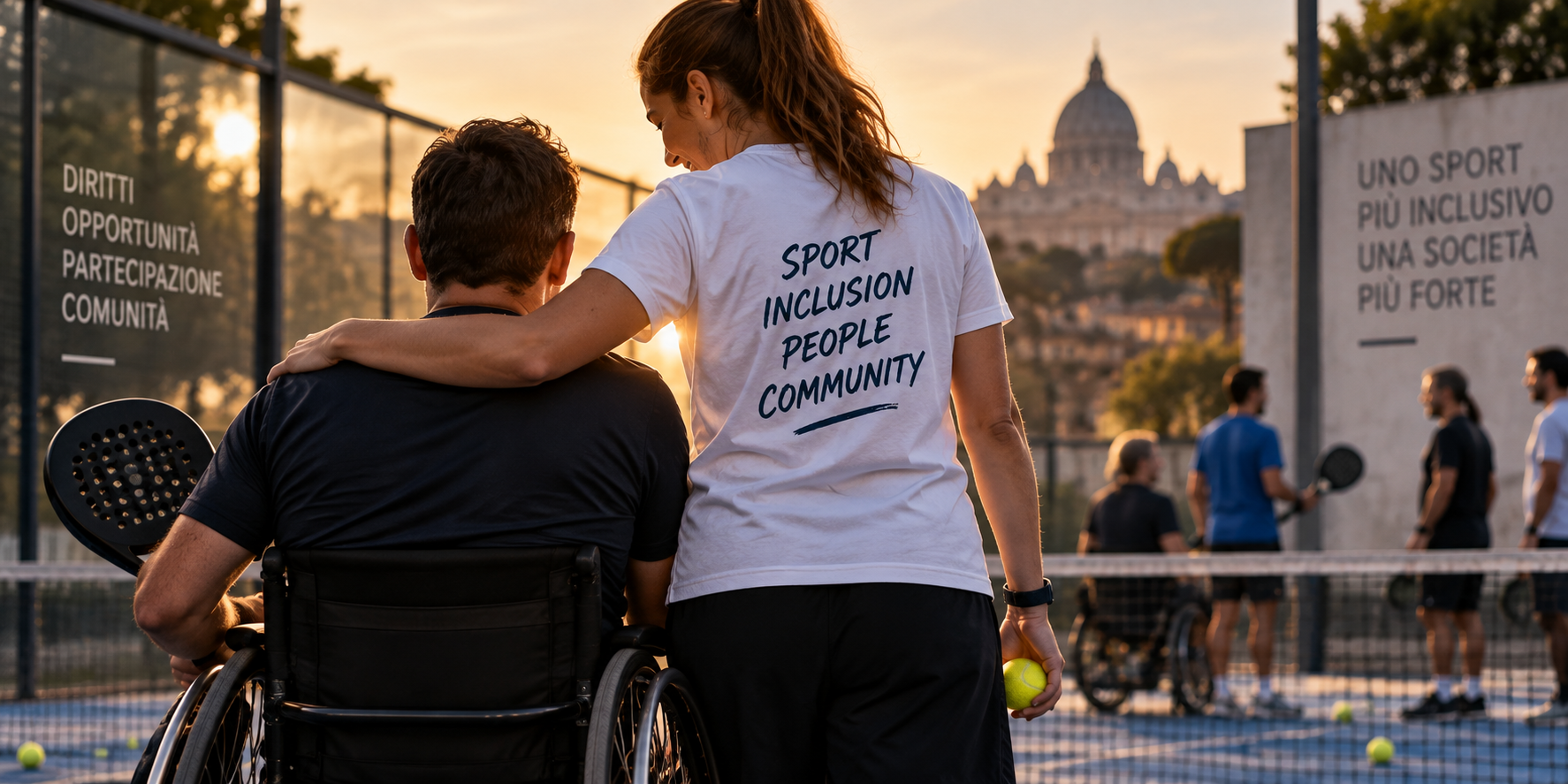
The images accompanying this article make precisely this dimension visible: not an isolated athlete represented through their disability, but the sports field as a shared space occupied by participants, coaches, families and volunteers. It may appear to be a small difference, but culturally it is highly significant.
Inclusion, in fact, does not simply mean allowing someone to enter a space previously designed for others. It means designing that space from the outset in recognition of the diversity of the people who may inhabit it.
Beyond the Rhetoric of “Overcoming Disability”
This perspective also makes it possible to question one of the most persistent representations of disability: the idea that a person’s social value emerges above all when, through extraordinary effort, they succeed in overcoming the limitations attributed to their condition.
Such a narrative may appear positive, but it risks once again placing responsibility for inclusion on the individual. If you manage to practise a sport, work, study or participate in social life despite the obstacles, you become an example; if, by contrast, you require greater support, you risk remaining confined to the category of dependency.
The paradigm of universal accessibility points in a different direction: rather than asking people to become exceptional in order to participate, it asks the community to organise itself so that participation can become ordinary.
In this sense, the value of sporting activity extends far beyond its physical benefits: the sports field becomes a space for socialisation, autonomy, relationship-building and mutual recognition, within which the individual returns to being, first and foremost, a participant in collective life.
When Those Who Receive Help Become Those Who Help
The same approach emerges, in a different form, in the project Nessuno è troppo povero per donare un sorriso (“No One Is Too Poor to Give a Smile”), through which people who themselves experience conditions of vulnerability take part in the activities of Caritas canteens and services, contributing their time, presence and capacity to listen.
This is perhaps one of the most interesting aspects of the entire experience, because it challenges the traditional distinction between those who provide help and those who receive it.
Assistance-based welfare inevitably tends to establish relatively fixed roles: on one side are those who possess the resources, expertise or authority to provide a service; on the other are those who, finding themselves in a situation of need, receive it. This relationship is often necessary and cannot simply be eliminated, but it becomes problematic when it ultimately defines people socially only in terms of what they lack.
Reciprocity changes this representation because it recognises that a person may require support in one dimension of their life while simultaneously being capable of offering support in another. There are therefore not simply strong individuals assisting vulnerable ones, but interdependent people who, at different times and under different circumstances, can both give and receive.
It is here that welfare acquires a regenerative dimension: it does not merely transfer resources to those experiencing difficulty, but generates relationships, belonging and shared responsibility.
From Vulnerability to Social Capital
The issue also has broader sociological significance, because a community is not constituted solely by the institutions that provide services, but by the density of the relationships it is able to generate among the people who form part of it.
When a person is systematically regarded only as a recipient of services, part of their social potential remains unused. When, by contrast, they are recognised as capable of contributing to collective life, that same person can become a producer of social capital, understood as the network of relationships, trust, reciprocity and cooperation that enables a community to function.
Disability then ceases to be the criterion through which the individual as a whole is defined and becomes one of the conditions in which that person lives—a condition involving needs that require appropriate responses, but also capacities, relationships and aspirations that cannot be subsumed within the category of assistance.
This transformation also concerns families and caregivers, because a genuinely inclusive society cannot continue to delegate predominantly to families the organisational, economic and emotional burden of disability, only to intervene through fragmented services when that capacity for care becomes insufficient. The community must be part of the response, not as a substitute for the family, but as a network that prevents the family from becoming the only place in which vulnerability is supported.
A Welfare System That Builds Community
Speaking of regenerative welfare therefore means imagining a system in which service provision remains necessary but does not exhaust the social relationship, because economic, healthcare, educational or care support must also become the means through which individuals can exercise autonomy, build relationships and participate in community life.
Such a model inevitably requires a plurality of actors: public institutions, Third Sector organisations, sports associations, professionals, families, volunteers, businesses and citizens. None of these actors, acting alone, possesses all the resources required to create genuinely inclusive environments, whereas their cooperation can transform limited initiatives into social infrastructures capable of enduring over time.
The experience of A Tutto Campo is significant precisely because the project is not built entirely by a single organisation: the association provides volunteers and expertise; coaches ensure the sporting dimension; professionals intervene when more complex forms of support are required; and sports clubs and associations make facilities and professional expertise available.
Inclusion thus becomes an architecture of shared responsibilities rather than a service delivered unilaterally.
Businesses Are Part of the Community Too
A model of this kind, however, cannot be sustained indefinitely through the commitment of volunteers alone. Bringing inclusive activities into local communities, ensuring qualified staff, providing continuity for projects and reaching people with complex needs all require stable economic and organisational resources.
This is why businesses, foundations, professionals and donors must also be involved. Yet the relationship with the economic sector can be understood in broader terms than traditional sponsorship: supporting a social project means contributing to the social quality of the community in which the business itself operates.
The original text therefore makes an explicit appeal to companies, entrepreneurs and donors to become long-term partners in these projects, not through occasional acts of charity, but by taking an active role in the cultural and social change that such initiatives seek to bring about.
This conception of social responsibility goes beyond reputational considerations and restores a community function to business: contributing to the accessibility of a sports facility, the continuity of a service or the participation of people who would otherwise remain excluded means intervening directly in the conditions through which a community distributes opportunities for citizenship.
A Community in Which Everyone Can Give and Receive
The transition from rights to practice occurs precisely here, when inclusion ceases to be regarded as a specialised field intended for particular categories of people and instead becomes a characteristic by which the overall quality of a community is assessed.
This does not mean replacing rights with solidarity, nor public responsibility with volunteering. On the contrary, rights remain the foundation that prevents the participation of people with disabilities from depending on someone else’s occasional willingness to help. But precisely because rights are recognised, the next challenge is to build the social conditions that enable them to be exercised fully.
An inclusive society, therefore, is not one in which some people generously take care of others regarded as vulnerable, but one in which no one is defined solely by their needs and everyone retains the possibility of being, at the same time, both a recipient and a producer of social value.
This is perhaps the most profound transformation that genuinely regenerative welfare can bring about: moving from the question, “What can we do for these people?” to a radically different one: “What can we build together?”
Because a community truly begins to take responsibility for its own future when it understands that inclusion does not simply mean leaving as few people behind as possible, but recognising that without everyone’s participation, the community itself is poorer.
OTHER CONTRIBUTIONS BY THE SAME AUTHOR
Beyond Welfare-dependence Toward a Society of Recognition
LATEST 5 CONTRIBUTIONS ON SOCIOLOGY
Online Gambling and the New Economy of Organized Crime
Crime and the Normalization of Lower Standards
FIVE LATEST CONTRIBUTIONS
2001–2026: Twenty-Five Years of the War on Terror
When Climate Change Reshapes Global Strategy
Care Has No Gender. Rethinking Relationships to Prevent Violence
The World Nomad Games and the hierarchies of the global narrative
When Possession Is Mistaken for Love
Ethica Societas is a free, non-profit review published by a social cooperative non-profit organization
Copyright Ethica Societas, Human&Social Science Review © 2026 by Ethica Societas UPLI onlus.
ISSN 2785-602X. Licensed under CC BY-NC 4.0