

Sport, identity, culture, sustainability and geopolitics of an international event that questions our way of describing the world and suggests a different idea of education, resilience and inner strength

Abstract: From 31 August to 6 September 2026, Kyrgyzstan hosted the sixth World Nomad Games, bringing together athletes from 104 countries and connecting sport with cultural heritage, tradition, territory and ecology. Created in 2014, the Games have evolved into an international platform presenting nomadic cultures not as mere folklore, but as living traditions capable of engaging with the present. Their limited visibility in the Western media raises a broader question about the hierarchies of global narratives and why some cultural traditions are more readily recognised as universal than others. Like Eastern martial arts, nomadic sporting practices can also be understood as educational disciplines and models of personal development. In a society increasingly shaped by technological dependence and reduced physical experience, the Games invite us to rediscover a nomadic mindset based on adaptability, resilience, movement and the preservation of identity through change. Their dialogue with martial arts and Islamic educational traditions ultimately raises a contemporary question: are we still preparing young people to face hardship and engage with the world, rather than merely inhabit its most comfortable spaces?
Keywords: #WorldNomadGames #Sport #NomadicCultures #Kyrgyzstan #CentralAsia #Geopolitics #Identity #CulturalDiversity #Mainstream #Media #GlobalNarrative #CulturalDiplomacy #CulturalHeritage #Journalism #MartialArts #Resilience #Education #Discipline #Adaptation #InnerStrength #NomadicMindset #Sustainability #Ecology #ElhemBeddouda #ethicasocietas #ethicasocietasmagazine #scientificmagazine #humanities #socialsciences #ethicasocietasupli
It’s not just sport
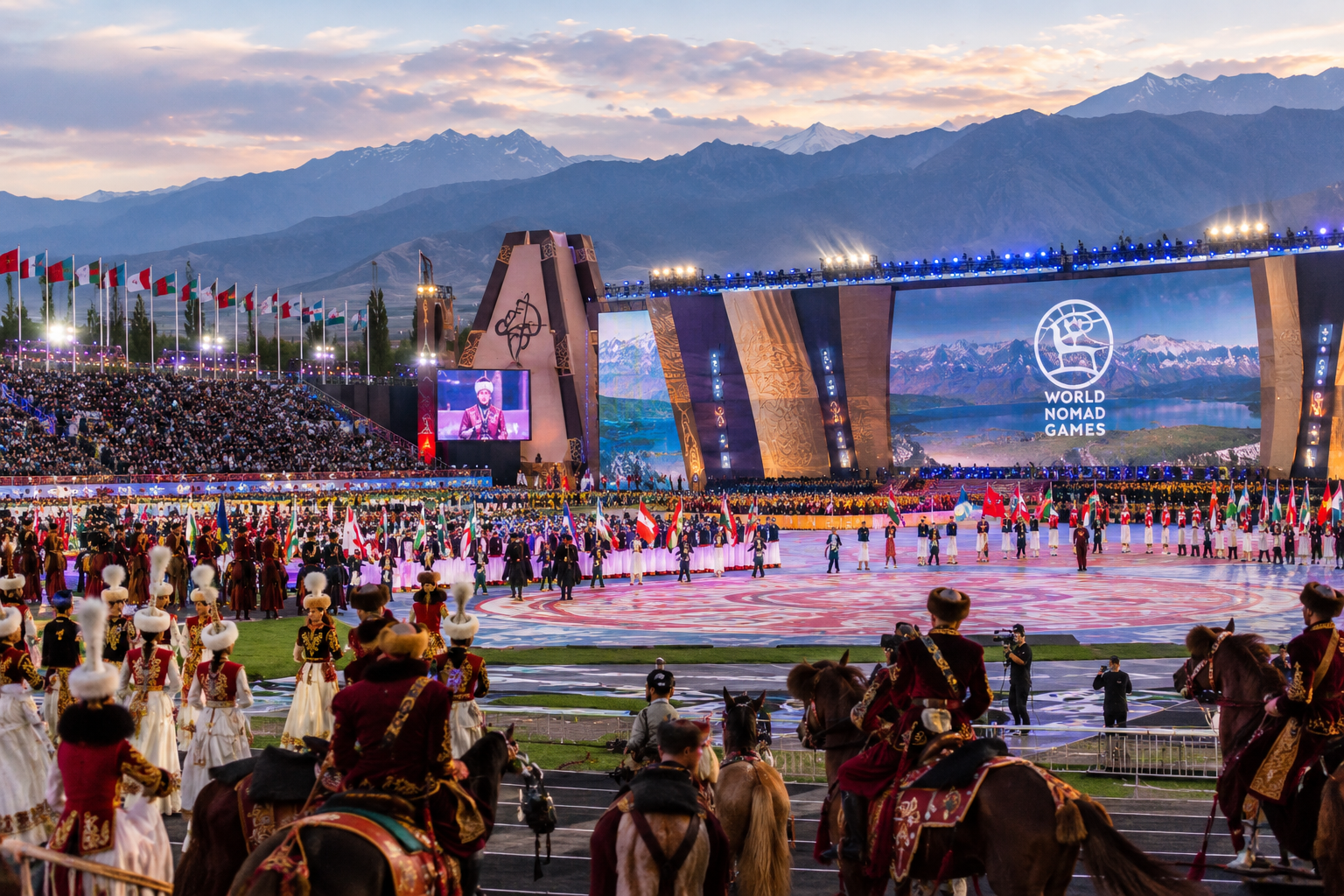
When you look at the World Nomad Games through the categories commonly used by Western journalism, you run the risk of not fully understanding what they represent. The first temptation is, in fact, to consider them simply as a sporting event dedicated to traditional disciplines, almost a folkloric version of an international competition. Such an interpretation, however, drastically reduces the scope of the event and ends up reproducing precisely the cultural hierarchy that should be challenged. The sixth edition of the Games, hosted by Kyrgyzstan from 31 August to 6 September 2026, involves 104 countries and presents a programme that combines equestrian disciplines, archery, traditional wrestling, intellectual games and other sports related to nomadic cultures. But the very structure of the initiative shows that the competition is only part of a larger project. In fact, the organisation identifies three fundamental dimensions – ethnosport, ethnoculture and traditional knowledge – and combines them with initiatives dedicated to culture, heritage and ecology. The difference from a conventional sporting event is therefore substantial. In the Nomad Games, sport is not separated from the cultural context that produced it. The athletic gesture is not considered solely in terms of the result, but as a trace of the historical relationship between a community, its environment, its body and its forms of social organisation. In this context, the horse is not simply an animal used for a competition, the bow is not just a piece of sports equipment and wrestling is not just a test of strength; each of these elements carries with it a history and a collective memory. It is precisely this dimension that makes the World Nomad Games a cultural phenomenon even before a sporting one. The question we should ask ourselves, therefore, is not just why these disciplines are not yet familiar to the European public; rather, we should ask ourselves why we continue to use familiarity as an implicit criterion of relevance in an increasingly globalised world.
The problem is not the absence of the media, but the hierarchy of attention
To say that the Western media have completely ignored the World Nomad Games would be an oversimplification. The event has received international coverage and has its own official communication and press accreditation system. Even Reuters reported on the opening of the 2026 edition, highlighting the participation of 104 countries and the presence of important international leaders. The question, therefore, is not whether or not there is coverage. The question is to understand the proportion between the real dimension of the event and the space it manages to conquer in the Western imagination. An event that involves more than a hundred countries, that combines sport, culture, heritage and diplomacy, and that takes place in conjunction with an important regional geopolitical event, would probably deserve to be treated as a complex international phenomenon, not just as a curiosity from a region that is peripheral to the traditional centres of media power. This is where the concept of global storytelling comes into play. In fact, the media do not limit themselves to describing reality: they also help to determine which parts of reality are perceived as central. The selection of news is inevitable, but it is never completely neutral from a cultural point of view; what is considered important also depends on the categories through which a society interprets the world. A major European football tournament is immediately recognised as an international event, a judo competition is recognisable because the Western public is now familiar with the discipline, but an event dedicated to the sporting traditions of the nomadic societies of Central Asia requires more work to contextualise it. It is necessary to explain who the populations involved are, where those disciplines come from, what relationship they have with the territory and why those practices are still significant. The problem, therefore, is not only the amount of space allocated, but also the quality of the perspective.
When a culture is transformed into folklore
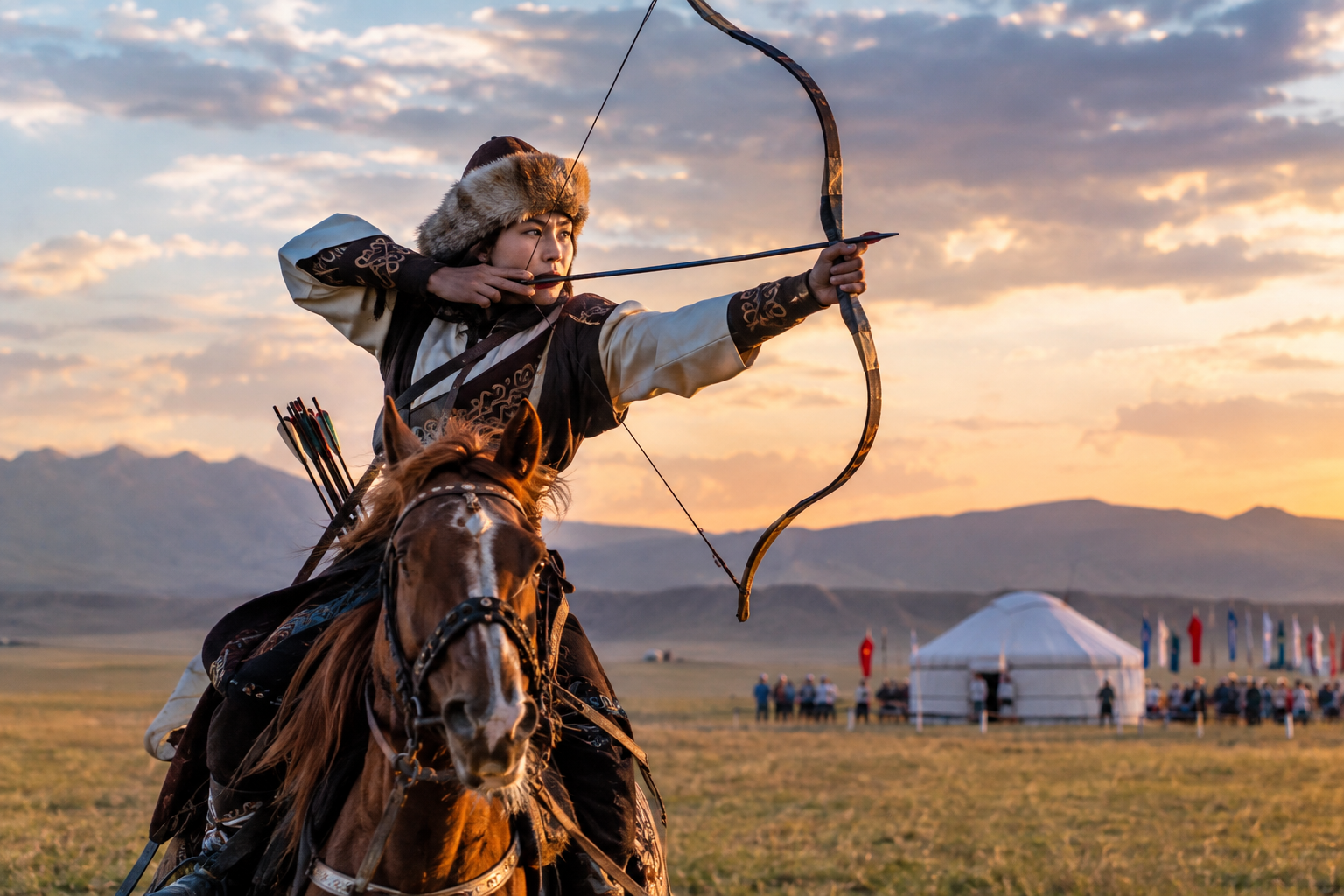
One of the most interesting dynamics concerns the way in which non-Western cultures are represented. When a society is described through its political institutions, its economy or its technology, it tends to be perceived as part of the present, but when it is described through traditional customs, dances, crafts, horses and rituals, it risks being symbolically placed in the past: this is the transition from culture to folklore. Folklore is not necessarily something negative; popular traditions are an important component of the heritage of any society. The problem arises when the label “folkloric” becomes a way of stripping a cultural practice of its depth. An archer on horseback can be seen as a spectacular and picturesque image, or it can be understood as the result of centuries of adaptation to a particular environment, of technical transmission and of building a relationship between human, animal and land. The two perspectives are not equivalent: the first produces spectacle, the second produces understanding, and it is precisely this difference that should interest journalism . Reporting on a culture does not necessarily mean celebrating or idealising it; it means making its complexity, contradictions, transformations and historical continuity understandable.
The lesson of martial arts: when sport becomes education
The comparison with the Oriental martial arts allows us to better understand this dynamic. The case of judo is particularly significant. Jigoro Kano developed judo as an educational system in which physical training was not separated from intellectual and moral training. The discipline was then progressively internationalised until it entered the Olympic programme, becoming one of the most recognisable forms of global sport. Today, for many Western practitioners, judo is not just about competition; the practice can be associated with self-control, concentration, relationships with others, handling defeat and personal discipline. Similar, albeit different, processes have also affected karate, taekwondo and other disciplines from East Asia. Their spread in the West has shown that a practice born within a specific cultural tradition can become an international language without necessarily losing all reference to its origin. Of course, this process has not been without its transformations, simplifications and commercialisation. The global spread of martial arts has often also led to the construction of stereotypical images of the East. However, one important fact remains: the Western public has learned to recognise in some disciplines not only a sporting technique, but a possible path of personal development, so it is legitimate to ask whether such an open interpretation can also be applied to the practices of the World Nomad Games. It does not mean transforming every tradition into a universal philosophy to make it acceptable to the West; it means recognising that even a traditional sporting practice can contain a conception of the body, of discipline, of the relationship with the environment and of the development of the individual that is different from what we are used to conceiving.
Sport, territory and a different idea of sustainability
The World Nomad Games also offer an interesting perspective on the relationship between sport and territory. Their organisation explicitly associates the event with the promotion of culture, heritage and ecology, with a significant part of the activities taking place in the Lake Issyk-Kul area. It would not be correct to say, without a specific comparative analysis, that they are “the greenest Olympics” in the world; such a definition would require precise indicators relating to emissions, infrastructure, transport, energy consumption, waste management and other sustainability parameters. However, it can be observed that the event is based on a different conception of the relationship between sporting event and territory. The location is not simply the setting in which the competition takes place, but becomes part of the very narrative of the event. This approach is interesting at a time when the issue of the sustainability of international sporting events has become increasingly important. Large contemporary events require infrastructure, transport, energy and considerable material investments. The Nomad Games, on the other hand, introduce a reflection in which the territorial and cultural dimension is more directly visible. This does not mean that nomadic societies should be transformed into a perfect ecological model, not least because the history of nomadic populations is much more complex and includes conflicts, adaptations, exploitation of resources and environmental transformations. The value of the perspective therefore does not lie in the construction of a myth of the “good nomad”, but in the possibility of recovering a question that modernity sometimes tends to forget: what relationship do we want to have with the land in which we live?
The body as part of education
At this point, the theme of sport inevitably becomes educational. Contemporary society has invested enormously in the development of cognitive and technological skills, but it does not always attach the same importance to the ability to use the body, endure fatigue, face the natural environment, manage risk and acquire practical skills. This does not mean that technology is a problem in itself; the problem arises when the virtual experience progressively replaces the concrete experience. A child can be perfectly familiar with a digital environment and have difficulty orienting themselves in a physical space, can quickly develop technical skills and at the same time have a low tolerance for frustration, can be constantly connected to others and have difficulty building real relationships. It is in this space that the idea of education indirectly proposed by the Nomad Games becomes interesting. Learning to ride means developing balance, coordination, responsibility and a relationship with a living being. Learning to shoot with a bow requires concentration, control of movement, patience and repetition. Traditional wrestling requires the ability to compete with an opponent while respecting rules. It is not necessary to turn these activities into universal prescriptions; the educational principle is more general: the body is not an accessory to education, but one of the dimensions through which a person learns to exist in the world.
The Islamic tradition and the education of the body
It is interesting to note how this concept can find a point of dialogue with some elements of the Islamic educational tradition. In Muslim culture, the saying that children should be taught swimming, archery and horse riding is very widespread. However, precisely because it is a religious reference, it is important to avoid an inaccurate citation. The complete formula cannot be presented simply as an authentic hadith of the Prophet Muhammad ﷺ. In fact, a tradition reported in Ahmad’s Musnad attributes to ʿUmar ibn al-Khattab a recommendation concerning the teaching of swimming and archery, while the popular formulation that also includes horse riding cannot be attributed without reservation to the Prophet ﷺ. However, there are authentic accounts in which the Prophet ﷺ encourages archery and horse riding. The theme, therefore, does not come out of nowhere: there is a recognition in the Islamic tradition of the value of certain physical and practical skills. The issue becomes interesting precisely because it allows us to move beyond an exclusively intellectual conception of education. In the classical Islamic perspective, the human being cannot be reduced to the cognitive dimension alone; the formation of the person also concerns behaviour, self-control, responsibility, the ability to act and the relationship with one’s body. This does not mean that Islamic tradition and nomadic cultures are the same thing, but there is an interesting convergence. Nomadic cultures have developed bodily practices closely linked to the practical needs of life. The Islamic tradition has also placed value on the acquisition of practical skills and the overall education of the individual. In both cases, a concept of education emerges in which knowledge is not enough. One must also know how to do things, know how to act and be able to face the world in all its complexity.
From the discipline of the body to inner strength
This is precisely the point where sport and education meet the psychology of the contemporary world. Discipline should not be interpreted only as the ability to obey a rule. In a deeper sense, it means developing the ability to govern oneself even when immediate motivation would push in the opposite direction; an athlete learns that the result does not necessarily come when they want it. They have to repeat a movement, accept the mistake, endure the fatigue and start again. This experience has a value that goes beyond the competition. The person who learns to manage a physical difficulty can develop, through experience, a different perception of their ability to face obstacles. It is not a magic formula and it does not mean that sport automatically makes you resilient, but structured bodily experiences can offer concrete opportunities to develop perseverance, self-control and the ability to manage frustration. In this sense, being strong in body and soul does not mean being devoid of vulnerability; strength does not mean the absence of fear, the inability to cry or the refusal of help. A strong person can be afraid and continue to act, can be hurt and continue to rebuild, can ask for help without considering themselves incapable. True inner strength also comes from being aware of one’s limits and from the ability not to let those limits become a permanent definition of oneself.
The nomadic mindset in a fragile society
This is where the concept of the nomadic mindset can take on a contemporary meaning. It is not a matter of romanticising the nomadic life, which historically has often been characterised by extremely harsh conditions and a constant need for adaptation, nor does it mean arguing that mobility is always positive or that having stable roots is a limitation. Rather, nomadism can be used as a metaphor for a skill that is fundamental today: the ability to continue living when the ground changes. Contemporary societies have built many of their expectations around stability. We imagine that we can plan our educational, professional, family and social paths according to a relatively predictable sequence, but reality rarely fully respects this linearity. People lose their jobs, move to different cities, go through family crises, face illness, war, economic hardship, failure and sudden changes. The educational question therefore cannot be only how to protect a person from every difficulty; it must also be how to prepare them to face those difficulties that will inevitably come. This is the meaning of the nomadic mindset: not living with the expectation that the territory will remain unchanged, but developing the ability to move when it changes. The nomad, in this metaphor, is not someone who has no roots, but someone who knows how to take with them what they consider essential, even when the place they are in changes. This distinction is fundamental. Adaptation does not mean giving up one’s identity; it means knowing how to change the way one lives without necessarily losing what one considers fundamental.
Resilience does not mean invulnerability
This reflection leads directly to the concept of resilience. In popular culture, resilience is sometimes transformed into a kind of cult of individual strength. People are asked to be strong, to react, not to give up, almost as if asking for help were a form of weakness. It is a simplistic view. A truly resilient society is not one in which every individual has to fend for themselves. It is one in which people have personal resources but also social networks capable of supporting them; resilience is therefore both individual and collective. A person can develop adaptability, but they need relationships, communities, institutions and opportunities. The nomadic mindset should therefore not become a celebration of the individual who survives alone; rather, it should represent a culture of the ability to start over and over again. This does not mean erasing what has happened; it means being able to build something even after what has happened.
Geopolitics beyond the summits
The World Nomad Games also take on particular significance because they are held in a region where culture and geopolitics are deeply intertwined. The opening of the Games in Bishkek coincided with the Shanghai Cooperation Organisation summit, which was attended by numerous international leaders. This coincidence transformed the Kyrgyz capital for a few days into a place where sport, culture and international politics overlapped. This is significant because Central Asia is often portrayed by the international media almost exclusively through the categories of competition between great powers, energy resources, strategic infrastructure and relations with Russia, China, Turkey and the West. All these dimensions are real and important, but a region is not only the sum of its geopolitical functions; it is also culture, memory, population, heritage, identity and daily life. Reporting on the World Nomad Games therefore also means giving Central Asia back a dimension that often remains subordinate to its position on the geopolitical map.
Cultural diplomacy and symbolic power
In this sense, sport becomes an instrument of cultural diplomacy. International relations are not built solely through treaties, economic agreements and political summits. There is also a symbolic dimension in which states and societies seek to present their identity and build relationships with other peoples. The Nomad Games allow Kyrgyzstan and the other participating countries to showcase a part of their cultural identity in an international context. This does not mean that the event is devoid of geopolitical interests; on the contrary, precisely because culture and politics are not separate worlds, every major international event can also have a soft power dimension, but it would be simplistic to stop at this interpretation. If we were to consider the Games only as a geopolitical tool, we would end up erasing precisely what makes them interesting: the ability to connect people and traditions beyond relations between governments.
The risk of reporting everything through the leaders
The presence of important international leaders is naturally newsworthy, but there is an obvious journalistic risk: covering a cultural event exclusively through the political figures who take part in it. If the World Nomad Games are reported only through Putin, Erdoğan, Modi or the other leaders present, the reader might forget that the heart of the event is made up of athletes, communities, techniques and traditions. The horse risks becoming a background, the archer risks becoming a photograph, the wrestler risks becoming a curiosity and the culture risks becoming a stage set. Good journalism should instead take the opposite route: start with the person and the practice and then eventually get to geopolitics. Because behind a sport there is a story and behind a story there is a society.
Cultural diversity is not a periphery
The most profound problem therefore concerns our conception of cultural diversity. For too long, diversity has been portrayed through two opposing extremes. On the one hand, assimilation, according to which cultures only become truly modern when they adopt the dominant cultural codes. On the other, exoticisation, which preserves difference but transforms it into a spectacle. Both perspectives are problematic: the first eliminates difference, the second freezes it. A true appreciation of cultural heritage should instead allow traditions to be contemporary without having to cease being specific; this is one of the most interesting messages of the World Nomad Games. They don’t tell us that we have to become nomads; they remind us that there are other ways of being contemporary. A culture can modernise without completely erasing its heritage, and a society can participate in globalisation without becoming culturally indistinct. Universality does not necessarily require uniformity.
Journalism capable of leaving its niche
This consideration directly concerns journalism. In a globalised world, being informed does not simply mean receiving more news. It also means being exposed to perspectives that we would not have encountered spontaneously. Journalism should perform precisely this function of opening up. Not only telling the public what it already knows, but guiding it towards what it does not yet know. Not only confirming its own interpretative categories, but occasionally putting them to the test. The World Nomad Games are a perfect example of this need. A Western audience may not be familiar with kok-boru, salbuurun, horseback archery or other traditional disciplines. But this ignorance should not be a reason to ignore the event; it should be precisely the reason to report it better. The function of journalism is not only to reduce the world to what is immediately understandable, it is also to increase the reader’s ability to understand what is initially foreign to them.
A lesson for European education
In the end, the most interesting meaning of the Games may be neither sporting nor geopolitical; it may be educational. In a society where children and adolescents are often protected from hardship, frustration and exposure to real experiences, the issue of preparing for difficulty is becoming increasingly important. It is not a question of glorifying suffering, because suffering does not automatically make us better. Nor is it a question of arguing that young people should be left alone to face difficulties, because protection and care are fundamental, but protecting should not mean preventing any experience of hardship. A child must be able to experience limits without being defined by them, a teenager must be able to fail without interpreting failure as the end of their identity, a person must be able to discover that they can face a difficulty and, above all, that they can ask for help while facing it. This is where education, resilience, discipline and inner strength can meet.
A society that must learn to move
Perhaps the real lesson of the nomadic mindset for contemporary Europe is precisely this: we must return to considering adaptation as an educational skill. We do not know what the labour market will be like in twenty years’ time, which technologies will transform professions, which geopolitical crises will affect our societies, which climate changes will alter the land, or which forms social relations will take, but we can prepare people to live in a world where change will be inevitable. This means educating people to be curious, competent, able to learn again, manage frustration, collaborate and start over. It also means recovering the relationship with the body, with nature and with concrete experience. A person who is truly prepared for the future is not necessarily the one who already knows all the answers, but the one who has the tools to tackle new questions.
The world is bigger than our narrative habits
The World Nomad Games do not need to be transformed into the “new Olympics” to acquire international dignity, they do not have to be westernised to become interesting, and they do not have to be deprived of their cultural specificity to be considered modern. Their strength lies precisely in the fact that they offer another perspective. They show us a sport in which the body preserves a cultural memory, they show us traditions that continue to live in the present and a special relationship between sport and territory. They remind us that cultural heritage is not necessarily something fixed and they offer us, perhaps, a useful metaphor for an increasingly fragile society: that of a person capable of changing terrain without completely losing themselves. The nomadic mindset, interpreted in this sense, does not mean fleeing, it means knowing how to move. It does not mean not having roots; it means knowing which roots to take with you. It does not mean not being afraid; it means not allowing fear to become the only criterion by which to make decisions. It does not mean being invulnerable, it means learning to rebuild oneself, and it is precisely here that sport, culture, education, resilience, discipline, adaptation and inner strength end up converging. Perhaps we need a society capable of teaching its young people not only how to live when the ground is stable, but also how to keep walking when it is no longer so, a culture in which the body is not considered separate from the mind, in which fatigue is not automatically interpreted as something to be avoided and in which fragility can coexist with the ability to react and, consequently, we probably also need a journalism capable of applying the same principle to the way it reports on the world.
Not everything that is recognisable is universal.
Not everything that is far away is marginal.
Not everything that appears folkloric is devoid of depth.
And not everything that doesn’t make the front pages is irrelevant.
The World Nomad Games remind us that there is a world that is much larger than our usual categories. The task of journalism, education and culture should be to help us cross it without fear of what we do not know, because knowing the world does not only mean looking at it, it means learning to move within it.
REFERENCES
- World Nomad Games, Official Website, 6th World Nomad Games, Kyrgyz Republic, 2026.
- World Nomad Games, official materials relating to the programme, culture, heritage, ethnosport and ecology.
- Reuters, Leaders gather in Kyrgyzstan for the World Nomad Games, 31 August 2026.
- International Judo Federation, historical and institutional materials on the birth of judo and the educational concept of Jigoro Kano.
- Jamiʿ al-Tirmidhi, hadith 1637, concerning the encouragement of the practice of archery and horse riding.
- Musnad Ahmad, hadith 323, concerning the recommendation attributed to ʿUmar ibn al-Khattab on the teaching of swimming and archery.
- Hadith Answers, Teach Your Children Swimming, Archery and Horse Riding, for the analysis of the transmission of the popular formula.
- UNESCO, materials dedicated to the World Nomad Games, the heritage of nomadic civilisations and intercultural dialogue.
- Shanghai Cooperation Organisation, documentation relating to the meetings and the Bishkek 2026 summit.
- Bowman, P., The Invention of Martial Arts, Oxford University Press, 2021.
- Benn, T., Judo as a Way of Life: The Development of a Global Martial Art, Cambridge Journal of Global History.
LATEST FIVE CONTRIBUTIONS BY THE SAME AUTHOR
Islam, Radicalization, and Global Security
Beyond Courtship: Intentionality, Gift, and Gratuitousness in Love
Destroying Images, Governing Memory: Jihadist Iconoclasm and Cognitive Warfare
Humanoid Robots: Reproduction of the Living and Ontological Limit
Motherhood Influencers: Between Catalog Pregnancies and Lived-in Homes
LATEST 5 CONTRIBUTIONS ON SOCIOLOGY
Care Has No Gender. Rethinking Relationships to Prevent Violence
When Possession Is Mistaken for Love
Crime and the Normalization of Lower Standards
White Jihad as a Transnational Grammar of Contemporary Violence
FIVE LATEST CONTRIBUTIONS
The Invisible Architectures of Coherence
Ceuta, When the Border Becomes a Weapon
Will Humans Govern AI, or Will AI Govern Humans? [VIDEO]
Ethica Societas is a free, non-profit review published by a social cooperative non-profit organization
Copyright Ethica Societas, Human&Social Science Review © 2026 by Ethica Societas UPLI onlus.
ISSN 2785-602X. Licensed under CC BY-NC 4.0