

From 9/11 to Afghanistan, from Iraq to global security: how four hijacked aircraft transformed a quarter-century of history

Abstract: Climate change is becoming a structural component of the strategic environment in which military power is exercised. Rising temperatures, extreme events, ecosystem transformation and sea-level rise are affecting infrastructure, mobility, logistics, training, energy and operational capability. NATO, France and the armed forces of the Bay of Bengal region are progressively integrating the climate dimension into defence planning, while Russia and China also view the transformation of the Arctic as a reconfiguration of strategic geography. Climate change, therefore, is altering not only the threats against which states must defend themselves, but also the material and geopolitical conditions under which defence capabilities must be maintained and exercised.
Keywords: #ClimateChange #Defence #Security #Geopolitics #NATO #MilitaryStrategy #ArmedForces #ClimateSecurity #Arctic #Russia #China #France #BayOfBengal #Resilience #StrategicInfrastructure #CristinaDiSilvio #EthicaSocietas #EthicaSocietasReview #ScientificJournal #SocialSciences #EthicaSocietasUPLI
A morning that would transform the perception of security
The morning of 11 September 2001 began like any other working day on the eastern seaboard of the United States, in a context in which international terrorism was certainly present in the assessments of security agencies but had not yet assumed, in the collective Western imagination, the central position it would occupy only hours later, when nineteen men belonging to al-Qaeda transformed four ordinary commercial aircraft into offensive weapons and demonstrated how the infrastructure, technologies and symbols of globalised society could be turned against the very society that had created them.
Among those who would participate in the attack were Mohamed Atta and Abdul Aziz al-Omari, who, according to the reconstruction provided by the National Commission on Terrorist Attacks Upon the United States, arrived at Portland International Jetport in Maine to board the 6:00 a.m. flight to Boston. Atta was selected by the CAPPS system for additional screening, but the procedures then in force were primarily focused on checked-baggage security and created no significant obstacle to the plan. At 6:45 a.m., the two men reached Logan International Airport and, together with the other members of the group assigned to seize American Airlines Flight 11, passed through security and boarded the Boeing 767 bound for Los Angeles. At 7:59 a.m., the aircraft took off carrying 81 passengers, including the five terrorists, nine flight attendants and two pilots. At that moment, neither the passengers nor airport personnel could yet perceive that a process had already begun that would trigger one of the most profound transformations of contemporary security policy.
From a sociological perspective, it is precisely this apparent normality that helps explain the traumatic power of the event. The attacks of 11 September did not derive their impact solely from the number of victims or the spectacular nature of the violence, but also from the demonstration that spaces regarded as ordinary and systems considered controllable—the airport, the commercial flight, the skyscraper, the financial city—could suddenly become theatres of organised violence capable of eroding the distinction between the battlefield and civilian life.
From Betty Ong’s call to the realisation that the aircraft had been hijacked
At around 8:14 a.m., the first anomalies appeared in the behaviour of Flight AA11 and, according to the Commission’s reconstruction, the hijacking probably began at or immediately after that time. At 8:19 a.m., flight attendant Betty Ong managed to contact an American Airlines operations centre and, with remarkable composure, reported that the cockpit was not responding, that several people had been stabbed and that the aircraft might have been hijacked, providing one of the first concrete pieces of information through which the United States security system began to understand what was happening.
A few minutes later, Mohamed Atta attempted to address the passengers but inadvertently opened communications with air traffic controllers, uttering the words “We have some planes”. The significance of that phrase would become clear only retrospectively, because the plural already revealed the coordinated nature of the operation and showed that this was not a single hijacking, but a multiple attack designed simultaneously to produce physical destruction, institutional paralysis and a global psychological effect.
From a criminological perspective, the coordinated nature of the operation is one of the features that distinguishes organised terrorism from individual violence. The objective is not merely to inflict physical damage on a particular target, but to produce political meaning through the selection of victims, locations and methods of attack. The World Trade Center, the Pentagon and, presumably, the Capitol or the White House were not random targets, but symbols of the economic, military and political power of the United States. It was precisely this symbolic dimension that would multiply the significance of the event far beyond the immediate damage inflicted.
Response time and the limitations of traditional security systems
At 8:37:52 a.m., the Boston air traffic control centre contacted the Northeast Air Defense Sector, providing the US military with its first notification of the hijacking of American 11. Two F-15 fighter aircraft at Otis Air Force Base were subsequently placed on alert, but the scramble order came when the hijacked aircraft was already approaching Manhattan, and the fighters took off at 8:53 a.m., after the Boeing had already struck the North Tower.
This detail is important because 9/11 revealed not so much the absence of security institutions as the inadequacy of systems designed to respond to different kinds of threats, organised through functional compartments and procedures that had not been developed to react within minutes to an attack carried out domestically using civilian assets already present within national territory. The vulnerability exposed that morning would lead in subsequent years to a radical transformation of intelligence models, information sharing and prevention, progressively shifting the focus of security policy from responding after an offence had occurred towards anticipating risk.
In criminological terms, this transition marks the consolidation of a preventive logic in which the objective is no longer solely to identify and punish the perpetrator of an offence already committed, but to identify individuals, networks, behaviours and signals regarded as potential precursors of a threat, with all the problematic consequences arising from extending security policy into the prediction of future behaviour.
The impact on the North Tower and the transformation of trauma into a global event
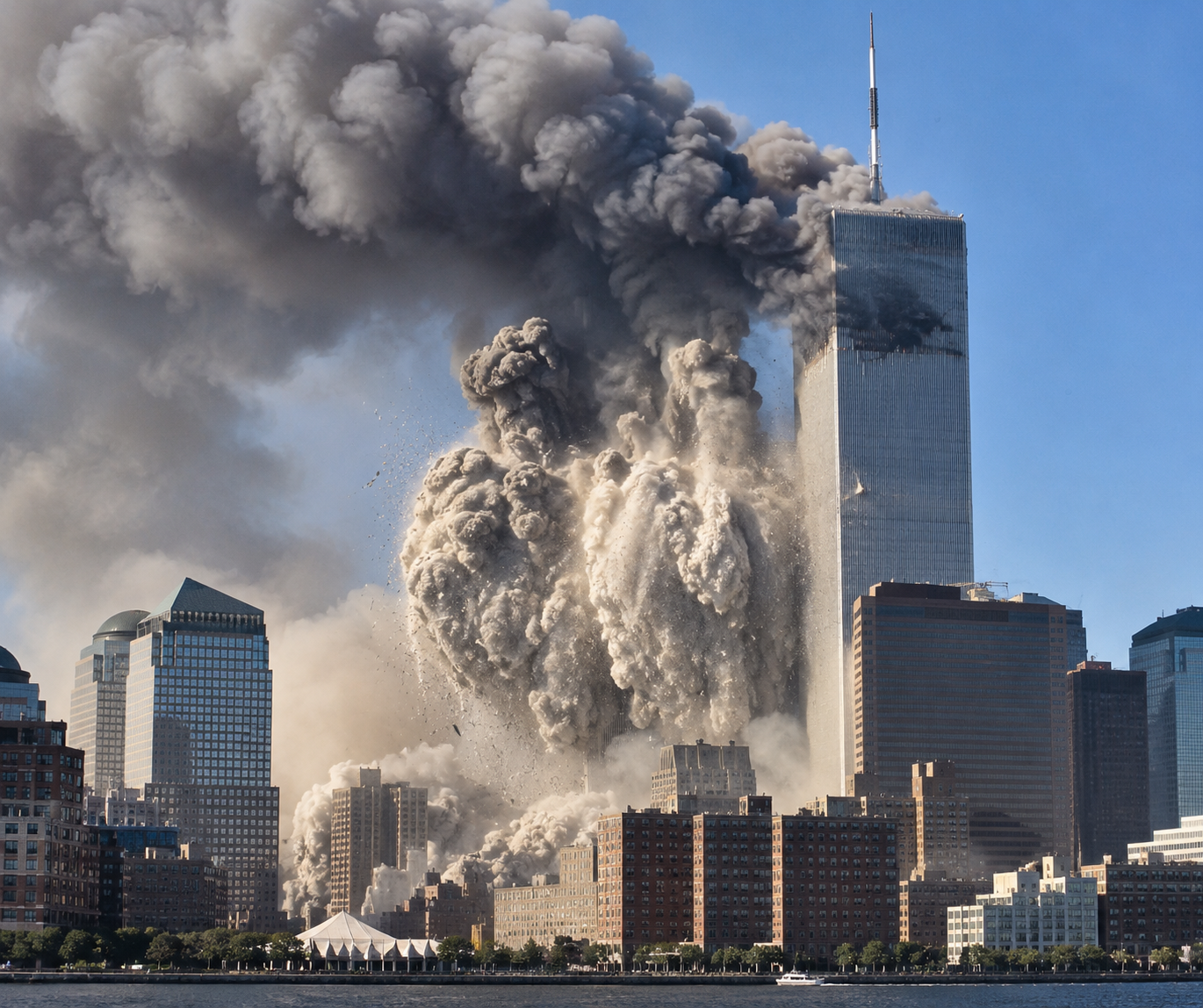
At 8:46:40 a.m., American Airlines Flight 11 struck the North Tower of the World Trade Center, damaging floors 93 to 99 and rendering all three stairwells above the impact zone impassable. The impact, fires and smoke trapped hundreds of people who no longer had a viable evacuation route.
Those trapped on the upper floors attempted to contact relatives, colleagues and emergency services, while others tried to reach the roof in the hope of being evacuated. Structural conditions and the volume of smoke, however, made aerial rescue impossible. Those telephone calls, many of which would become part of the collective memory of the event, progressively transformed a catastrophe observed from the outside into a tragedy experienced through the voices of those trapped within it.
At 9:03:11 a.m., when United Airlines Flight 175 struck the South Tower before cameras that were already broadcasting live images of the North Tower, collective perception changed definitively: what until that moment could still have been interpreted as an accident became unmistakably an attack.
From that point onward, the event also acquired an unprecedented media dimension, because millions of people around the world witnessed, almost simultaneously, the attack, the rescue operations and the subsequent collapses. Terrorism thus became a phenomenon operating not only through explosions or physical impacts, but also through the global circulation of images, repeated television coverage and the construction of a shared memory that would profoundly shape perceptions of risk.
From this perspective, terrorism uses communication as a multiplier of violence: the number of people physically affected remains limited in relation to the population as a whole, but the number psychologically reached by the event may be virtually unlimited. It is precisely in this disproportion between material damage and symbolic impact that a fundamental part of terrorism’s political effectiveness lies.
Four aircraft used to strike a society
At 9:37:46 a.m., American Airlines Flight 77 struck the Pentagon, while United Airlines Flight 93, which had departed Newark for San Francisco, was hijacked at 9:28 a.m. In this case, however, passengers learned through telephone calls from the aircraft what had already happened in New York and realised that their plane had not been seized as part of a conventional hijacking, but was intended to be used as a weapon against another target.
At 9:57 a.m., passengers and members of the crew therefore began to resist the hijackers. After several minutes of struggle, the aircraft crashed at 10:03 a.m. near Shanksville, Pennsylvania, preventing it from reaching what the 9/11 Commission identified as its likely target in Washington: either the Capitol or the White House.
This sequence demonstrates that 9/11 cannot be understood merely as a series of attacks. Al-Qaeda’s plan was built around simultaneity, the ability to saturate response mechanisms and the selection of targets capable of symbolising the entire political, economic and military system of the United States. The objective was not simply to kill, but to demonstrate systemic vulnerability by showing that even the world’s foremost power could be struck on its own territory using ordinary means and by individuals apparently indistinguishable from other passengers.
The collapse and the emergence of a new paradigm of fear
At 9:59 a.m., the South Tower collapsed, followed by the North Tower at 10:28 a.m., little more than one hundred minutes after it had been struck. Subsequent investigations by the National Institute of Standards and Technology reconstructed the collapse as the combined result of structural damage caused by the aircraft impacts, the impairment of fireproofing systems and fires spreading across multiple floors, moving beyond simplistic explanations according to which the collapse depended exclusively on steel reaching a particular temperature.
A total of 2,977 people from more than ninety countries were killed in the attacks in New York, at the Pentagon and in Pennsylvania.
The deaths of almost three thousand people are, of course, the fundamental human fact of 9/11. Sociologically, however, the event simultaneously produced something further: it transformed security from a predominantly specialist field into a permanent component of everyday life. From that moment onward, terrorism, airport screening, intelligence, surveillance and prevention became enduring features of political language and the ordinary experience of Western societies.
From the attacks to the War on Terror
On 12 September 2001, the United Nations Security Council adopted Resolution 1368, condemning the attacks and recognising the inherent right of individual and collective self-defence, while NATO invoked Article 5 of the North Atlantic Treaty for the first time in its history, transforming the attack on the United States into a matter of collective security for the Alliance.
On 18 September, the United States Congress adopted the Authorization for Use of Military Force, granting the President broad authority to use force against states, organisations or persons who had planned, authorised, committed or assisted the attacks, or harboured those responsible. This formulation, conceived in the immediate emergency following the attacks, would subsequently provide one of the legal bases for military and counter-terrorism operations extending far beyond the Afghan theatre originally envisaged.
It was through this transition that the response to a transnational criminal and terrorist organisation began to be defined through the category of war, a terminological and political choice that would have profound consequences. To speak of a War on Terror meant transforming terrorism from criminal conduct to be prosecuted through judicial and policing instruments into an enemy against which armies, military intelligence, wartime detention and exceptional powers could be mobilised.
From a criminological perspective, this transformation progressively blurred categories that had traditionally remained distinct: criminal and combatant, investigation and intelligence, prevention and repression, national territory and theatre of war. The result was a system in which countering the terrorist threat no longer belonged exclusively either to criminal law or to military defence, but to an intermediate space in which instruments and logics derived from different fields were continuously combined.
Afghanistan: from destroying terrorist bases to state-building
On 7 October 2001, the Bush administration began military operations in Afghanistan, declaring as its objectives the destruction of al-Qaeda training camps, the degradation of the Taliban regime’s military capabilities and the termination of support provided to those responsible for the attacks. The coalition’s military superiority rapidly brought about the fall of the regime, but Osama bin Laden was not captured and the intervention, initially presented as an operation directed against al-Qaeda and its protectors, progressively evolved into a far broader project of stabilisation, counter-insurgency and institution-building.
It is precisely this transformation that constitutes one of the principal strategic problems of the following twenty years. A mission initially defined through a relatively limited objective—preventing Afghanistan from continuing to serve as a terrorist platform—gradually acquired far more ambitious political, social and institutional aims, culminating in the construction of a state apparatus, new armed forces and institutions whose fragility would become fully apparent when Western forces withdrew.
Iraq and the expansion of the logic of 9/11
In 2003, the invasion of Iraq marked a further extension of the strategic response begun two years earlier, even though Saddam Hussein was not responsible for the attacks of 11 September and the 9/11 Commission found no operational relationship between the Iraqi regime and al-Qaeda’s plot.
The Iraq War nevertheless helped redefine the War on Terror as a much broader political category within which the terrorist threat became linked to proliferation, states considered hostile and the perceived need to reshape regional political balances. The rapid fall of Saddam Hussein was followed by the collapse of significant parts of the state apparatus, the growth of insurgency, jihadist terrorism and intensifying sectarian conflict, creating conditions that would contribute to the subsequent evolution of al-Qaeda in Iraq and, through later transformations, the emergence of the Islamic State.
This process illustrates one of the fundamental paradoxes of counter-terrorism: eliminating an organisation or its leadership does not necessarily eliminate the political, social and identity-related conditions that may sustain new forms of violent mobilisation. In some contexts, the disintegration of state structures, collective humiliation, marginalisation and the absence of credible institutions can create new spaces in which extremist organisations are able to recruit, construct belonging and present themselves as alternatives to the existing order.
Radicalisation, belonging and the construction of the enemy
One of the aspects made particularly evident by twenty-five years of the War on Terror is the need to distinguish operational measures against terrorist organisations from an understanding of the processes through which individuals may become attracted to them.
Radicalisation does not arise from a single variable and cannot be reduced to poverty, religion, discrimination or some presumed individual predisposition towards violence. Most contemporary criminological and sociological models instead interpret it as a process in which personal, relational, political, identity-related and environmental factors interact, producing in some individuals a progressive legitimisation of violence.
From this perspective, extremist groups may perform a function that is not exclusively ideological. They can offer belonging, recognition, simplified explanations of complex realities, the attribution of responsibility to an identifiable enemy and the transformation of individual distress into a collective mission. Violence may therefore become not only a political instrument, but also a means of constructing identity, particularly where individuals perceive that they have finally found a community capable of giving meaning to their experience.
For precisely this reason, an exclusively repressive response becomes insufficient: it may neutralise an attacker or dismantle a cell, but it does not necessarily prevent the reproduction of narratives and social networks that make the emergence of new militants possible.
Preventive security and the question of freedom
The second major consequence of 9/11 concerns the transformation of systems of control and the progressive expansion of preventive logic.
In the United States, the Department of Homeland Security was established, the USA PATRIOT Act was adopted and mechanisms for collecting, integrating and sharing information were substantially strengthened. At the same time, airports, borders and critical infrastructure became subject to far more intrusive forms of control than previously, while intelligence assumed an increasingly central position in threat prevention.
Sociologically, this development can be interpreted as a transition from predominantly reactive security towards anticipatory security, in which the state seeks to intervene before danger materialises. The difficulty is that the further security moves towards the future and prediction, the harder it becomes to determine which behaviours genuinely represent a risk and which merely constitute probabilistic indicators. As a consequence, social categories, communities and individuals may be subjected to scrutiny not because of what they have done, but because of what authorities believe they might do.
The issue therefore concerns the structural tension between security and freedom, because the same society that demands that the state prevent terrorism must simultaneously decide how much surveillance, data collection, restriction and exceptional power it is prepared to accept in order to reduce a risk that, by its very nature, can never be completely eliminated.
Guantánamo and the exception that became a system
Detention at Guantánamo Bay, extraordinary renditions and the use of coercive interrogation techniques represent some of the most controversial examples of this transformation, because they demonstrate how the War on Terror generated legal spaces in which the traditional categories of defendant, prisoner of war and administrative detainee were redefined in an effort to adapt legal systems to a conflict involving non-state actors and transnational networks.
From a criminological perspective, this issue is particularly significant because the state does not combat terrorism solely through force, but also through the legitimacy of its institutions. Whenever a counter-terrorism response is perceived as arbitrary, discriminatory or incompatible with the values proclaimed by the democratic system itself, it may become part of the narrative used by extremist organisations to portray the conflict as evidence of hostility by the entire West towards particular communities.
This does not mean attributing responsibility for terrorism to Western policies. Rather, it means recognising a basic principle of criminological prevention: countermeasures have social and symbolic consequences, and under certain conditions those consequences may influence the environment in which recruitment, radicalisation and the legitimisation of violence occur.
The death of bin Laden and the impossibility of definitive victory
During the night of 1–2 May 2011, US special forces reached the compound in Abbottabad, Pakistan, where Osama bin Laden was hiding and killed him, eliminating the principal symbol of the organisation responsible for the attacks.
Politically and symbolically, this represented an enormous achievement, but it did not mark the end of the War on Terror. By then, al-Qaeda had developed regional branches, global jihadism had assumed different forms, and the decentralisation of terrorist networks made increasingly implausible the notion that the death of a single leader could bring the phenomenon to an end.
Only a few years later, ISIS would demonstrate the ability to combine terrorism, insurgency, territorial administration, digital propaganda and transnational recruitment, seizing extensive areas of Iraq and Syria and constructing a form of power that, for a period, even surpassed the operational capabilities of the original al-Qaeda.
Terrorism as an ecosystem rather than merely an organisation
This evolution suggests an important change in the interpretative paradigm. Contemporary terrorism must increasingly be understood not solely as the product of rigidly structured organisations, but also as a phenomenon capable of developing through networks, digital communities, propaganda, imitation and individual processes of radicalisation.
The expansion of social networks and digital platforms has enabled extremist ideologies to bypass the need for initial physical contact with an organisation, creating environments in which geographically distant individuals can be exposed to the same narratives, share materials, construct identities and mutually reinforce their views.
The transition from organised terrorism to networked terrorism and, in some cases, to individual action inspired by online propaganda has therefore made the task of security agencies even more complex, because the challenge no longer consists only in identifying a clandestine organisation, but also in recognising radicalisation processes that may develop within ordinary social environments and through communications technologies used daily by billions of people.
The Taliban’s return and the meaning of 2021
In August 2021, as Western forces completed their withdrawal from Afghanistan, the institutions and armed forces built and supported over twenty years collapsed with a speed that revealed how profoundly the stability of the Afghan system still depended on international presence. On 15 August, the Taliban once again entered Kabul, returning to power twenty years after having been removed precisely as a consequence of the 9/11 attacks.
The event represented an enormous symbolic rupture because it demonstrated the limits of military transformation when it is not accompanied by the construction of socially legitimate institutions capable of surviving autonomously. Politically, it also raised a question that remains central: if the original objective was to prevent Afghanistan from serving as a safe haven for al-Qaeda, to what extent can twenty years of war, occupation, reconstruction and counter-insurgency be assessed in light of the return to power of the very movement overthrown in 2001?
The human and economic costs of the War on Terror
Measuring the overall cost of the War on Terror remains methodologically complex, because it first requires determining which conflicts, operations and indirect consequences should fall within the scope of the analysis. The Costs of War project at Brown University, however, has produced one of the most systematic academic reconstructions of the human, economic and social effects of the post-9/11 wars.
According to these estimates, more than 940,000 people died directly as a result of violence in the principal post-9/11 theatres between 2001 and 2023, including civilians, military personnel, combatants, contractors, journalists and humanitarian workers. Indirect deaths associated with the destruction of healthcare systems, food insecurity, impoverishment, damaged infrastructure and environmental consequences would bring the estimated overall toll to between 4.5 and 4.7 million.
These figures are accompanied by tens of millions of displaced people and economic costs to the United States estimated in the trillions of dollars, demonstrating how a strategy conceived in response to an event lasting only a few hours generated political, social and financial consequences extending across a quarter-century.
The social construction of risk
The legacy of 9/11 cannot, however, be measured solely through casualties or military expenditure, because one of its deepest consequences concerns the transformation of the way contemporary societies perceive risk.
A statistically rare but highly spectacular risk can generate collective fear far greater than its actual probability, particularly when the event is continually reproduced through images, commemorations, political discourse and visible security measures. In this sense, terrorism possesses a distinctive capacity to transform fear into an integral component of social order, prompting citizens and institutions to modify everyday behaviour, political priorities and the acceptability of certain forms of control.
This is one of terrorism’s fundamental paradoxes: a relatively small number of attackers can compel societies vastly more powerful than themselves to reorganise a significant part of their institutions around the possibility of further attacks, thereby achieving a political effect infinitely greater than their actual military capability.
Twenty-five years later
At 8:46:40 a.m. on 11 September 2001, a Boeing 767 entered the North Tower of the World Trade Center, and at 10:28 a.m. that same tower collapsed. Little more than one hundred minutes separated those two moments, yet the consequences of that brief interval have extended across a quarter-century and transformed wars, legislation, intelligence, airport security, military technologies, surveillance, international relations, social representations and the ways in which the West has interpreted the relationship between freedom and risk.
The 2,977 people killed on 9/11 remain the original and irreducible human reality at the heart of this history. Yet remembering those attacks in 2026 also means critically examining what followed, because historical memory acquires deeper meaning when it does not limit itself to commemorating tragedy but also interrogates the consequences of the decisions taken in response to it.
Twenty-five years later, the question is no longer simply what happened on 11 September 2001, but how that event transformed global society, what forms of security it produced, which freedoms it redefined, which conflicts it helped open, which radicalisation processes it sought to counter and which, at times, it may indirectly have reinforced through the political and social consequences of the response.
Ultimately, the War on Terror reveals a structural limitation already contained within its own definition: an army can be defeated, a government overthrown, a terrorist base destroyed and a leader eliminated, but it is far more difficult to declare victory in a war against a method of political violence capable of changing, decentralising, adapting technologically and finding new social conditions in which to reproduce itself.
Perhaps this is the principal lesson of the twenty-five years since 9/11: security depends not only on the ability to strike those preparing an attack, but also on societies’ capacity to understand the processes through which violence becomes thinkable, legitimate and desirable to those who choose to practise it—without abandoning, in the attempt to prevent that violence, the very principles those societies seek to defend.
Bibliographical and documentary references
National Commission on Terrorist Attacks Upon the United States (2004), The 9/11 Commission Report, Washington, D.C. This is the principal source for reconstructing the preparation of the attacks, the four hijackings and the response of the United States authorities.
National Institute of Standards and Technology (NIST) (2005–2008), Final Reports of the Federal Building and Fire Investigation of the World Trade Center Disaster, Washington, D.C.
National September 11 Memorial & Museum, historical documentation, archives and 9/11 Primer.
United Nations Security Council (2001), Resolution 1368 (2001), 12 September 2001.
United States Congress (2001), Authorization for Use of Military Force, Public Law 107-40, 18 September 2001.
The White House (2001), George W. Bush, Presidential Address to the Nation, 7 October 2001.
NATO, official documentation concerning the invocation of Article 5 following the terrorist attacks of 11 September 2001.
The White House (2011), Barack Obama, Remarks by the President on Osama Bin Laden, 1–2 May 2011.
Crawford, Neta C. (2021), The U.S. Budgetary Costs of the Post-9/11 Wars, Costs of War Project, Watson Institute for International and Public Affairs, Brown University.
Costs of War Project, Watson Institute for International and Public Affairs, Brown University, data and studies on the human, economic and social costs of the post-9/11 wars.
LATEST FIVE CONTRIBUTIONS BY THE SAME AUTHOR
The Italian Republic’s Longest-Serving Government Faces the Test of the Economy
Will Humans Govern AI, or Will AI Govern Humans? [VIDEO]
“Love That Moves Sun and Other Stars”: the Theme of the 2026 Meeting [WITH VIDEO]
The Pietro Mennea Golden Gala Lights up Rome and Italian Sport
Two Suicides on the Same Day: a Carabinieri Officer Takes His Own Life in Varazze
LATEST 5 CONTRIBUTIONS ON CRIMINOLOGY
When the investigation stops searching
Online Gambling and the New Economy of Organized Crime
Crime and the Normalization of Lower Standards
Monaco and Europe’s Security Vulnerabilities
FIVE LATEST CONTRIBUTIONS
When the investigation stops searching
The Invisible Architectures of Coherence
Nabucco at the Verona Arena: When Opera Transcends into Vision
Ceuta, When the Border Becomes a Weapon
Ethica Societas is a free, non-profit review published by a social cooperative non-profit organization
Copyright Ethica Societas, Human&Social Science Review © 2026 by Ethica Societas UPLI onlus.
ISSN 2785-602X. Licensed under CC BY-NC 4.0