


Employment growth and political stability confront the structural weakness of the Italian economy

Abstract: On 4 September 2026, the government led by Giorgia Meloni reached 1,413 days in office, surpassing the second Berlusconi government and becoming the longest-serving single government in the history of the Italian Republic. This record has considerable institutional significance in a political system traditionally characterised by high levels of government instability; yet it is precisely the government’s longevity that now makes possible a more structured assessment of the results achieved during the legislature. The labour market represents the most favourable indicator, with more than one million additional people in employment compared with 2022, 24.37 million employed persons in July 2026 and unemployment falling to 5.8%, below the averages for both the European Union and the euro area. Significant weaknesses nevertheless persist in labour-force participation and youth employment, while output growth remains modest. Italy’s weakness must be placed within an international context adversely affected by the war in the Middle East, the energy shock, trade tensions and the European slowdown; however, comparisons with other European and global economies indicate that Italy’s low growth continues to have a structural component. The government’s record longevity therefore makes it possible to distinguish between political stability, cyclical outcomes and the capacity to alter the long-term conditions of the Italian economy.
Keywords: #MeloniGovernment #GiorgiaMeloni #ItalianPolitics #PoliticalStability #ItalianEconomy #EconomicOutlook #Employment #Unemployment #LabourMarket #GDP #EconomicGrowth #Productivity #Wages #EuropeanUnion #EuroArea #GlobalEconomy #TaxBurden #PublicDebt #PersonalIncomeTax #TaxWedge #PublicPolicy #EthicaSocietas #EthicaSocietasReview #ScientificJournal #SocialSciences #EthicaSocietasUPLI
An institutional record that changes the criteria for assessment
The starting point is an objective fact: on 4 September 2026, the Meloni government reached 1,413 days in office, surpassing the 1,412 days of the second Berlusconi government and thereby becoming the longest-serving single government in the history of the Italian Republic. This achievement follows another historic first—the appointment, for the first time, of a woman as President of the Council of Ministers—and acquires particular significance in a political system in which 68 governments have succeeded one another since 1946.
The distinction is important because the record concerns the uninterrupted tenure of a single government, rather than the total period during which the same political figure may have occupied Palazzo Chigi through different administrations, and it naturally does not encompass Italian political history before the Republic. What is being measured, therefore, is the capacity of a parliamentary majority and its government to maintain political continuity for almost an entire legislature without being replaced by a different governing coalition.
Such stability is in itself institutionally significant, but it cannot be treated as synonymous with effectiveness, because longevity provides the conditions within which public policy can develop rather than constituting a measure of its results. Indeed, the longer a government remains in office, the less plausible it becomes to attribute the failure to address the country’s structural problems to the brevity of its political experience, parliamentary crises or administrative discontinuity. After almost four years, therefore, the most analytically relevant question is no longer whether the Meloni government has been stable—that is now an established fact—but what economic and social transformation that stability has made possible.

Employment represents the clearest quantitative result
From this perspective, the labour market is undoubtedly one of the most favourable aspects of the period. According to Sky TG24’s reconstruction based on the available data, between the third quarter of 2022 and the first quarter of 2026 Italy recorded approximately 1.1 million additional people in employment and 670,000 fewer unemployed people, a trend whose direction is fully confirmed by the most recent official statistics.
According to ISTAT, employment reached 24.37 million in July 2026, with an employment rate of 63.2% and unemployment falling to 5.8%. Compared with July 2025, there were also 307,000 more people in employment, an increase driven primarily by 303,000 additional permanent employees and 85,000 more self-employed workers, while the number of fixed-term employees fell by 82,000. This latter development also deserves attention because it prevents the rise in employment from being interpreted simply as an expansion of temporary work: at least during the most recent phase, a substantial proportion of the increase has involved permanent employment.
The European comparison reinforces part of this assessment. In July 2026, unemployment stood at 6.1% in the European Union and 6.4% in the euro area, compared with 5.8% in Italy, reversing a long-standing pattern in which the country had generally recorded unemployment levels above the European average. The European Commission also forecasts an Italian unemployment rate of 5.7% for 2026 as a whole.
It would, however, be methodologically inappropriate to attribute these results entirely to the government, just as it would be inappropriate to deny them. Employment trends depend on national policies but also on the economic cycle, demographic developments, investments under the National Recovery and Resilience Plan (NRRP), changes in labour demand and the effects of measures adopted in previous years. A more scientifically cautious assessment therefore allows us to conclude that the Italian labour market experienced a significant quantitative improvement during the Meloni government, without automatically transforming a temporal correlation into an exclusive causal relationship.

Low unemployment does not yet mean full European convergence
The unemployment rate, moreover, tells only part of the story of the labour market, because it measures people actively seeking employment rather than the entire population potentially able to participate in it. The figure must therefore be considered alongside the employment and inactivity rates, which stood at 63.2% and 32.8%, respectively, in July 2026.
There is also a generational weakness that further qualifies an exclusively positive interpretation. In July 2026, Italy’s youth unemployment rate rose to 18.9%, compared with 15.1% in the European Union and 14.9% in the euro area. Italy therefore simultaneously records an overall unemployment rate below the European average and a youth unemployment rate significantly above it, indicating persistent difficulties in the entry of younger generations into the labour market.
It is precisely this apparent contradiction that demonstrates why labour-market quality cannot be measured through a single indicator. Rising employment and declining unemployment are genuine achievements, but a structural assessment must also consider female labour-force participation, youth employment, territorial disparities, real wages, hours worked, productivity and the demographic composition of the population.
The Italian paradox of more employment and little growth
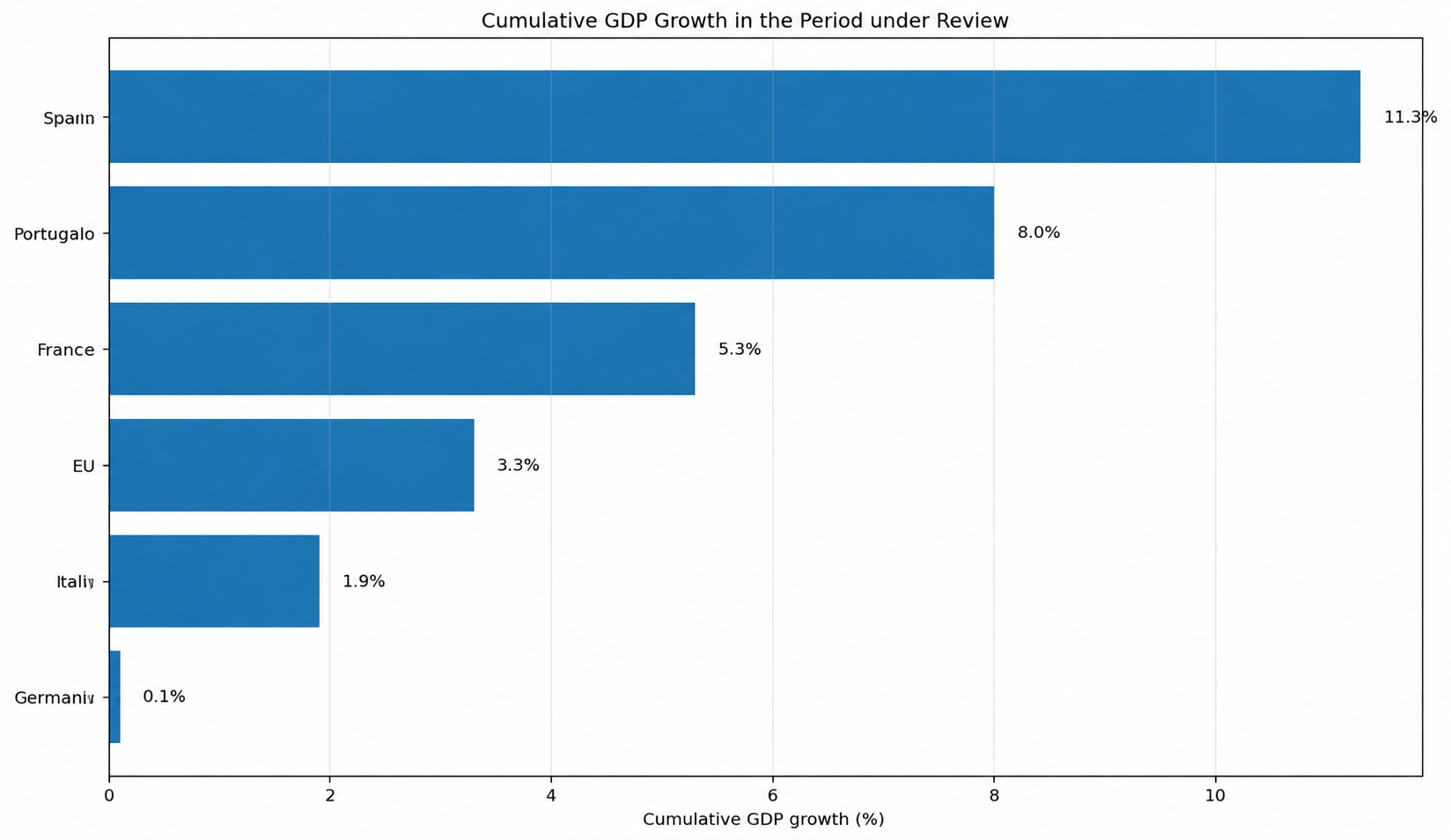
The assessment changes when attention shifts from the number of people in employment to the amount of wealth produced. According to Sky TG24’s reconstruction, over the period considered Italian GDP increased cumulatively by 1.9%, compared with 3.3% in the European Union, 5.3% in France, 8% in Portugal and 11.3% in Spain, while still outperforming Germany’s near-stagnation, estimated at 0.1%.
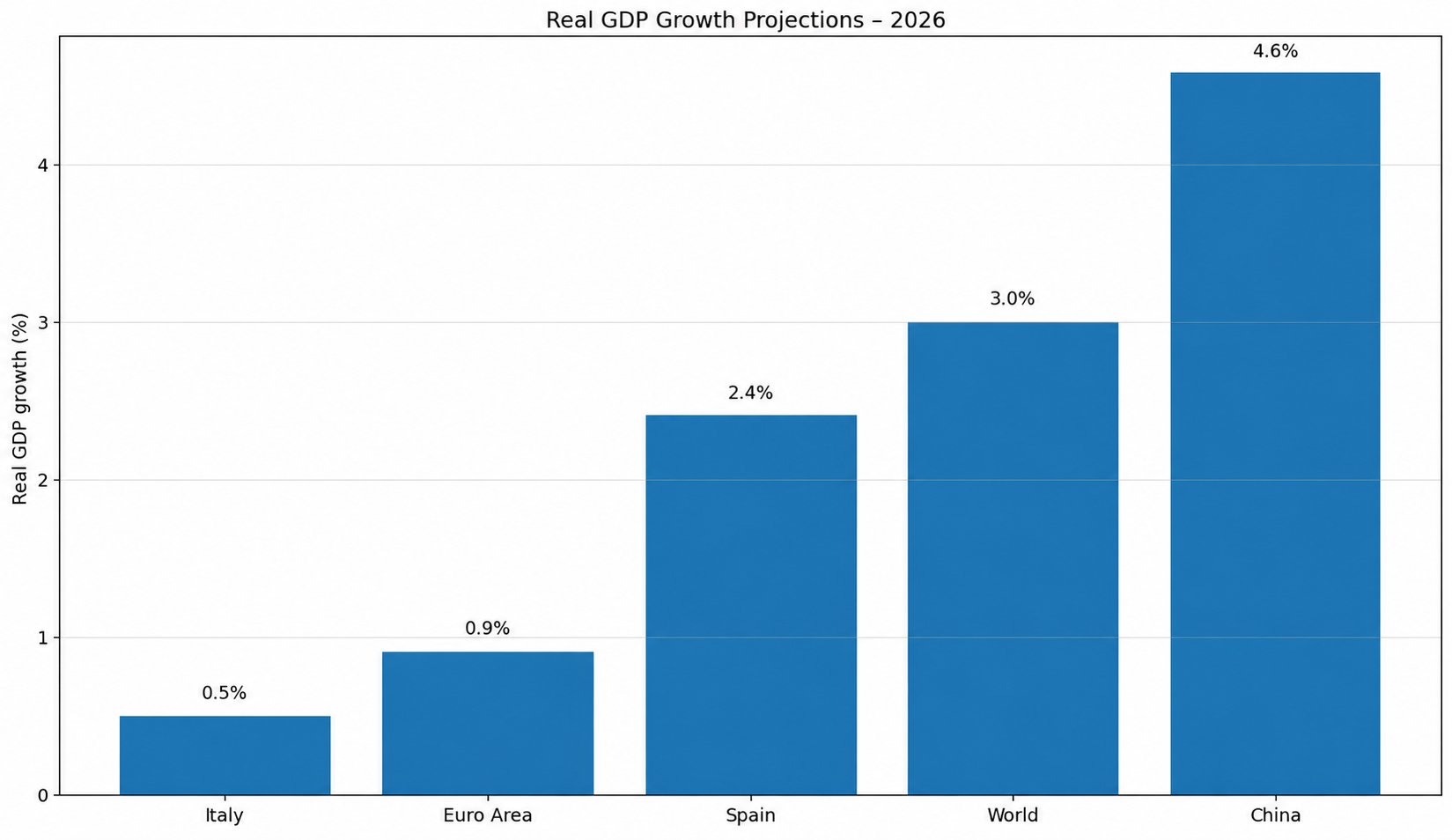
These cumulative figures should be interpreted with caution, as they depend on the specific starting and ending points used and are not equivalent to conventional annual growth rates. Nevertheless, their general indication is confirmed by the leading national and international institutions: Bank of Italy reported that Italian GDP grew by 0.5% in 2025, below the euro-area average, and that the conflict in the Persian Gulf has further weakened an already fragile outlook. Moreover, the European Commission forecasts real GDP growth of just 0.5% for Italy in 2026 and 0.6% in 2027, while in the second quarter of 2026 GDP increased by 0.4% quarter-on-quarter in the euro area and by 0.5% in the European Union as a whole.
This reveals what may be regarded as one of the principal paradoxes of Italy’s current economic situation: employment is expanding far more clearly than output. This is socially positive because it broadens participation in employment and the contribution base, but economically problematic if it is not accompanied by higher productivity, since over the long term productivity and value added per hour worked are among the principal determinants of the scope for increasing real wages, competitiveness and per capita income. In the Governor’s Concluding Remarks this year, Bank of Italy emphasised that, without a decisive increase in productivity, the country risks remaining locked into structurally modest rates of economic growth.
Italy is slowing within a Europe that is itself slowing
Italy’s weak growth cannot, however, be properly interpreted without placing it within the European economic environment of 2026, which deteriorated considerably during the year. The war in the Middle East and the resulting tensions in energy markets have particularly affected energy-importing economies, while uncertainty arising from the war in Ukraine and international trade tensions persists.
In July 2026, the International Monetary Fund lowered its euro-area growth forecast to 0.9%, compared with the 1.4% recorded in 2025, identifying the Middle Eastern shock, higher energy costs, deteriorating confidence and tighter financial conditions among the principal causes of the slowdown. For 2027, the IMF forecasts a recovery to 1.2%, while stressing that risks remain tilted towards weaker growth and higher inflation.
The European Central Bank offers a similar assessment. In its June projections, it forecast euro-area growth of 0.8% in 2026 alongside inflation of 3.3%, while a more severe scenario linked to the consequences of the conflict would reduce growth to 0.5% and raise inflation to 4%. Pressure on prices has already produced a concrete monetary-policy consequence: on 11 June, the ECB raised its three key interest rates by 25 basis points, interrupting the previous easing phase in response to renewed inflationary pressures stemming from the Middle Eastern conflict.
Italy is therefore growing slowly within a Europe that is itself experiencing weak growth. This context qualifies the claim that all of Italy’s economic weakness can be attributed to national policy choices, but it does not eliminate the problem, since Italy’s 0.5% growth rate remains below even the already modest rate forecast for the euro area.
The global comparison makes the growth gap even clearer
Broadening the perspective further makes the gap more pronounced. In its July 2026 World Economic Outlook Update, the International Monetary Fund forecasts global economic growth of 3.0% in 2026 and 3.4% in 2027, within a context characterised by the tension between the energy shock generated by the war and a strong expansion in investment related to technology and artificial intelligence. For China, the IMF forecasts growth of 4.6% in 2026.
Artificial intelligence plays a role in the economy that extends far beyond technological innovation alone, as it forms part of a broader transformation of production structures, labour relations, investment patterns and the growth trajectories of advanced economies (Bank of Italy, 2026).
The World Bank, while adopting a more cautious scenario published before the IMF’s summer update, forecast in June global growth of 2.5% in 2026, compared with 1.5% for advanced economies as a whole and 0.8% for the euro area. This nevertheless confirms the same fundamental pattern: the centre of gravity of global growth remains considerably more dynamic in emerging and Asian economies than in Europe.
International comparisons must naturally be approached with caution, since mature economies such as Italy cannot be mechanically compared with emerging economies characterised by different demographic dynamics and convergence processes. Nevertheless, the comparison indicates that Italy’s problem does not consist solely in growing more slowly than Spain or the European average, but also in being part of an economic area—Europe—that is losing relative dynamism compared with the more innovative segments of the global economy.
Spain shows that the European slowdown does not explain everything
The most meaningful comparison therefore remains that with European economies operating under relatively similar monetary, regulatory and geopolitical conditions. From this perspective, Spain provides a particularly useful case. According to Sky TG24’s comparative reconstruction, since the beginning of the legislature Spanish GDP has increased by 11.3%, compared with 1.9% in Italy, while European forecasts for 2026 continue to indicate substantially stronger growth in Spain.
The Spanish case therefore prevents Italy’s low growth from being attributed entirely to the European economic environment, just as Germany’s stagnation prevents the opposite mistake of treating Italy as an isolated exception. Europe’s major economies are following markedly different trajectories, shaped by productive structures, demographics, energy exposure, domestic demand, investment and the ability to use public expenditure and European funds to increase productive potential.
For Italy, the central issue therefore remains productivity, because greater employment can become a structural transformation only if a growing volume of labour is able to generate greater value added.
The NRRP supports growth but raises the question of what happens after 2026
This consideration becomes even more relevant given that the European Commission attributes a central role to NRRP-funded investment in supporting Italy’s already modest growth in 2026, while pointing to consumption weakened by the loss of purchasing power and a negative contribution from net exports.
This situation presents both a positive element and an open question. It is positive that European resources are being translated into investment and are supporting economic activity during an adverse international environment; however, it remains to be seen how much of this expenditure will translate into permanent productive capacity, since the conclusion of the extraordinary NextGenerationEU cycle will progressively reduce the direct support provided by European public investment.
The true measure of the NRRP’s success will therefore not simply be the amount of resources spent within the established deadlines, but the extent to which the investments financed generate lasting improvements in productivity, digitalisation, administrative efficiency and competitiveness (Bank of Italy, 2026).
The tax wedge and personal income tax: genuine measures that do not amount to a reduction in the overall tax burden
In fiscal policy, some measures can be linked relatively clearly to the objectives announced by the governing majority in 2022. The reduction in the labour tax wedge has been made structural and the personal income tax system (IRPEF) has moved from four rates to three. From 2026, these are 23% on income up to €28,000, 33% between €28,001 and €50,000, and 43% above €50,000. For this reason, Sky TG24’s assessment regards the commitment relating to the tax wedge as substantially fulfilled.
It is nevertheless necessary to distinguish between reducing the tax burden on particular categories of income and reducing the aggregate tax burden, because the two measures can move in different directions. An employee may benefit from lower taxation on personal income while, at the same time, the overall ratio of tax and social-security revenues to GDP increases.
This is precisely what has occurred at the macroeconomic level. The overall tax burden, equal to 41.7% of GDP in 2022, fell to 41.2% in 2023 before rising to 42.4% in 2024 and 43.1% in 2025. It is estimated at 42.9% for 2026, slightly below the previous year but still significantly above the level recorded at the beginning of the legislature.
It is therefore possible to maintain, without contradiction, both that the government has implemented a structural reduction in the labour tax wedge and that it has not, so far, reduced the overall tax burden relative to 2022.

Social policies and demographic trends require a less binary assessment
A similar consideration applies to pensions and family policies. Sky TG24 regards the objective of increasing minimum pensions for people aged over 75 as having been achieved, reporting an increase from approximately €525 in 2022 to €614 in 2026, while considering the objective of bringing Italian expenditure on children and families into line with the European average to have remained unmet, although it acknowledges that resources allocated to supporting families and the birth rate have increased.
The classification of a promise as “kept” or “not kept” has obvious journalistic effectiveness, but the evaluation of public policies requires more nuanced categories, since a measure may be fully implemented at the legislative level yet produce limited effects, or may fail to reach the originally stated target while still generating a measurable improvement.
The demographic issue makes this distinction particularly important: the effectiveness of family policies cannot be assessed solely on the basis of nominal increases in public expenditure, but must also be considered in relation to birth rates, female labour-force participation, the availability of childcare services, housing costs, employment stability among young people, and families’ ability to reconcile work and care responsibilities. Bank of Italy has warned that Italy will not be able to sustain economic development simply by increasing employment if the working-age population continues to decline sharply.
Markets indicate a lower perception of risk, but causality is multiple
Over the period considered, Sky TG24 also records a 140% increase in the FTSE MIB and a 63% reduction in the BTP-Bund spread, indicators pointing to a highly favourable performance by the Italian stock market and a decline in the premium demanded by investors for holding Italian government debt rather than German debt.
These figures can legitimately be included in an assessment of the legislature, but they cannot be attributed exclusively to the government. Stock-market performance depends on corporate earnings, the sectoral composition of the index, international liquidity and the global financial cycle, while the sovereign spread simultaneously reflects Italian fiscal policy, expectations regarding the public finances, ECB monetary policy, interest-rate levels, European growth and international risk appetite.
Political stability and the perception of fiscal continuity may have contributed to the improvement, but the appropriate interpretation is one of multiple causation rather than exclusive causality.
Public finances: an improving deficit but still-rising debt
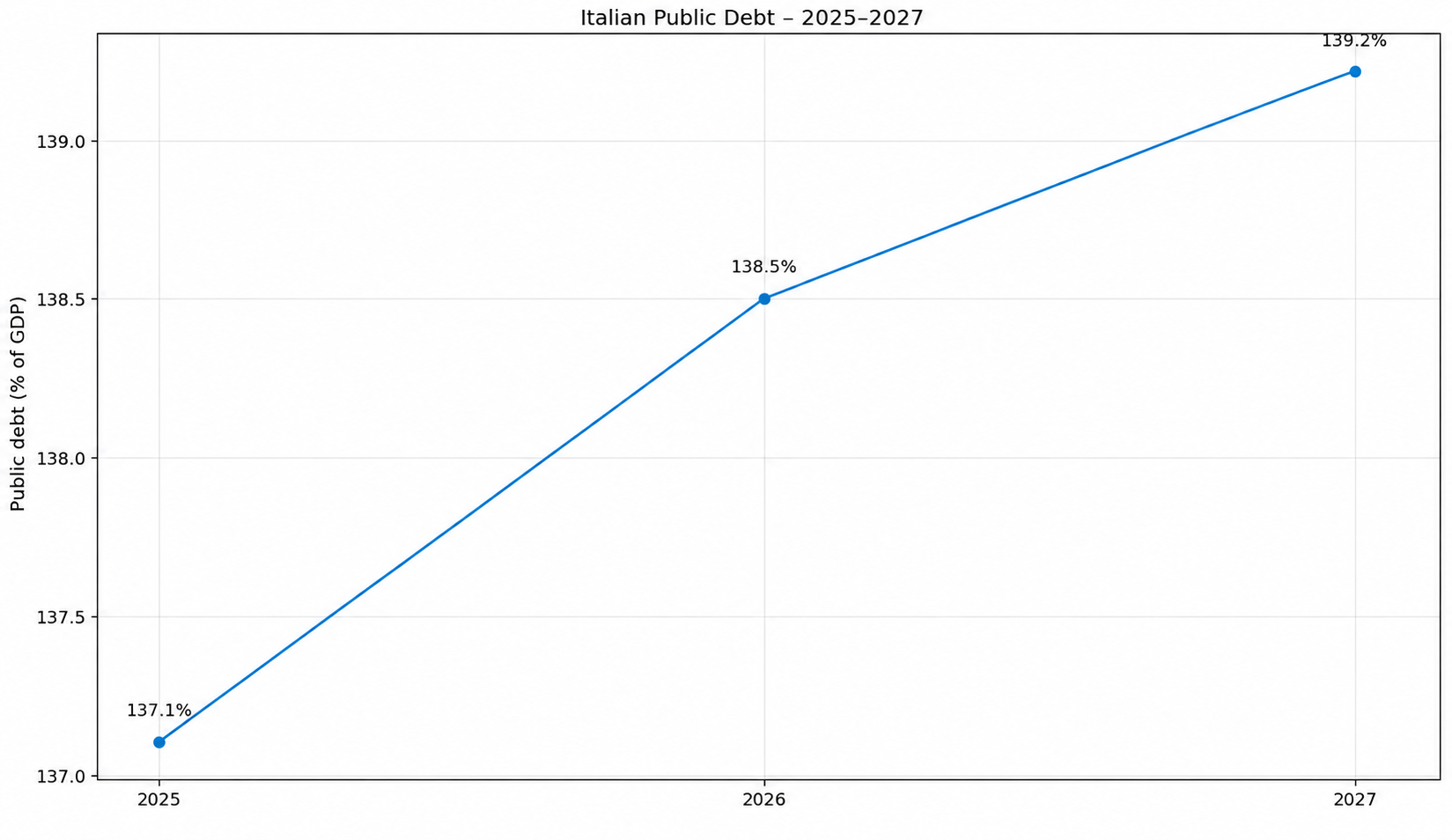
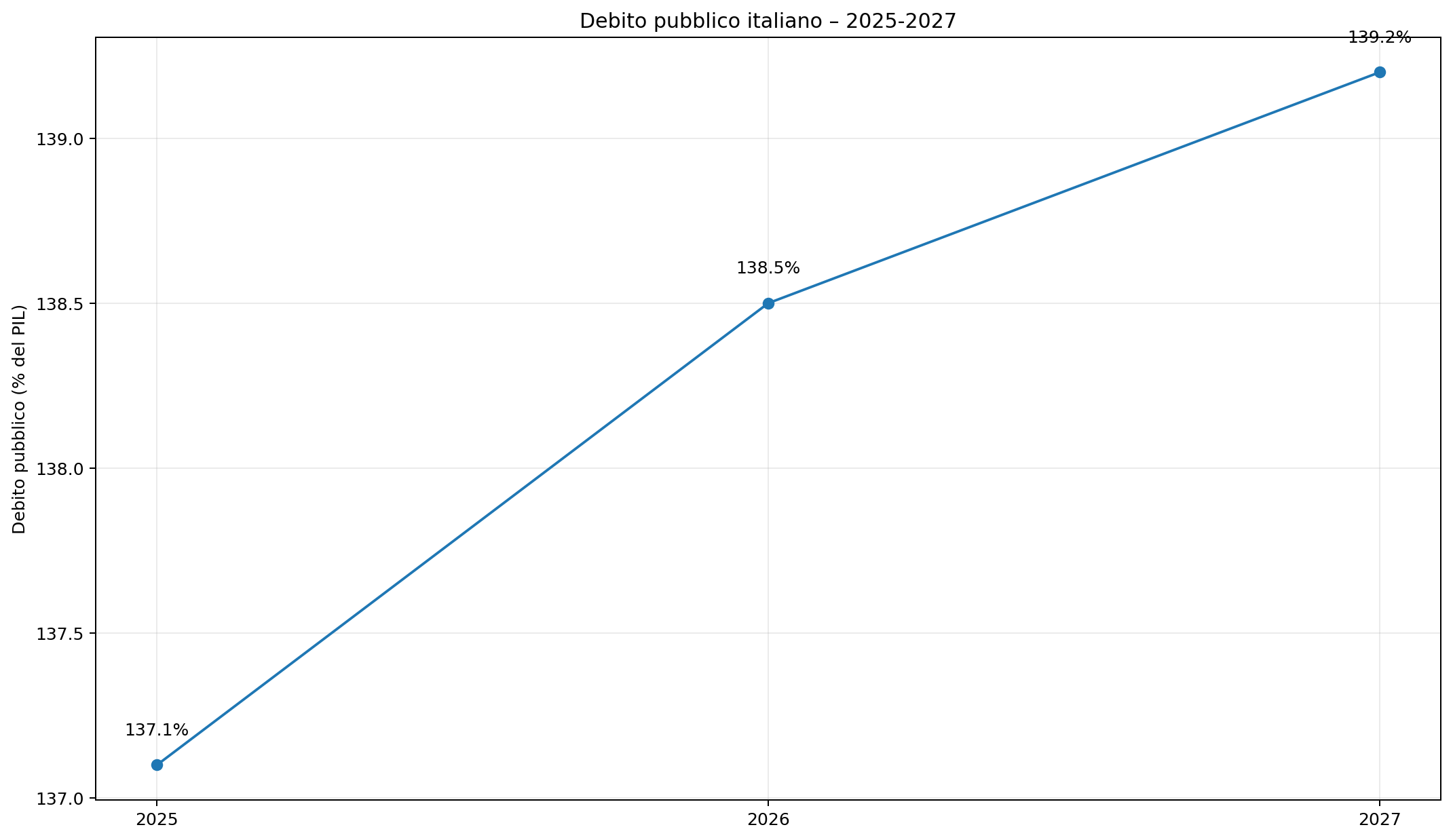
The public-finance outlook likewise presents a combination of favourable signals and persistent vulnerabilities. The European Commission forecasts that Italy’s deficit, which stood at 3.1% of GDP in 2025, will decline to 2.9% in 2026 and remain at that level in 2027, thereby returning below the 3% threshold. At the same time, however, the public debt-to-GDP ratio is expected to increase from 137.1% in 2025 to 138.5% in 2026 and 139.2% in 2027.
This apparent contradiction arises because debt dynamics depend not only on the annual deficit but also on interest costs, nominal economic growth, stock-flow adjustments and the composition of financial operations. In an economy characterised by very limited real growth, even a gradually declining deficit may be insufficient to stabilise the debt-to-GDP ratio rapidly.
The issue becomes still more important in the new European monetary environment, because renewed energy-related inflationary pressures and the ECB’s decision to raise interest rates reduce the likelihood of a rapid return to the exceptionally favourable financing conditions that characterised part of the previous decade.
Stability is not the same as transformation
The overall picture is therefore more complex than either a celebratory interpretation or an exclusively negative one would suggest. During the Meloni government, employment has risen substantially, unemployment has fallen below the European average, permanent employment has continued to increase, the tax wedge has been structurally reduced, the deficit is on a downward trajectory and perceptions of Italian financial risk have improved. These are measurable results, and denying them would mean subordinating the evidence to a predetermined political judgement.
At the same time, however, Italian growth remains weak, youth unemployment remains above the European average, the overall tax burden is higher than in 2022, public debt is still projected to rise and productivity has so far failed to translate the increase in employment into a corresponding acceleration in output. These, too, are verifiable facts and cannot be subsumed under the single indicator of political stability.
The international environment of 2026 makes the assessment still more complex. The war in the Middle East, higher energy costs, trade tensions, the euro-area slowdown and renewed monetary tightening are shocks that no national government can independently control. It would therefore be methodologically incorrect to attribute the entirety of the cyclical weakness to Palazzo Chigi. Yet comparison with European economies that are exposed to many of the same shocks but continue to grow more rapidly indicates that a substantial part of Italy’s problem predates the current economic cycle and concerns productivity, demographics, investment, human capital, firm size and innovative capacity.
The real significance of 1,413 days
It is from this perspective that the record reached on 4 September acquires its most interesting significance. For much of the history of the Italian Republic, the short lifespan of governments has been cited as one of the causes of Italy’s inability to design long-term reforms, maintain administrative continuity and address problems requiring time horizons extending beyond a single budget law. The Meloni government demonstrates instead that, under certain political conditions, Italy too can have a government that remains substantially stable throughout an entire legislature.
Stability therefore ceases to be the problem and becomes the benchmark against which results should be assessed.
After 1,413 days, it is no longer sufficient to ask whether the government has survived, because the answer is self-evident. Nor is it analytically satisfactory to reduce its record to a tally of electoral promises kept and broken. The more relevant question is whether almost four years of continuity have altered the country’s growth potential, increased productivity, improved the quality of employment, placed the public finances on a more sustainable footing and created conditions capable of outlasting the political experience that produced them.
On these grounds, the assessment cannot yet be definitive. The Meloni government has already achieved a historic record in terms of longevity, has produced significant labour-market outcomes and can point to some improvements in fiscal management and the country’s financial perception. It has not, however, yet generated an equally evident break with Italy’s long-standing pattern of weak structural growth, while some of the results recorded in 2026 continue to depend on the extraordinary support provided by European investment and are unfolding within an international environment that has suddenly become more difficult.
The political significance of these 1,413 days therefore lies precisely in the opportunity they provide to separate two concepts that have often been conflated in Italian political history: governability and transformative capacity. The former has been demonstrated; the latter remains the real test.
The stability of a government can be measured by counting the days it spends in Palazzo Chigi. Its economic legacy, by contrast, can be assessed only by observing what, once those days have passed, is capable of continuing to grow without it.
References and Statistical Sources
Bank of Italy (2026), The Governor’s Concluding Remarks for 2025, Annual Report for 2025 – 132nd Financial Year, Rome, 29 May 2026.
European Central Bank (2026), Eurosystem Staff Macroeconomic Projections for the Euro Area, June 2026, Frankfurt am Main.
European Central Bank (2026), Monetary Policy Decisions, 11 June 2026, Frankfurt am Main.
European Commission (2026), Economic Forecast for Italy, Spring Economic Forecast, Brussels, 21 May 2026.
Eurostat (2026), GDP Up by 0.4% and Employment Up by 0.1% in the Euro Area, Euro Indicators, 14 August 2026.
Eurostat (2026), Euro Area Unemployment at 6.4%, Euro Indicators, 1 September 2026.
International Monetary Fund (2026), World Economic Outlook Update: Global Economy in Crosscurrents of War and Technology, Washington, D.C., July 2026.
International Monetary Fund (2026), 2026 Consultation with Euro Area, Washington, D.C., 16 July 2026.
ISTAT (2026), Employment and Unemployment (Provisional Data) – July 2026, Rome, 1 September 2026.
Sky TG24 (2026), Governo Meloni batte record di longevità: il bilancio delle promesse elettorali economiche, 4 September 2026.
World Bank (2026), Global Economic Prospects, Washington, D.C., June 2026.
Mancini, F. (2026), The State of the Global and National Economy in the Governor’s Final Considerations, Ethica Societas, May 2026.
Mancini, F. (2026), Productivity and Inequality in the Era of Artificial Intelligence: Insights from the Governor’s Annual Reports, Ethica Societas, May 2026.
Mancini, M. (2024), Per gli Interessi sul Debito pubblico italiano si Spende quanto per l’istruzione, Ethica Societas, Sep. 2024.
LATEST FIVE CONTRIBUTIONS BY THE SAME AUTHOR
Will Humans Govern AI, or Will AI Govern Humans? [VIDEO]
“Love That Moves Sun and Other Stars”: the Theme of the 2026 Meeting [WITH VIDEO]
The Pietro Mennea Golden Gala Lights up Rome and Italian Sport
Two Suicides on the Same Day: a Carabinieri Officer Takes His Own Life in Varazze
FIVE LAST CONTRIBUTIONS ON ECONOMICS
Europe Between British Rearmament, New Trade Barriers, and Selective Credit
The State of the Global and National Economy in the Governor’s Final Considerations
Energy Geopolitics and Macrofinancial Instability
FIVE LATEST CONTRIBUTIONS
When the investigation stops searching
The Invisible Architectures of Coherence
Nabucco at the Verona Arena: When Opera Transcends into Vision
Ceuta, When the Border Becomes a Weapon
Ethica Societas is a free, non-profit review published by a social cooperative non-profit organization
Copyright Ethica Societas, Human&Social Science Review © 2026 by Ethica Societas UPLI onlus.
ISSN 2785-602X. Licensed under CC BY-NC 4.0