

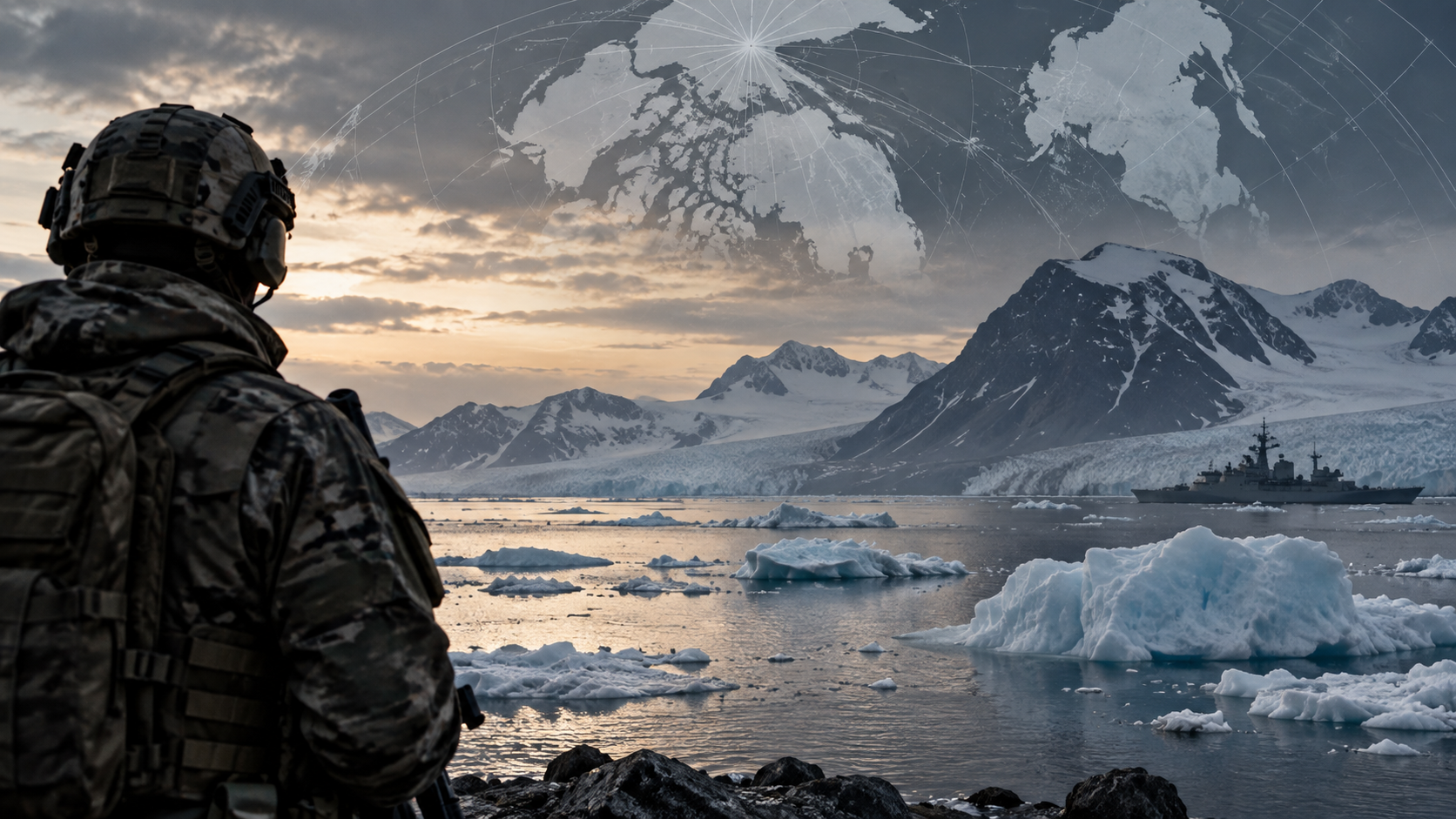
How Global Warming Is Transforming Defence Strategies Around the World

Abstract: Climate change is becoming a structural component of the strategic environment in which military power is exercised. Rising temperatures, extreme events, ecosystem transformation and sea-level rise are affecting infrastructure, mobility, logistics, training, energy and operational capability. NATO, France and the armed forces of the Bay of Bengal region are progressively integrating the climate dimension into defence planning, while Russia and China also view the transformation of the Arctic as a reconfiguration of strategic geography. Climate change, therefore, is altering not only the threats against which states must defend themselves, but also the material and geopolitical conditions under which defence capabilities must be maintained and exercised.
Keywords: #ClimateChange #Defence #Security #Geopolitics #NATO #MilitaryStrategy #ArmedForces #ClimateSecurity #Arctic #Russia #China #France #BayOfBengal #Resilience #StrategicInfrastructure #CristinaDiSilvio #EthicaSocietas #EthicaSocietasReview #ScientificJournal #SocialSciences #EthicaSocietasUPLI
Climate enters strategic thinking
For a long time, climate change was treated within strategic studies as an indirect variable. It was associated primarily with increasing social vulnerability, competition for resources, migration, political instability and the possibility of new conflicts. From this perspective, climate functioned principally as a threat multiplier. Its strategic relevance therefore derived more from the effects it produced on societies and political systems than from any direct transformation of the military function.
This approach now appears insufficient. The issue is not simply that global warming may contribute to the emergence or intensification of particular crises. Rather, it is progressively altering the physical conditions in which armed forces must operate, the infrastructure on which they depend, the routes along which they must move, the energy resources they must use, the conditions under which they must train and even the parameters by which their readiness must be assessed.¹
The question, therefore, is no longer simply whether climate change can generate new security threats. It is whether a permanent transformation of the physical environment may require us to rethink the strategy through which security itself is produced.
The strategic question thus becomes more fundamental: how does military strategy change when the physical world in which it must be applied is itself changing?
The answer requires a conceptual shift. Climate change should no longer be viewed exclusively as an external cause of instability, but as a transformation of the operational environment. The distinction is not merely terminological. If climate change represents an additional threat, the response can be developed through specific instruments designed to contain its effects. If, however, climate change transforms the operational environment as a whole, the response must extend across the entire defence system: planning, infrastructure, capabilities, mobility, logistics, training, technology, energy, resilience and deterrence.
It is precisely this second dynamic that makes the phenomenon strategically new.
A global transformation
There is no single way in which climate change enters defence strategy. The transformation takes different forms according to geography, economic structure, military capabilities and the international position of individual states. Yet the very diversity of these responses demonstrates that the phenomenon is not confined to a single geopolitical region.
Within the Euro-Atlantic system, NATO has progressively transformed climate change from a predominantly environmental issue into a matter of security and military readiness. The 2021 Climate Change and Security Action Plan recognised that extreme temperatures, sea-level rise, changing precipitation patterns and more intense weather events can undermine infrastructure, operational capabilities and the conditions in which forces are deployed. The Alliance has therefore linked climate change to resilience, defence planning, military mobility, civil preparedness, education and training, exercises, innovation and deterrence.²
The French case illustrates a similar dynamic developed at the national level. The Climat & Défense strategy, adopted in 2022, explicitly recognises that climate change is altering both the international strategic environment and the conditions under which the armed forces must carry out their missions. Adapting the military instrument thus becomes a component of defence policy rather than simply an environmental policy pursued by the ministry.³
In the United Kingdom, the United States and other Western defence systems, the issue takes additional forms relating to the management of military installations, energy availability, emissions reduction, the design of future capabilities and the need to maintain operational effectiveness under increasingly unpredictable environmental conditions. Contemporary research on climate and defence shows how climate change is simultaneously entering resource management, logistics, operations and the conceptualisation of future military capabilities.⁴
Yet this transformation is not inherently Western.
In the Bay of Bengal region, India, Bangladesh, Indonesia, Myanmar, Sri Lanka and Thailand offer a different example. Here, the increasing frequency of extreme events and natural disasters has strengthened the role of armed forces in humanitarian assistance and disaster relief operations, encouraging the progressive integration of climate considerations into security strategies and arrangements. Climate enters defence not necessarily through a theoretical reassessment of deterrence, but through the tangible increase in the missions that military organisations must be capable of sustaining.⁵
The diversity of these responses is precisely what makes the phenomenon strategically significant. There is no single “climate strategy” for defence. Rather, there is a cross-cutting transformation of the military function, interpreted by each state according to its geography, vulnerabilities, industrial capabilities and position within the international system.
In other words, climate change does not merely alter risk. It can alter the geography of power.
From climate threat to operational environment
The most important transformation concerns the shift from understanding climate change as a threat to recognising it as part of the operational environment.
A military force is effective only under certain material conditions. An airfield must remain operational, a base must be capable of being supplied, a runway must remain usable, a port must be able to accommodate naval vessels, electricity and digital networks must be sufficiently resilient, and roads and logistical corridors must permit the movement of forces. Even the most advanced weapons systems depend on complex physical infrastructure.
When environmental conditions change, therefore, so does the relationship between military capability and territory.
Rising temperatures can affect engine performance, aircraft range, personnel safety and the duration of operational activities. Sea-level rise exposes naval bases and coastal infrastructure. Extreme rainfall can disrupt land communications and compromise supply routes. Drought can increase pressure on water resources and alter the conditions under which exercises and operations are conducted. Wildfires, floods and extreme events may force armed forces to devote resources to relief operations precisely when they must maintain readiness for traditional defence tasks.
The consequence is a redefinition of the very concept of readiness.
Readiness can no longer be measured solely by the number of available platforms, quantities of ammunition, levels of training or mobilisation capacity. It must also include the ability of the entire system to continue functioning when the environment in which it operates becomes more unstable.
Resilience, therefore, is no longer merely a complementary component of national security. It becomes a condition of military capability.
This transformation is particularly evident in planning. If future climatic conditions no longer correspond to those for which much existing infrastructure was designed, planning assumptions must also be revised. It is no longer sufficient to design a base to withstand historically observed climatic conditions. The possibility must be considered that those conditions may no longer provide an adequate benchmark for the future.
Military planning is thus entering territory traditionally unfamiliar to strategy: the management of long-term physical uncertainty.
Infrastructure, logistics and mobility
Military power is often represented through weapons systems, technologies, budgets and numbers. Yet no military capability exists independently. Every system depends on infrastructure, energy, maintenance, transport, personnel and logistical chains.
It is precisely this material dimension of power that is progressively being affected by climate change.
A military base located in a coastal area exposed to sea-level rise no longer represents the same infrastructural capability that it did several decades ago. Infrastructure built in a region subject to increasingly frequent wildfires requires new protection standards. A logistical network dependent on land corridors vulnerable to extreme weather events becomes less reliable even if its transport assets remain technologically advanced.
Military capability depends not only on the power of weapons systems, but on the ability to fuel, maintain, move and sustain them over time.
This introduces an often underestimated strategic dimension: operational continuity.
In an environment characterised by greater climatic variability, the problem will not merely be reaching a particular theatre of operations, but ensuring that the force can remain there. Logistics therefore acquires an even more central role. Energy supplies, water availability, infrastructure maintenance, the security of communications networks and the ability to move personnel and materiel become elements of the same strategic equation.
Climate change also makes the relationship between defence and civilian infrastructure increasingly apparent. Armed forces depend on ports, airports, railways, roads, energy systems, telecommunications and supply chains that often belong to the civilian sphere. Military resilience therefore cannot be separated from the resilience of the state.
It is at this point that climate security also becomes national security.
Training, technology and readiness
Climate change is also altering the way armed forces must prepare for war.
Military training is based on reproducing operational conditions, simulating stress and developing procedures. But as environmental conditions become more variable, what must be simulated changes as well.
The soldier of the future may increasingly be required to operate in extreme heat, with limited access to water, during wildfires, floods or storms, or in areas characterised by rapid changes in terrain and transport networks. The ability to adapt to different environmental conditions therefore becomes part of operational competence.
This does not mean replacing traditional training with “climate training”. It means recognising that climate forms part of the practical reality of any operation.
Technology plays an ambivalent role in this context. On the one hand, new technologies can increase energy autonomy, improve environmental monitoring, strengthen communications and enable more efficient resource management. On the other, growing technological complexity may increase dependence on vulnerable energy systems, materials and infrastructure.
The strategic question can therefore no longer be limited to how advanced a particular system is. It must also consider how adaptable that system is.
This shift is essential. Within the traditional paradigm of military superiority, technological quality tends to be regarded as a relatively stable advantage. In a changing physical environment, however, adaptability may become more important than initial superiority.
Adaptability becomes a form of power.
Russia, China and the new geography of power
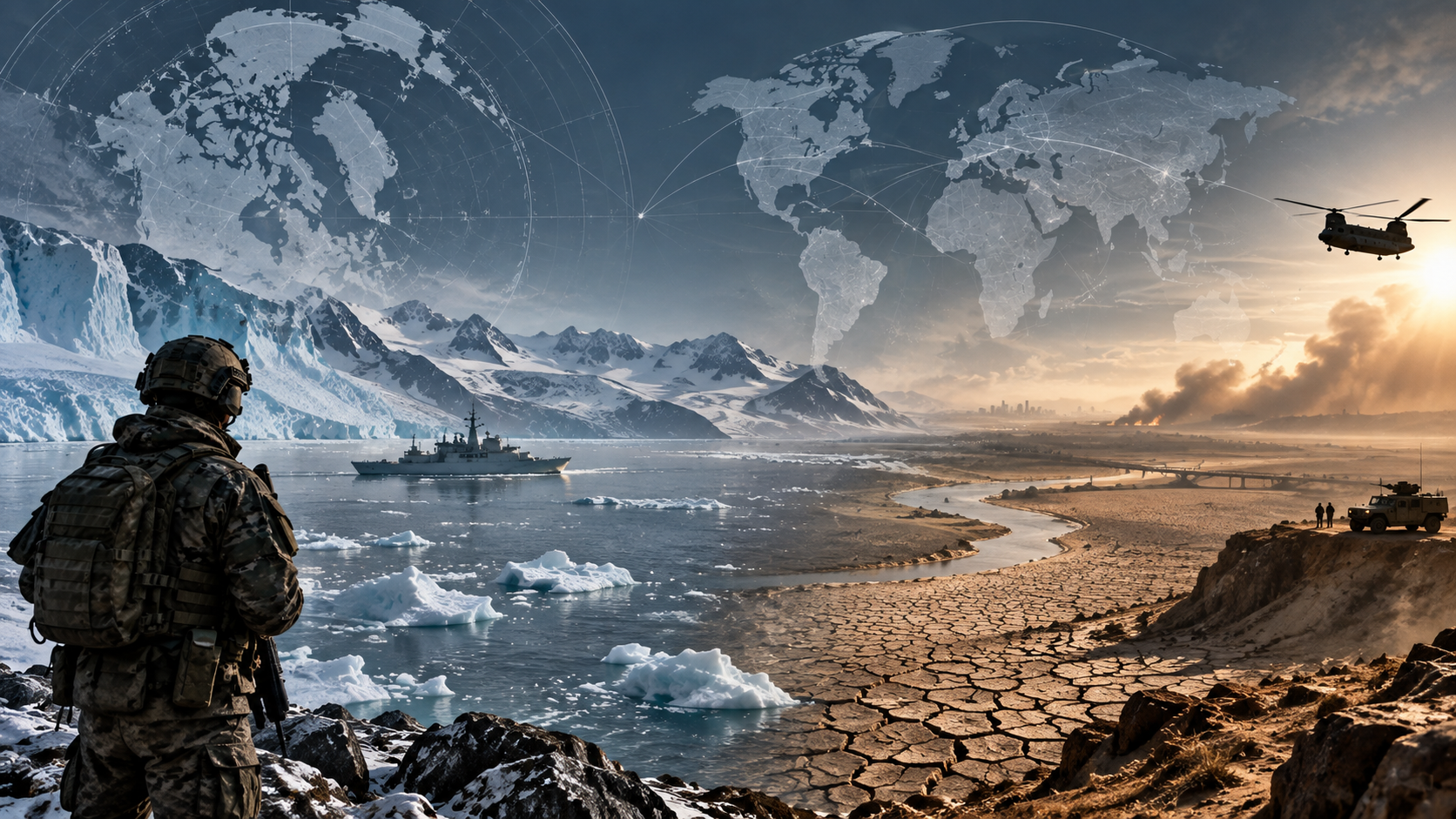
Nowhere is this transformation more visible than in the Arctic.
Melting ice does not simply generate new environmental vulnerabilities. It progressively alters access to spaces that have long been characterised by extremely restrictive physical conditions. The result is a transformation of strategic geography.
For Russia, the Arctic simultaneously represents strategic depth, a military space, an energy region and a communications corridor. The progressive transformation of environmental conditions increases the importance of infrastructure, bases, surveillance systems and logistical capabilities in the region. The physical transformation of the territory therefore cannot be separated from Russia’s strategic posture.
For China, the transformation of the Arctic opens a different dimension. Chinese interest in new routes, resources and opportunities for access to the region forms part of a broader strategy of economic and geopolitical projection. The Arctic thus becomes a space in which climate transformation interacts with great-power competition. Recent literature explicitly observes how warming in the region is increasing the strategic relevance of the Northeast Passage and encouraging greater Chinese attention to the capabilities required to operate in Arctic waters.⁶
The issue is not simply who controls new routes. It is who possesses the infrastructure, technologies, information and logistical capabilities required to operate in an environment that is becoming progressively more accessible without becoming any less challenging.
The Arctic therefore demonstrates that climate change can produce an apparently paradoxical effect: opening up new spaces while simultaneously making them more contested.
The same logic can be observed in other theatres. In the Mediterranean, the Indo-Pacific, sub-Saharan Africa and South Asia, changing environmental conditions interact with infrastructural vulnerabilities, demographic pressures, competition for resources and political instability.
Climate change does not automatically cause conflict. But it can alter the strategic value of territories.
When the physical geography of security changes, the geography of defence must change with it.
From deterrence to strategic resilience
Traditional deterrence rests on convincing an adversary that the cost of aggression will exceed its expected benefits. Yet this logic assumes that the state possesses a credible capacity to respond.
Climate change introduces a prior question: how resilient is that capacity?
An armed force may possess advanced systems and still remain vulnerable if its bases can easily be compromised, its energy infrastructure is fragile, its logistical networks can be disrupted or environmental conditions drastically reduce the operational availability of its forces.
Resilience therefore becomes part of deterrence.
An adversary that perceives an opportunity to paralyse essential infrastructure without necessarily destroying military capabilities in the strict sense may regard climate vulnerability as an exploitable weakness in the opposing strategy. The security of installations, energy diversification, communications redundancy and the ability to continue operating during extreme events therefore become components of strategic credibility.
This issue is particularly relevant in the context of hybrid warfare, where the distinction between military attack, economic pressure, infrastructure sabotage and information manipulation is increasingly difficult to draw.
Infrastructure already weakened by extreme climatic conditions may also become more vulnerable to hostile action. Physical fragility can therefore become strategic vulnerability.
Future defence must consequently be conceived not only in terms of the ability to strike, but also the ability to endure.
The defence paradox
There is, however, a paradox. Armed forces are being required to adapt to climate change while remaining among the organisations most dependent on energy, fuels, complex infrastructure and materially intensive technological systems. The transformation of defence therefore cannot be limited to adapting to climatic effects. It must also address the material sustainability of defence itself.
The issue is not exclusively environmental. It is strategic.
Greater dependence on fossil fuels can create vulnerabilities to energy markets, supply-chain disruptions and geopolitical crises. Conversely, energy efficiency, diversification of energy sources and the development of technologies less dependent on particular supply systems may also generate operational advantages.
The energy transition in defence should therefore not be interpreted simply as a policy for reducing emissions. It can become a question of strategic autonomy.
This does not mean imagining completely “green” armed forces, nor automatically transferring civilian environmental-policy objectives into the military sphere. The logic of defence remains that of operational availability and the protection of the state. Precisely for this reason, however, energy becomes a strategic issue: more sustainable technology is relevant to defence when it enhances resilience, reduces critical dependence or increases freedom of manoeuvre.
The decisive point, therefore, is to avoid treating sustainability and military capability as opposing objectives. Under certain conditions, climate adaptation can itself become a component of military capability.
A new conception of power
Climate change ultimately requires us to rethink the concept of power. For much of the modern era, military power has been associated with the ability to concentrate resources, project them across space and sustain them over time. Yet power projection depends on physical conditions that are not immutable.
Future power will therefore increasingly depend on the ability to function under conditions of growing uncertainty.
A strategically strong state will not simply be one that possesses advanced weapons systems. It will be one capable of keeping its forces operational when infrastructure is under stress, logistical routes become more vulnerable, energy availability becomes less predictable, extreme events disrupt normal operating conditions, and new geographical spaces become simultaneously accessible and contested.
Strategic superiority may therefore assume a new form: no longer merely technological or quantitative superiority, but adaptive superiority.
This is a profound transformation because it changes the relationship between time and strategy. Military infrastructure is designed to last for decades; weapons platforms may remain operational for generations; major logistical capabilities require long-term investment. Yet climate change is altering, over the same time horizon, the conditions under which those capabilities will have to function.
Strategy must therefore become capable of planning for an environment that can no longer be assumed to remain stable.
This does not mean predicting the future with precision. It means building capabilities that remain usable even when the future does not conform to expectations.
Defending in a different world
Climate change is entering defence strategy not because it has replaced traditional threats, but because it is altering the conditions under which those threats must be confronted.
Russia, China, France, India, the United States, the United Kingdom, NATO and other strategic systems are not developing a uniform response. Their differences are profound. Yet through those very differences, a common trend emerges: defence is progressively being reconsidered in light of a physical environment that can no longer be regarded as stable.
The transformation concerns infrastructure, because bases must be designed for future rather than merely historical conditions. It concerns logistics, because supply chains must function in a more vulnerable environment. It concerns mobility, because roads, ports, airports and strategic corridors can be affected by extreme events. It concerns training, because operational conditions are changing. It concerns technology, because adaptability is becoming increasingly important. It concerns energy, because the autonomy of armed forces also depends on the resilience of their energy sources. Finally, it concerns deterrence, because the credibility of defence depends on the ability to withstand shocks, continue operating and recover afterwards.
The real change, therefore, does not consist in simply adding climate change to the long list of threats to international security. It consists in recognising that climate change is altering the material context of strategy itself.
For centuries, defence has been tasked with protecting relatively stable territories against changing threats. In the twenty-first century, it will increasingly have to protect changing territories against equally changing threats.
This is why climate change cannot be confined to environmental policy, civil protection or emergency management. It concerns the very nature of strategic preparedness.
Future defence must be capable of fighting, but also of adapting; of projecting power, but also preserving it; of deterring adversaries, but also withstanding shocks; of protecting territory, but also understanding how that territory is changing.
Future readiness must therefore also encompass the ability to adapt rapidly to conditions that no longer correspond to traditional environmental models.
Climate is not merely something against which defence must be mounted. It is a condition within which defence must operate. And it is precisely this distinction that changes strategy.
It is not only what we must defend ourselves against that is changing. The world in which we must defend ourselves is changing too.
Notes
- McDonald (2026) examines the relationship between climate change and defence, showing how the issue encompasses operational conditions, new forms of conflict and missions, infrastructure, resource management, procurement, training and defence organisation.
- NATO (2021) integrated climate change into the Alliance’s security agenda through the Climate Change and Security Action Plan. The subsequent Climate Change and Security Impact Assessment 2024 extends the analysis to the land, maritime, air, space and cyber domains, as well as operations, resilience and the effects on adversaries and strategic competitors.⁷
- The Ministère des Armées (2022) adopted the ministerial Climat & Défense strategy on 25 April 2022, designed to prepare the armed forces for climatic transformations and adapt the defence instrument to the foreseeable consequences of climate change.
- Kabbej (2026) analyses the process through which climate change has progressively been incorporated into French security and defence policy, highlighting the role of institutional actors, threat representations and political dynamics in the construction of climate security.
- Narayanan, Jayaram and Bharadwaj (2026) show how military involvement in humanitarian assistance and disaster relief operations in the Bay of Bengal has encouraged a progressive “climatisation” of military strategies and regional security mechanisms, albeit with significant differences among the states concerned.
- Vauhkonen (2026) observes that the progressive opening of the Arctic maritime route as ice recedes is altering the region’s strategic environment and increasing the relevance of both the Russian presence and Chinese interest. The case demonstrates how the physical transformation of territory can simultaneously create new opportunities for access and new forms of strategic competition.
- Keenan, Trump, Kytömaa, Adlakha-Hutcheon and Linkov (2024) emphasise that military resilience also depends on systems spanning the civilian and military domains and argue for planning capable of incorporating forms of transformative adaptation when previous equilibrium conditions are no longer sustainable.
Bibliography
Depledge, D., Santos, T., & Hobson, T. (2026). “The UK Ministry of Defence, ‘Low-Carbon Warfare,’ and the Struggle to Construct Novel Sociotechnical Imaginaries of Future War.” Contemporary Security Policy, 47(1), 139–165. https://doi.org/10.1080/13523260.2025.2543776
Keenan, J. M., Trump, B., Kytömaa, E., Adlakha-Hutcheon, G., & Linkov, I. (2024). “The Role of Science in Resilience Planning for Military-Civilian Domains in the U.S. and NATO.” Defence Studies, 24(4), 493–524. https://doi.org/10.1080/14702436.2024.2365218
Kabbej, S. (2026). “The Politics of Climate Security in France.” Contemporary Security Policy, 47(1), 166–192. https://doi.org/10.1080/13523260.2025.2559657
McDonald, M. (2026). “Defence and Climate Change: An Introduction.” Contemporary Security Policy, 47(1), 9–25. https://doi.org/10.1080/13523260.2025.2583233
Ministère des Armées. (2022). Stratégie Climat & Défense. Ministère des Armées et des Anciens combattants.
Narayanan, H. S., Jayaram, D., & Bharadwaj, T. (2026). “Climate Security and Militaries in the Bay of Bengal Region: Climatization Through Humanitarian Assistance and Disaster Relief.” Contemporary Security Policy, 47(1), 108–138. https://doi.org/10.1080/13523260.2025.2574702
NATO. (2021). NATO Climate Change and Security Action Plan. North Atlantic Treaty Organization.
NATO. (2022). NATO 2022 Strategic Concept. North Atlantic Treaty Organization.
NATO. (2024). Climate Change and Security Impact Assessment 2024. North Atlantic Treaty Organization.
Stott, M. (2025). “Defence in a Climate-Changed World: Futureproofing Its Licence to Operate.” The RUSI Journal, 170(2), 46–56. https://doi.org/10.1080/03071847.2025.2476520
Vauhkonen, J. (2026). “Russia and China: Reflections and Security Challenges for the Arctic Region.” European View, 25(1), 70–80. https://doi.org/10.1177/17816858261439472
LATEST 5 CONTRIBUTIONS BY THE SAME AUTHOR
Ceuta, When the Border Becomes a Weapon
Ceuta: Digital Mobilization and the Jihadist Threat
Monaco and Europe’s Security Vulnerabilities
From Crimea to NATO: War Without a Rear
FIVE LAST CONTRIBUTIONS ON GEOPOLITICS
Islam, Radicalization, and Global Security
The State of the Global and National Economy in the Governor’s Final Considerations
Destroying Images, Governing Memory: Jihadist Iconoclasm and Cognitive Warfare
FIVE LATEST CONTRIBUTIONS
Care Has No Gender. Rethinking Relationships to Prevent Violence
The Italian Republic’s Longest-Serving Government Faces the Test of the Economy
When the investigation stops searching
The Invisible Architectures of Coherence
Ethica Societas is a free, non-profit review published by a social cooperative non-profit organization
Copyright Ethica Societas, Human&Social Science Review © 2026 by Ethica Societas UPLI onlus.
ISSN 2785-602X. Licensed under CC BY-NC 4.0