

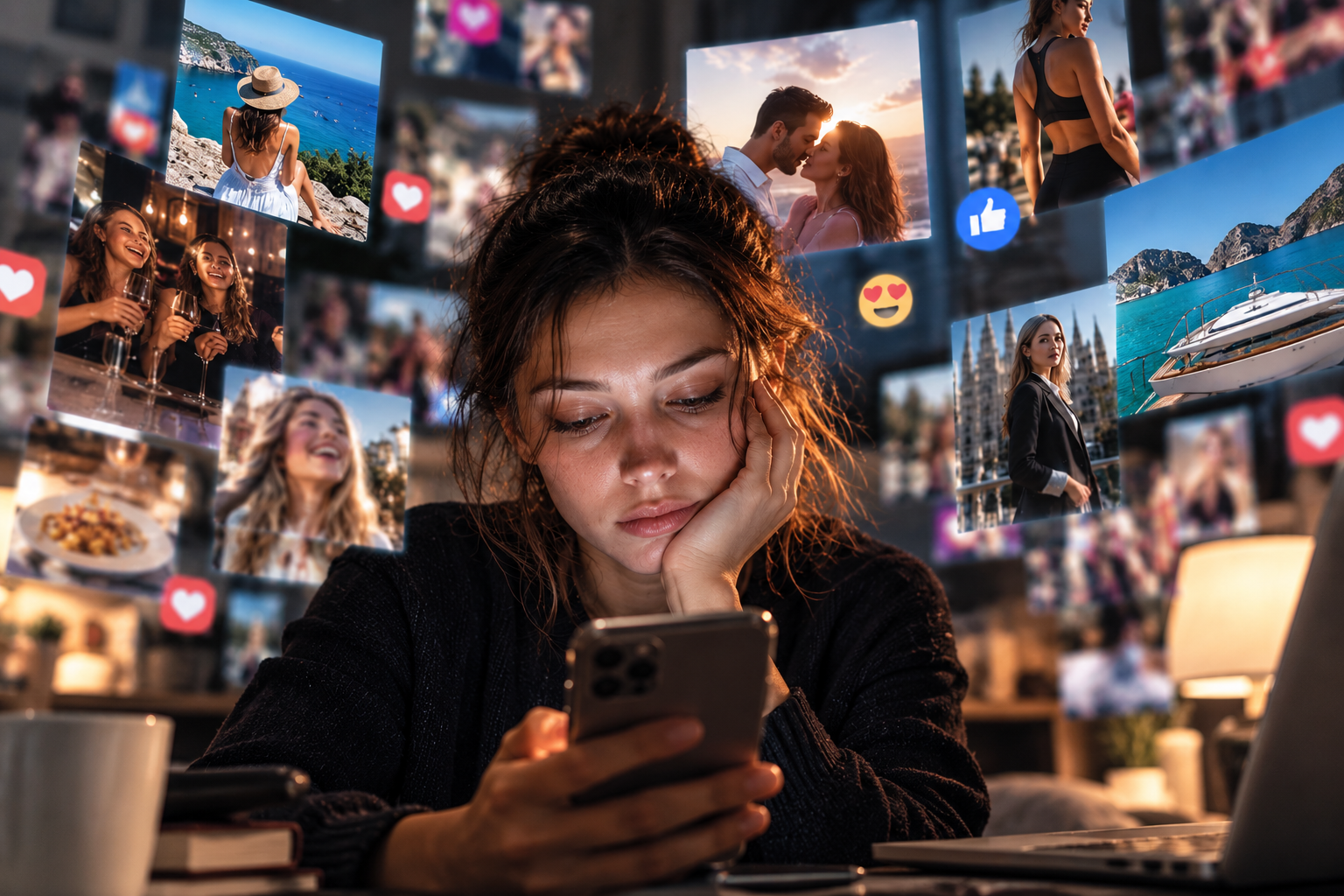
How Platforms, Social Comparison and Algorithms Are Transforming the Way We Experience, Describe and Share What We Feel

Abstract: Digitalisation of everyday life has transformed not only the ways in which we communicate, but also the temporal, spatial and social contexts within which emotions are perceived, processed and represented. Digital platforms have turned experiences traditionally associated with the sphere of intimacy into potentially public content, measurable through likes, views and shares and subject to recommendation systems that select what appears most likely to generate engagement. Comparison with idealised representations of other people’s lives may contribute to phenomena such as Fear of Missing Out and personal dissatisfaction, while morally charged emotions, such as indignation and anger, may acquire a particular capacity to circulate within digital environments. It would, however, be reductive to attribute the disappearance of emotional authenticity or empathy to technology itself: social media can foster connection, belonging and support, just as they can encourage social comparison, overexposure and emotional polarisation. The contemporary challenge is therefore to develop a new form of emotional and digital literacy capable of distinguishing between experience and representation, connection and recognition, visibility and personal worth, while restoring to emotions the time, silence and intimacy they need in order to be understood before they are shared.
Keywords: #Emotions #SocialMedia #Psychology #Sociology #FOMO #Empathy #SocialComparison #Algorithms #Anger #DigitalIdentity #DigitalWellbeing #EmotionalLiteracy #DigitalCommunication #DigitalSociety #SuelaScasseddu #EthicaSocietas #EthicaSocietasReview #ScientificJournal #SocialSciences #EthicaSocietasUPLI
From Battisti to Digital Society: What Remains of Emotions?
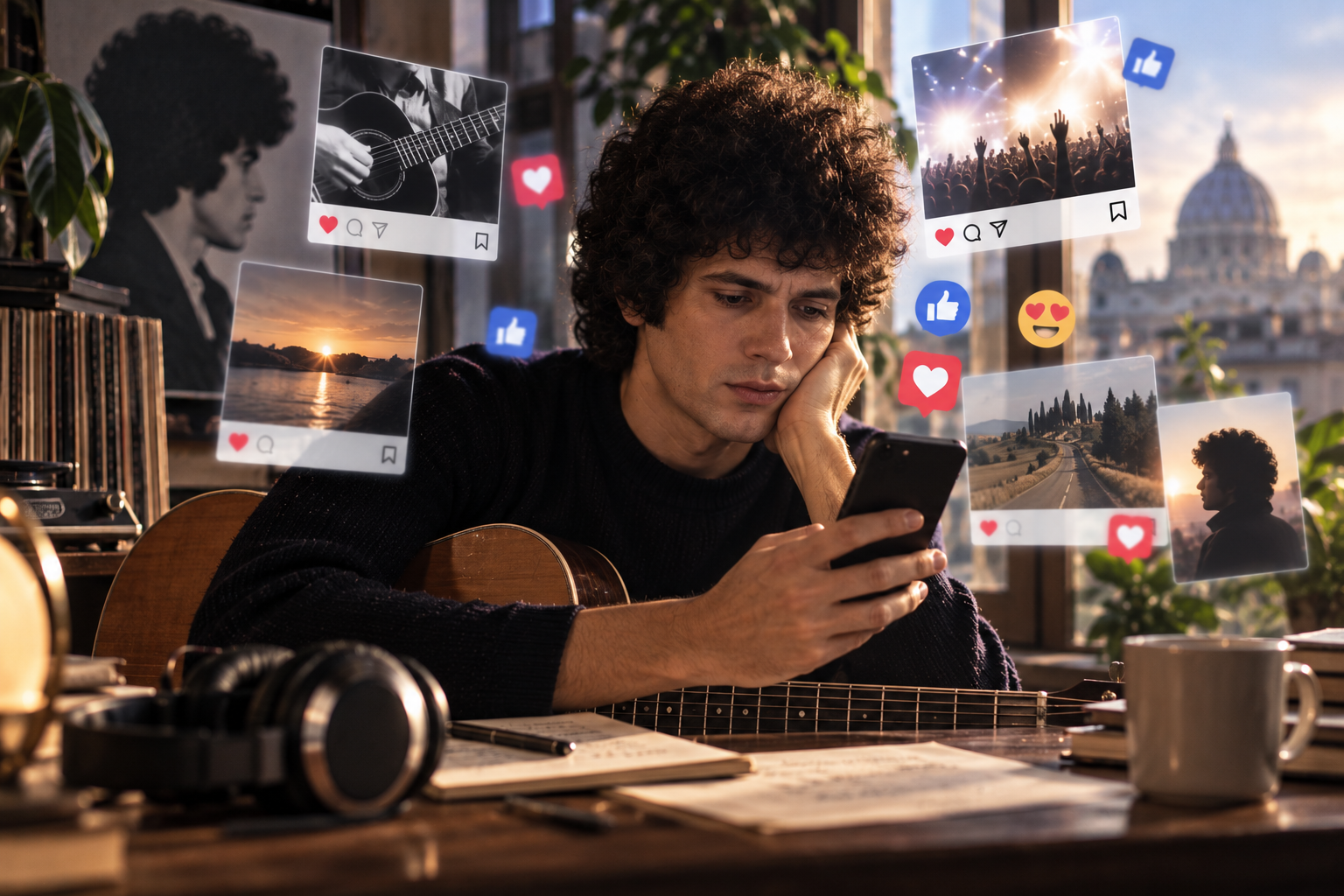
It was 15 October 1970 when Emozioni, one of the songs destined to become among the most recognisable in the history of Italian popular music, was released. Composed by Lucio Battisti with lyrics by Giulio Rapetti, known as Mogol, and released by Ricordi as the single Emozioni/Anna, the song placed at its centre a word that, fifty-six years later, remains both extraordinarily familiar and remarkably difficult to define. We all intuitively know what it means to feel an emotion, yet it becomes far more difficult to explain what actually happens within us when we experience fear, joy, anger, surprise or sadness.
Emotions can broadly be described as complex psychophysical responses through which an organism reacts to stimuli, events or representations perceived as significant, simultaneously involving subjective experience, cognitive processes, physiological changes, bodily expressions and tendencies towards action. Drawing a rigid distinction between emotions and feelings, however, is more difficult than everyday language might suggest, because definitions within the psychological literature vary according to the theoretical model adopted, and there is no universally accepted distinction whereby an emotion is simply brief and automatic while a feeling is necessarily longer-lasting and conscious.
Among the theories that have most strongly influenced contemporary culture is the one associated with the American psychologist Paul Ekman,[1] who, developing a line of research that can be traced back to Charles Darwin’s insights into the expression of emotions,[2] identified a set of emotions regarded as fundamental and focused particularly on the relationship between emotional experience and facial expressions. The best-known classification comprises happiness, sadness, fear, anger, surprise and disgust, regarded as basic emotions associated with expressive configurations recognisable across different cultures.[3] He subsequently expanded this list to include amusement, contempt, contentment, embarrassment, excitement, guilt, pride in achievement, relief, satisfaction, sensory pleasure and shame.[4]
Subsequent research has, however, produced a more complex picture, and the universality of facial expressions remains a matter of debate. Several studies have shown that culture, language and context contribute to the way in which facial signals are interpreted, calling into question any overly simple correspondence between a particular facial configuration and a single universally recognised emotion. Rather than abandoning Ekman, therefore, his work should be situated within the history of the psychology of emotion, acknowledging the enormous influence of his research without turning a scientific model into an immutable classification. It is precisely this complexity that becomes particularly interesting when emotional expression moves from the face to the screen.
When Emotion Becomes Public
What has changed profoundly is the social environment in which emotions are expressed, interpreted and reflected back by others. For much of human history, face-to-face interaction represented the primary setting in which relationships were constructed, a process in which words, silences, facial expressions, posture, tone of voice and the timing of responses all contribute simultaneously to mutual understanding. Even in the digital age, in-person interactions remain central to the formation of our closest relationships.
Social media have introduced something different. They did not invent the human need to be recognised, approved of, desired or heard, but they have made part of that need visible, quantifiable and continuously comparable.
An experience can be photographed, posted and exposed almost immediately to the reactions of dozens, hundreds or thousands of people. A romantic relationship can acquire its own public representation; professional satisfaction can become a post; a journey, a dinner, a trained body, a birth and even bereavement can enter a digital narrative in which the distinction between what is lived and what is displayed inevitably becomes more subtle.
The point is not that what is posted is necessarily false. A happy photograph may represent genuine happiness, just as sharing vulnerability may constitute a genuine request for closeness. The problem arises when a partial representation of someone else’s existence is interpreted as though it coincided with its entirety, forgetting that what we often observe is the result of selection: we see the journey rather than the ordinary day, the success rather than the failed attempts, the body in the chosen photograph rather than necessarily the body experienced every day, the happy anniversary rather than the conflicts that form part of every relationship.
Comparing Ourselves with Apparently Perfect Lives
It is within this space that social comparison acquires a new dimension. Comparing ourselves with others is certainly not a behaviour invented by Instagram or TikTok, but digital platforms allow us to do so continuously, exposing us within minutes to a quantity of other people’s lives, bodies, experiences and personal achievements that no previous generation could have observed with the same frequency.
A recent systematic review and meta-analysis, currently available as a preprint, comprising 149 observational studies and 77 experimental studies, found a significant association between so-called upward social comparison[5]—comparison with people perceived as better off or in more desirable circumstances—and several indicators of poorer psychological wellbeing, with a particularly consistent relationship with body dissatisfaction. The authors correctly emphasise that, especially in observational studies, association does not automatically imply causation. The experiments included in the review, however, strengthen the hypothesis that certain forms of upward comparison may negatively affect wellbeing.
The issue, then, is not that “everyone lies” on social media, but that each of us inevitably tends to compare the entirety of our own life with selected fragments of other people’s lives. It is a structurally asymmetrical comparison: about ourselves we also know our fears, uncertainty, bank balance, morning exhaustion, the argument that took place the previous evening and everything we would rather not show; of others, by contrast, we predominantly see what they have chosen to make visible.
The Fear of Being Somewhere Else
Within this transformation lies the phenomenon known as Fear of Missing Out, now almost universally abbreviated as FoMO. Contrary to what its everyday use might suggest, it is not merely a generational expression or a slogan born on social media. The concept has entered psychological research, and in 2013 Andrew Przybylski[6] and colleagues proposed one of its most influential scientific definitions, describing it as a persistent apprehension that others might be having rewarding experiences from which one is absent, accompanied by the desire to remain continuously connected with what others are doing. In their studies, higher levels of FoMO were associated with lower satisfaction of certain psychological needs, lower life satisfaction and greater engagement with social media.
The paradox is evident: the tools designed to allow us to remain constantly present in other people’s lives can just as constantly remind us of all the places where we are not present.
While at home, we can see who is at a party; while working, we can watch someone else travelling; while on holiday, we can encounter another person’s apparently better holiday; and even during a happy experience, we may find ourselves wondering whether something still more rewarding is happening elsewhere. Permanent connectivity does not therefore necessarily eliminate the feeling of exclusion. Under certain conditions, it may make that feeling more visible.
When the Attention Economy Meets Emotion
There is a further transformation that radically distinguishes digital communication from traditional conversation: what we see on social media is not simply what people post, but the outcome of selection and recommendation systems that determine which content receives greater visibility on the basis of multiple signals, including user interactions.
This means that emotion has not only human and relational value; it may also acquire economic value, because content capable of capturing attention, generating interaction and keeping users on a platform contributes to the economic objectives of the digital environment in which it circulates.
The simplistic claim that “algorithms want to make us angry” should be avoided: an algorithm has no psychological intentions, and recommendation systems differ across platforms and change over time. There is, however, a documented problem when ranking is optimised around engagement. A preregistered algorithmic audit published in 2025 found, in the Twitter context examined, that engagement-based ranking amplified politically more emotionally charged content and content displaying greater hostility towards out-groups compared with a chronological feed. Significantly, users did not even report preferring such content, demonstrating that what generates greater interaction does not necessarily coincide with what people say they want to see.
This distinction is crucial: what makes us react is not necessarily what makes us feel well.
The Anger That Circulates
Among the emotions that best illustrate this mechanism is anger, particularly when it takes the form of moral outrage. In 2017, a widely cited study of moral and emotional language on Twitter found that, within the sample analysed, each morally and emotionally charged word was associated with an approximately 20% increase in message diffusion, particularly within ideologically homogeneous networks. That finding was subsequently subjected to important methodological criticism, cautioning against turning an observed correlation into a general law of digital communication.
Later research nevertheless provided further evidence of interest. In a study involving more than 7,000 users and 12.7 million tweets, together with preregistered behavioural experiments, William Brady and colleagues found evidence consistent with a process of social learning: when expressions of outrage received positive social feedback, users became more likely to express outrage again in the future, while the norms of the digital group helped shape what was expressed.
Still more interesting is another consequence: not only may we express considerable outrage online, but we may perceive more of it than other people actually report experiencing. Research published in Nature Human Behaviour in 2023[7] showed that observers tended to overestimate the intensity of moral outrage experienced by the authors of certain messages, contributing to an exaggerated perception of hostility between groups.
The most sociologically interesting implication is that the digital public square may appear angrier than the society it claims to represent.
Experiencing Emotion Before an Audience
The transformation produced by social media concerns not only which emotions we express, but also the fact that we increasingly know that we are expressing them before an audience.
Long before social networks existed, Erving Goffman described social life through the theatrical metaphor of the presentation of self:[8] in different social situations, individuals regulate what they reveal about themselves, adapting behaviour, language and image to the context and to the expectations of others. Digital society did not invent this performative dimension of identity, but it has made it potentially permanent, archivable and measurable.
The audience, moreover, may be invisible. When we speak to another person face to face, their expression continuously provides information: interest, discomfort, surprise, boredom, approval. When we post content, by contrast, we address a group that may include close friends, acquaintances, colleagues, strangers and users who encounter that content only because a recommendation system has placed it before them.
The reaction comes later and is often numerical: 10 likes, 100, 10,000.
The cultural risk lies in progressively confusing the measurement of reaction with the value of the experience. A day does not become happier because the photograph representing it received a thousand likes, just as pain does not become less real because no one saw it.
Social Media Have Not Destroyed Empathy
It would, however, be scientifically inaccurate to conclude that digital communication has simply eliminated authentic dialogue and produced a generation incapable of empathy. The empirical reality is far less straightforward.
Digital platforms can allow people to maintain relationships over distance, find communities of others who share rare conditions or experiences of marginalisation, obtain support in moments of difficulty and establish relationships that might otherwise never have existed. A systematic review and meta-analysis published in 2026 on the relationship between social media use and empathy among adolescents reflects precisely the presence of two competing hypotheses: the augmentation hypothesis, according to which digital communication can expand opportunities for connection and empathy, and the social displacement hypothesis, according to which it may instead replace some face-to-face interaction and the corresponding opportunities to exercise empathy.
We are therefore not witnessing the disappearance of relationships, but their transformation. And precisely this transformation requires us to understand which forms of use promote wellbeing and which may instead intensify comparison, isolation, dependence on validation or conflict.
The Right Not to Show Everything
Perhaps it is here that the question of emotions in the age of social media becomes cultural even before it becomes technological, because we have acquired an extraordinary capacity to narrate ourselves while simultaneously risking the loss of an equally important awareness: not everything we experience necessarily has to become content.
There is psychological and relational value in intimacy that should not be confused with secrecy. Protecting an emotion does not mean being ashamed of it, just as not posting about a relationship does not mean experiencing it less intensely. It means recognising that some experiences need time before they can be narrated, and that not every pain must immediately become a post, not every happiness a photograph and not every indignation a public reaction.
Emotional time and digital time, moreover, operate according to different logics. The former may require hesitation, processing, reconsideration and even silence; the latter often rewards speed of response. A notification asks us to react now, while understanding what we feel may take hours, days or years.
True contemporary emotional competence may therefore also consist in the ability not to react immediately.
A New Emotional Literacy
The advent of social media does not, therefore, erase the authenticity of emotions, nor does it inevitably make relationships superficial. It does, however, make necessary a new form of literacy—both emotional and digital—through which we can learn to recognise what we feel before transforming it into communication, understand that the representation of another person’s life does not coincide with its entirety, accept imperfection as an ordinary feature of existence and distinguish the human need for relationships from the potentially endless search for validation.
It also means understanding how the environments in which we move actually function: knowing that the feed is not a neutral mirror of the world; that what goes viral is not necessarily what matters most; that what generates many reactions is not necessarily what produces greater wellbeing; and that a society observed exclusively through the content most strongly amplified by platforms may appear more perfect, happier, wealthier, more beautiful and, at the same time, more furious than it really is.
Fifty-six years after Emozioni, the word chosen by Mogol therefore retains all its force, but the context in which we experience those emotions has changed profoundly. We continue to fear, rejoice, desire, suffer, envy, love and become angry as human beings, while for the first time in history we possess instruments capable of transforming part of those experiences into data, content, metrics and signals that can be used to determine what we will see next.
The challenge, then, is neither to become less emotional nor to retreat nostalgically into a world before technology, but to recover a distinction that risks becoming increasingly difficult to maintain: the distinction between experiencing an emotion and representing it, sharing an experience and seeking validation for it, being connected and being genuinely in relationship with another person.
Because an emotion does not acquire value when someone clicks “like”. It exists before the screen, continues to exist when the screen goes dark and, sometimes, still needs what no algorithm can measure: time, silence and another person who is truly present.
Notes
[1] Paul Ekman (1934–2025) was an American psychologist and Professor of Psychology in the Department of Psychiatry at the University of California, San Francisco (UCSF), where he spent much of his academic career. One of the leading contemporary scholars of emotion and non-verbal behaviour, he conducted research on facial expressions, non-verbal communication and behavioural cues associated with deception, and also contributed to the development of the Facial Action Coding System (FACS).
[2] Ekman, P. (Ed.). (1973). Darwin and Facial Expression: A Century of Research in Review. New York: Academic Press.
[3] Through a series of cross-cultural studies, including research conducted among communities in New Guinea that at the time had had limited exposure to Western culture, Ekman identified evidence supporting the existence of universal components in the expression and recognition of certain emotions. These studies gave rise to the well-known classification of six basic emotions—anger, disgust, fear, happiness, sadness and surprise—associated with expressive configurations recognisable across different cultures. The universality hypothesis does not, however, exclude the influence of culture on the ways in which emotions are expressed, regulated and interpreted.
Ekman, P., Friesen, W. V., & Ellsworth, P. (1972). Emotion in the Human Face: Guidelines for Research and an Integration of Findings. New York: Pergamon Press.
[4] In 1992, Ekman further developed the basic-emotions model, discussing a broader set of emotional states and families, including amusement, contempt, contentment, embarrassment, excitement, guilt, pride in achievement, relief, satisfaction, sensory pleasure and shame. This expansion does not, however, imply that each of these emotions necessarily possesses a distinct universal facial expression.
Ekman, P. (1992). An argument for basic emotions. Cognition and Emotion, 6(3–4), 169–200. https://doi.org/10.1080/02699939208411068
[5] Hoppen, T. H., Höfer, L., Schlechter, P., Holling, H., Mutz, J., & Morina, N. (2026). Social comparisons on social media and mental health: A systematic review and meta-analysis. medRxiv [preprint]. https://doi.org/10.64898/2026.09.15.26363124
[6] Przybylski, A. K., Murayama, K., DeHaan, C. R., & Gladwell, V. (2013). Motivational, emotional, and behavioral correlates of fear of missing out. Computers in Human Behavior, 29(4), 1841–1848. https://doi.org/10.1016/j.chb.2013.02.014
[7] Goldenberg, A., & Willer, R. (2023). Amplification of emotion on social media. Nature Human Behaviour, 7, 845–846. https://doi.org/10.1038/s41562-023-01604-x
[8] Goffman, E. (1959). The Presentation of Self in Everyday Life. Garden City, NY: Doubleday.
References
Brady, W. J., Crockett, M. J., & Van Bavel, J. J. (2020). The MAD model of moral contagion: The role of motivation, attention, and design in the spread of moralized content online. Perspectives on Psychological Science, 15(4), 978–1010.
Brady, W. J., McLoughlin, K. L., Doan, T. N., & Crockett, M. J. (2021). How social learning amplifies moral outrage expression in online social networks. Science Advances, 7(33), eabe5641.
Brady, W. J., McLoughlin, K. L., Torres, M. P., Luo, K. F., Gendron, M., & Crockett, M. J. (2023). Overperception of moral outrage in online social networks inflates beliefs about intergroup hostility. Nature Human Behaviour, 7, 917–927.
Burton, J. W., Cruz, N., & Hahn, U. (2021). Reconsidering evidence of moral contagion in online social networks. Nature Human Behaviour, 5, 1629–1635.
Ekman, P. (1992). Are there basic emotions? Psychological Review, 99(3), 550–553.
Ekman, P. (Ed.). (1973). Darwin and Facial Expression: A Century of Research in Review. Academic Press.
Ekman, P., Friesen, W. V., & Ellsworth, P. (1972). Emotion in the Human Face: Guidelines for Research and an Integration of Findings. Pergamon Press.
Goffman, E. (1959). The Presentation of Self in Everyday Life. Doubleday.
Goldenberg, A., & Willer, R. (2023). Amplification of emotion on social media. Nature Human Behaviour, 7, 845–846.
Hadley, L. V., Naylor, G., & Hamilton, A. F. de C. (2022). A review of theories and methods in the science of face-to-face social interaction. Nature Reviews Psychology, 1, 42–54.
Hoppen, T. H., Höfer, L., Schlechter, P., Holling, H., Mutz, J., & Morina, N. (2026). Social comparisons on social media and mental health: A systematic review and meta-analysis. medRxiv [preprint].
Jack, R. E., Garrod, O. G. B., Yu, H., Caldara, R., & Schyns, P. G. (2012). Facial expressions of emotion are not culturally universal. Proceedings of the National Academy of Sciences, 109(19), 7241–7244.
McDonald, E. M., Tobin, K. E., Cooper, A. M., & Tully, E. C. (2026). A systematic review and meta-analysis of social media use and empathy in adolescence. Journal of Adolescence, 98(3), 643–658.
Przybylski, A. K., Murayama, K., DeHaan, C. R., & Gladwell, V. (2013). Motivational, emotional, and behavioral correlates of fear of missing out. Computers in Human Behavior, 29(4), 1841–1848.
Russell, J. A. (1995). Facial expressions of emotion: What lies beyond minimal universality? Psychological Bulletin, 118(3), 379–391.
FIVE LATEST CONTRIBUTIONS ON SOCIOLOGY
Sacred Disintermediation and Religious Control
The Drama of Loneliness in Contemporary Societies
Woman, Male Sensitivity, and Divine Mercy
The Spectacularization of Pain in the Contemporary Mediapoli
FIVE LATEST CONTRIBUTIONS
Emma Bonino: Freedom Against the Morality Imposed by Others
From Rights to Practice: When the Community Takes Responsibility for the Future
2001–2026: Twenty-Five Years of the War on Terror
Ethica Societas is a free, non-profit review published by a social cooperative non-profit organization
Copyright Ethica Societas, Human&Social Science Review © 2026 by Ethica Societas UPLI onlus.
ISSN 2785-602X. Licensed under CC BY-NC 4.0