


From the dream of connecting the world to the crisis of human relationships

Abstract: With The Social – The Price of Truth, released in Italian cinemas on 8 October 2026, director and screenwriter Aaron Sorkin once again examines the role of social networks in contemporary society, addressing the psychological, cultural, and political consequences of a communication system that, initially conceived with the promise of bringing people closer together, has progressively acquired extraordinary influence over the formation of opinions, the dissemination of information, and the shaping of collective behaviour. Drawing on the real-life experience of Frances Haugen, a former Facebook employee who helped bring internal company documents to public attention, the film explores the contradictions inherent in an economic model based on the monetisation of attention and the capacity of algorithms to select and prioritise content according to user engagement. What emerges is a reflection that extends beyond technological criticism to encompass fundamental questions concerning individual freedom, the protection of minors, the quality of human relationships, and the social responsibility of digital corporations, thereby reaffirming cinema’s role as a medium of knowledge, critical reflection, and civic awareness.
Keywords: #TheSocial #AaronSorkin #Cinema #SocialNetworks #Facebook #Meta #FrancesHaugen #Algorithms #SocialPsychology #DigitalManipulation #Disinformation #Democracy #SocialResponsibility #DigitalCulture #FedericaDarpino #EthicaSocietas #EthicaSocietasJournal #ScientificJournal #SocialSciences #ethicasocietasupli
From the dream of connecting the world to the crisis of human relationships
There is something profoundly unsettling about the realisation that one of the technological innovations which, perhaps more than any other, promised to bring people closer together, overcome geographical distances, and make communication accessible to everyone has, within the space of only a few years, also become an environment in which loneliness, aggression, disinformation, and social polarisation flourish, ultimately transforming what once appeared to be an extraordinary opportunity for collective participation into one of the most complex challenges facing contemporary society.
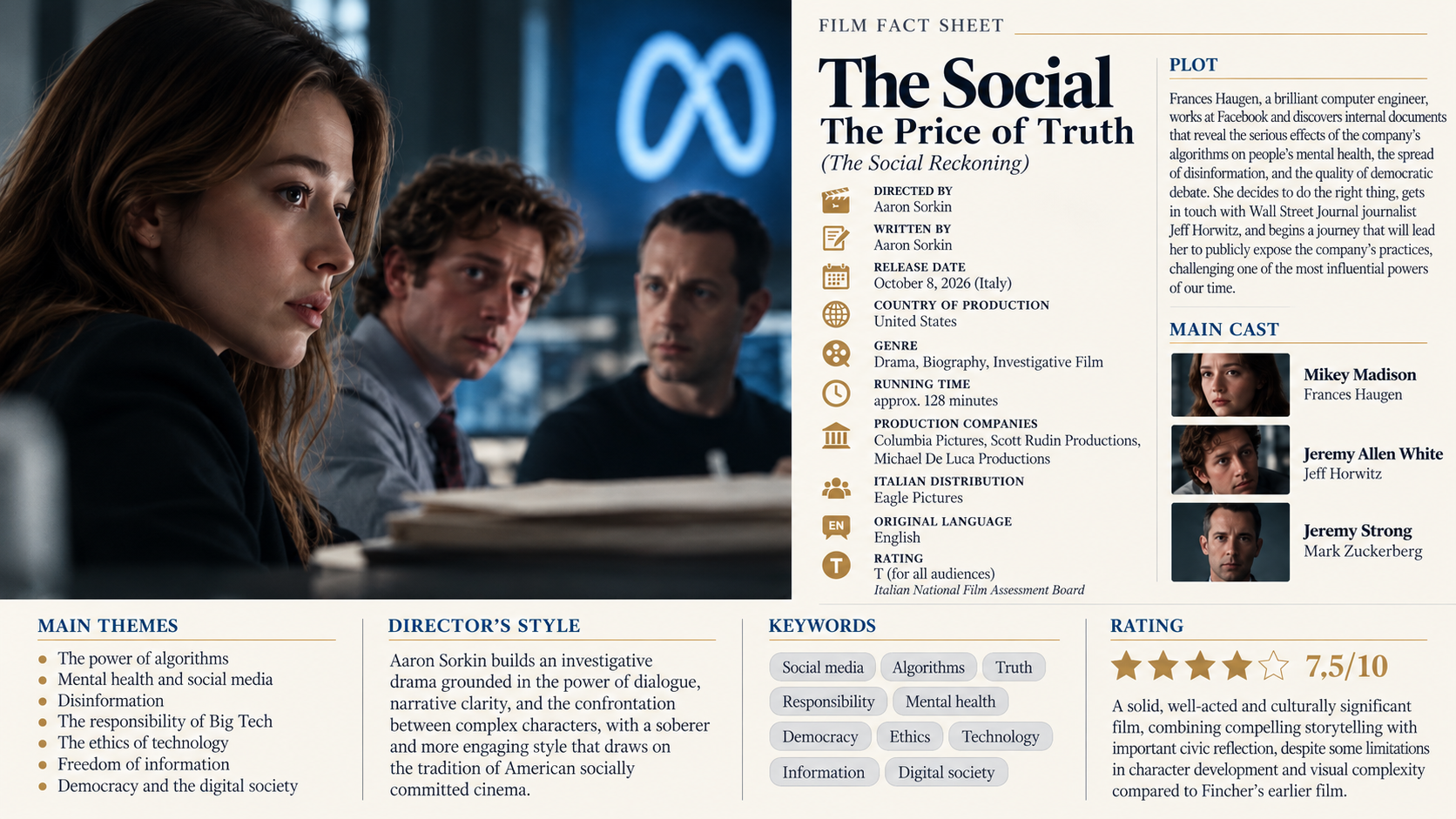
It is precisely this contradiction that lies at the heart of The Social – The Price of Truth, the new film written and directed by Aaron Sorkin, who returns to the world of Facebook sixteen years after The Social Network, the 2010 film directed by David Fincher and written by Sorkin himself, which portrayed the origins of a company destined to profoundly transform the ways in which people communicate, establish relationships, and participate in public life.
Whereas the earlier film explored the ambition, talent, and personal contradictions that accompanied Facebook’s emergence, this new work examines its social consequences, placing at the centre of the narrative not merely Mark Zuckerberg’s entrepreneurial success, but, more importantly, the responsibility borne by those who created and continue to govern a digital environment used daily by billions of people.
This shift is particularly significant because it also reflects a broader cultural transformation in which technology no longer functions simply as an instrument available to individuals, but increasingly constitutes an environment capable of influencing their perceptions, emotions, and even the processes through which they interpret reality.
The truth concealed behind algorithms
The film draws inspiration from the experience of Frances Haugen, portrayed by Mikey Madison, the former Facebook employee who, in 2021, helped bring internal corporate documents into the public domain, revealing significant concerns regarding the platform’s operation and the company’s internal awareness of the potentially harmful consequences associated with certain organisational and technological decisions.
Alongside her is The Wall Street Journal journalist Jeff Horwitz, portrayed by Jeremy Allen White, who undertakes the reconstruction of a case that would contribute to an international debate concerning the relationship between the economic interests of major digital platforms, user safety, and the accountability of technology corporations.
Sorkin chooses to tell this story through the conventions of investigative cinema, constructing a narrative in which dramatic tension arises not only from the gradual disclosure of documents and information, but above all from the growing awareness that decisions which appear to be merely technical may conceal profound consequences for people’s lives.
The central issue concerns the operation of algorithmic systems that determine which content receives greater visibility, which news reaches users, and which messages are most likely to attract attention, through mechanisms that may ultimately privilege material capable of provoking intense emotional reactions over content that encourages balanced understanding and informed reflection.
This does not imply that every piece of content disseminated through social networks is manipulative, nor that users lack the capacity to make autonomous choices; rather, it requires acknowledging that the digital environment in which such choices are made is not neutral, since it operates according to criteria of selection and prioritisation established by private entities that also pursue legitimate economic objectives.
It is precisely in the balance between these interests and the protection of individuals that one of the film’s most significant ethical questions emerges.
The psychology of attention and the need for recognition
One of the most compelling aspects of the reflection developed in The Social concerns the psychological dimension of the relationship between individuals and digital platforms, since the success of social networks cannot be explained solely through technological innovation, but must also be understood in relation to profoundly human needs, including the desire for belonging, the pursuit of approval, the need to be heard, and the search for social recognition.
The possibility of receiving an immediate reaction, comment, or share may become a form of gratification that encourages the repetition of particular behaviours, especially when the system tends to increase the visibility of content capable of eliciting intense emotional responses.
Within this context, indignation, fear, and anger may become particularly effective instruments for capturing attention, reinforcing dynamics in which dialogue is progressively replaced by confrontation and the complexity of social issues is reduced to immediate messages that frequently fail to convey the nuances of reality.
The risk concerns not only the dissemination of inaccurate information, but also the gradual transformation of human relationships, since, when communication is assessed primarily according to the number of reactions it generates, the value of an idea may become confused with its popularity, while listening and understanding others lose their centrality in favour of the need to assert one’s position publicly.
This transformation particularly affects younger generations, whose personal identities are also constructed through their digital presence and continuous exposure to images, judgements, and behavioural models that may influence both their self-perception and their relationships with others.
The film therefore encourages reflection on a fundamental question, since a society in which attention becomes an economic resource risks overlooking the fact that behind every digital interaction stands a human being, with individual sensitivities, vulnerabilities, and a fundamental need to establish authentic relationships.
Cinema as an instrument of civic awareness
From a cinematic perspective, Aaron Sorkin once again demonstrates his ability to transform complex events, seemingly ill-suited to the big screen, into compelling narratives sustained by the strength of dialogue, interpersonal confrontation, and a dramatic tension that guides viewers towards a progressively deeper understanding of the events portrayed.
Mikey Madison conveys the complexity of Frances Haugen as a woman confronted with a difficult decision, in which professional loyalty comes into conflict with an awareness of the potential social consequences of the information she has acquired, while Jeremy Allen White portrays the journalist committed to uncovering a truth that concerns not merely a private corporation, but the collective interest.
Particularly significant is Jeremy Strong’s portrayal of Mark Zuckerberg, a figure who, within the film’s narrative, assumes the symbolic significance of technological and economic power capable of profoundly influencing society without being subject to the same forms of political accountability that characterise democratic institutions.
The film is not, however, without limitations, since its determination to make the moral dimension of the story immediately recognisable occasionally leads to the simplification of certain contradictions, leaving less room for the ambiguities that might have produced a more nuanced representation of the relationships between innovation, business interests, and responsibility.
Nevertheless, the work’s principal strength lies in its ability to make accessible an issue that is frequently addressed through exclusively technical language, demonstrating how cinema can contribute to the development of collective critical awareness without relinquishing its narrative and emotional dimensions.
It is not necessary to agree with every interpretative choice made by the director to recognise the cultural significance of a film that encourages viewers to question technologies which have become firmly embedded in everyday life, but whose underlying mechanisms and consequences are rarely subjected to sustained critical examination.
Platform accountability and the future of digital freedom
Ultimately, the central question running through The Social – The Price of Truth concerns the very meaning of responsibility in the digital age, since freedom of communication and expression constitutes a fundamental achievement of democratic societies, yet cannot be separated from the need to understand the mechanisms through which opinions are disseminated, amplified, and transformed into collective phenomena.
Attributing all responsibility to digital platforms would mean underestimating the role played by individuals, institutions, and cultural contexts in shaping particular behaviours, while treating social networks as merely neutral instruments would mean disregarding the power exercised by those who establish their operating rules and determine the criteria governing content visibility.
Responsibility must therefore be shared, albeit according to the different roles involved, among technology corporations, public institutions, educational systems, and citizens, through greater transparency in algorithmic processes, effective protection of the most vulnerable individuals, and cultural and educational initiatives capable of fostering critical awareness in the use of digital technologies.
From this perspective, the objective is not to demonise social networks, which continue to represent extraordinary instruments of communication, knowledge, and participation, but rather to restore the centrality of the individual within systems in which economic success risks being measured independently of the quality of the relationships and information they generate.
The Italian title, The Price of Truth, evokes precisely the difficulty of exposing contradictions involving enormous economic interests, while also suggesting a deeper reflection on the price that society may be required to pay when it relinquishes its capacity to critically examine the instruments through which it constructs its understanding of the world.
The phrase “We have gone too far”, associated with the film’s promotion, thus acquires a significance that extends beyond the specific circumstances surrounding Facebook and becomes a question addressed to contemporary society as a whole, since technological progress does not necessarily coincide with human progress, and the possibility of remaining constantly connected does not, in itself, guarantee a greater capacity to understand others.
Perhaps this is the most important reflection the film leaves with its audience, reminding us that the defining challenge of our time is not merely to develop increasingly powerful technologies, but to preserve our capacity to govern them without losing those qualities that make our relationships, freedom of thought, and sense of responsibility towards others authentically human.
Essential references
Sorkin, A. (Director and Screenwriter). (2026). The Social Reckoning (The Social – The Price of Truth). Columbia Pictures, United States.
Haugen, F. (2023). The Power of One: How I Found the Strength to Tell the Truth and Why I Blew the Whistle on Facebook. Little, Brown and Company.
Horwitz, J. (2023). Broken Code: Inside Facebook and the Fight to Expose Its Harmful Secrets. Doubleday.
Zuboff, S. (2019). The Age of Surveillance Capitalism: The Fight for a Human Future at the New Frontier of Power. PublicAffairs.
European Parliament and Council of the European Union. (2022). Regulation (EU) 2022/2065 of 19 October 2022 on a Single Market for Digital Services and amending Directive 2000/31/EC (Digital Services Act). Official Journal of the European Union, L 277, 1–102.
FIVE LATEST CONTRIBUTIONS BY THE SAME AUTHOR
International Week of Deaf People: From Accessibility to Full Citizenship
When Possession Is Mistaken for Love
Nabucco at the Verona Arena: When Opera Transcends into Vision
Dreaming on the Tiber Between Culture, Elegance and Solidarity
FIVE LATEST CONTRIBUTIONS ON SOCIAL TEMATICS
From Rights to Practice: When the Community Takes Responsibility for the Future
Gender-based Violence and Economic Abuse
Psychological Violence and the Instrumentalization of Children in Conflictual Family Relationships
The Brain Held Hostage: the Neurochemical Hijacking of Domestic Violence
FIVE LATEST CONTRIBUTIONS
Circular Economy: The Physical Limits of an Imperfect Circle
Anna Politkovskaya: Twenty Years After Her Murder, the Truth Remains Incomplete
Geography of vulnerability and regional security in the Horn of Africa
16 October: The Return of Antisemitism
Data: The New Capital of Organised Crime
Ethica Societas is a free, non-profit news publication published by a non-profit social cooperative
Copyright Ethica Societas, Human&Social Science Review © 2026 by Ethica Societas UPLI onlus.
ISSN 2785-602X. Licensed under CC BY-NC 4.0