


The deportation of Rome’s Jews in 1943 and the new forms of anti-Jewish hatred between historical memory, identity conflicts, political radicalisation and the transformations of contemporary society

Abstract: 16 October 1943 represents one of the darkest chapters in contemporary Italian history, when Nazi occupation forces carried out a systematic round-up of Rome’s Jewish population, leading to the deportation of more than one thousand people, most of whom were subsequently murdered at Auschwitz-Birkenau. Eighty-three years after those events, the anniversary assumes particular significance in light of the growing prevalence of antisemitism across European societies, a phenomenon which, while retaining elements of continuity with the religious, racial and conspiratorial prejudices of the past, exhibits new forms of expression associated with digital communication, political polarisation and the transformation of the Israeli-Palestinian conflict into a source of identity-based confrontation. The analysis reconstructs the historical context of the deportation of Roman Jews and examines the principal sociological characteristics of contemporary antisemitism, distinguishing legitimate criticism of the policies of the State of Israel from forms of hostility that attribute collective responsibility to Jewish people or reproduce discriminatory stereotypes. Drawing on data from the Foundation for Contemporary Jewish Documentation and the European Union Agency for Fundamental Rights, the study investigates the mechanisms through which hatred becomes normalised, the role of digital environments, the relationship between Holocaust remembrance and collective identity, and the need to develop educational, cultural and institutional measures capable of combating antisemitism without restricting freedom of democratic debate.
Keywords: #16October1943 #Deportation #JewsOfRome #Holocaust #Antisemitism #HistoricalMemory #Sociology #Discrimination #HumanRights #Israel #Palestine #OnlineHate #Democracy #Constitution #MassimilianoMancini #EthicaSocietas #EthicaSocietasReview #ScientificJournal #Humanities #SocialSciences #EthicaSocietasUPLI
16 October 1943 and the deportation of Rome’s Jews
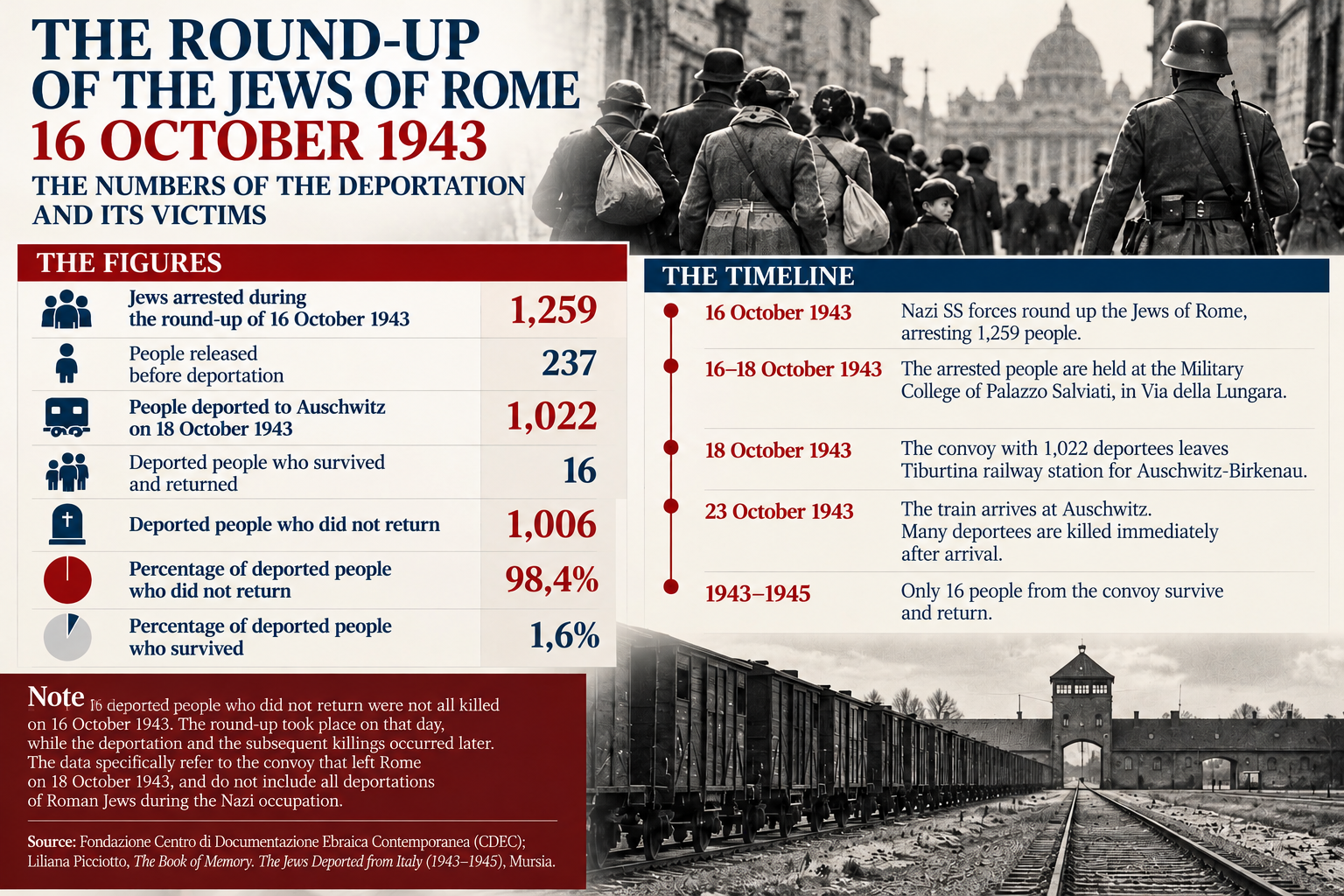
At dawn on 16 October 1943, while Rome was under German military occupation following the armistice of 8 September, units of the Nazi forces launched a systematic operation to arrest the capital’s Jewish population, entering homes, disrupting the everyday lives of entire families and subjecting men, women, elderly people and children to persecution based exclusively on their Jewish identity. The operation, remembered collectively as the round-up of the Roman Ghetto, actually extended to several districts of the city and represented one of the most significant episodes in the deportation of Jews from occupied Italy, forming part of the wider system of persecution and extermination organised by the National Socialist regime.
The round-up was neither a sudden occurrence nor an event that can be interpreted exclusively as a consequence of the German occupation, since it developed within a context in which Italy’s Jewish population had progressively been deprived of rights and legal protections through the Fascist racial legislation of 1938, while the subsequent military occupation and collaboration of the Italian Social Republic brought about the transition from institutional discrimination to systematic persecution, arrests and deportation.
Those arrested were initially assembled at the Military College in Palazzo Salviati, on Via della Lungara, before being transferred to Tiburtina railway station, from which the train bound for Auschwitz-Birkenau departed on 18 October. According to the generally accepted historical reconstruction, 1,259 people were arrested during the operation, of whom 1,022 were deported following the release of the remaining detainees. Among those deported, including numerous children, only 16 survived and returned, while 1,006 never came back from the Nazi camps.
Although indispensable to understanding the scale of the tragedy, its quantitative dimension cannot fully convey the complexity of the victims’ experiences, since behind every arrest lay family relationships, professional lives, cultural affiliations and individual histories that the persecution sought to erase by reducing human beings to a racial category. The presence of children and elderly people among the deportees demonstrates with particular clarity the nature of Nazi violence, directed not against individual conduct or established responsibility, but against the very existence of a community identified as incompatible with the political and social order pursued by the regime.
The memory of that day has been preserved through testimonies, archival documentation and historical research that have made it possible to reconstruct responsibilities, operational procedures and the consequences of deportation, progressively restoring identities and biographies to those who were persecuted. Particularly important in this process are the studies conducted by the Foundation for Contemporary Jewish Documentation (CDEC), the activities of the Jewish Museum of Rome and the work of cultural institutions dedicated to preserving the memory of the Holocaust.
Eighty-three years later, the significance of the anniversary therefore extends beyond commemorating the victims, calling for an understanding of the processes through which a society can progressively accept discrimination, incorporate it into its institutions and ultimately regard the exclusion of part of its population from the community of rights as legitimate.
The racial laws and the institutional construction of discrimination
The persecution of Italian Jews constitutes one of the most significant examples of the transformation of prejudice into a legal system, since the Fascist regime, through the measures introduced in 1938 and particularly Royal Decree-Law No. 1728 of 17 November 1938, established a system of racial classification that progressively restricted the civil, economic and social rights of those considered to belong to the so-called Jewish race. Exclusion from teaching, the removal of Jewish pupils from schools, restrictions on access to public employment and limitations concerning marriage and property contributed to establishing a condition of institutionalised separation in which citizenship ceased to provide a uniform guarantee of belonging to the political community.
The historical significance of this legislation lies in the state’s ability to confer an appearance of legal objectivity upon categories founded on racist ideology, transforming a political and cultural construct into an administrative criterion for differentiating between individuals. Persecution thus developed through a process in which public authority, rather than guaranteeing equality among citizens, became the instrument of their separation, altering not only the legal position of the Jewish minority but also the wider social perception of its belonging to the national community.
The responsibility of Italian Fascism must therefore be regarded as an essential component of the historical reconstruction of the Holocaust, without conflating the different stages of persecution or indiscriminately attributing every operational responsibility to the same actors. The round-up of 16 October was organised and carried out by Nazi forces, but occurred within a context in which Italian racial legislation had already identified, classified and marginalised the Jewish population, while the subsequent collaboration of the Italian Social Republic’s institutions contributed to the arrest and deportation of numerous Jews during the occupation.
Particularly significant in this respect is the administrative dimension of persecution, since access to population registers and documentation concerning discriminated individuals could facilitate the identification of those targeted by repressive measures, demonstrating how instruments ordinarily intended to organise collective life can become mechanisms of systematic rights violations when subordinated to discriminatory objectives.
The case therefore raises an issue extending beyond the particular historical circumstances of Fascism and National Socialism, without diminishing the distinctive criminal character of those regimes, concerning the relationship between formal legality and the substantive legitimacy of public action, since the existence of a legal provision does not in itself guarantee its conformity with the principles of dignity, equality and justice upon which a democratic legal order must be founded.
The normalisation of discrimination and the role of social indifference
Sociological reflection on antisemitism provides an opportunity to examine the relationship between the spread of prejudice, institutional legitimisation and the progressive normalisation of discriminatory practices, demonstrating how persecution does not necessarily require the entire population to embrace a violent ideology explicitly, but may develop through interaction between institutions of power, radicalised social groups and sections of society that, through conformity, opportunism, fear or indifference, fail to resist the progressive exclusion of minorities.
Indifference cannot automatically be equated with criminal complicity, since individual responsibility must be assessed in light of the actual possibilities for choice and the historical circumstances in which behaviour occurs. Nevertheless, it can contribute to reducing social resistance to discrimination, particularly when persecutory measures are introduced gradually and presented as ordinary instruments for regulating public life.
The exclusion of Italian Jews from schools, public administration and numerous professions between 1938 and 1943 demonstrates how the loss of rights may be accompanied by processes of collective adaptation, in which decisions initially perceived as exceptional are progressively incorporated into everyday life, altering social expectations and making a separation resulting from deliberate political choices appear natural.
Particularly relevant in this context is the work of Zygmunt Bauman, who, in Modernity and the Holocaust, examined the relationship between administrative modernity and genocidal violence, demonstrating that the Holocaust cannot be understood exclusively as the product of irrationality external to modern society, since its organisation also involved systems of classification, bureaucratic rationalisation, the division of responsibilities and the coordination of procedures.
Applying this perspective to the round-up of Roman Jews helps explain how identifying individuals, organising arrests and arranging railway transport required a series of coordinated activities through which ideological violence was translated into administrative and logistical operations, contributing to the creation of a distance between the performance of individual tasks and responsibility for their overall consequences.
The memory of 16 October therefore draws attention not only to explicit expressions of hatred, but also to the processes through which discrimination can progressively become embedded in ordinary social practices, ultimately undermining the capacity of institutions and citizens to recognise the erosion of the fundamental principles of coexistence.
Contemporary antisemitism between historical continuities and social transformations
Contemporary antisemitism exhibits characteristics that make it necessary to distinguish between the persistence of historically established representations and the transformation of the contexts in which they are reproduced, since the defeat of National Socialism did not eliminate anti-Jewish prejudice, but partly changed its language, forms of expression and environments of dissemination.
Religious stereotypes, conspiratorial representations, Holocaust denial or minimisation, and the attribution to Jews of supposed collective power over political, economic and cultural institutions continue to constitute recurring elements of antisemitism, even when expressed through apparently new formulations or incorporated into narratives that do not explicitly invoke the ideological traditions from which they originate.
The expression new antisemitism is frequently employed to describe certain contemporary manifestations of the phenomenon, particularly when hostility towards Jewish people becomes intertwined with international controversies and forms of political mobilisation that attribute collective responsibility to Jewish communities for decisions taken by the State of Israel. The category nevertheless requires interpretative caution, since it risks suggesting a more pronounced discontinuity than the evidence supports, whereas many contemporary representations reproduce stereotypes already present in European history, adapting them to different communicative and political contexts.
The portrayal of Jews as a group supposedly capable of controlling international finance, manipulating information or secretly influencing government decisions constitutes, for example, a reworking of conspiratorial representations that have permeated modern antisemitism and found one of their best-known expressions in the historical forgery The Protocols of the Elders of Zion. Its continued circulation demonstrates how baseless narratives can retain the capacity to mobilise support even after having been extensively discredited.
Antisemitism may today emerge within neo-Nazi and supremacist environments, conspiracy movements, certain forms of religious extremism and political contexts in which the Middle Eastern conflict is used to justify hostility towards Jewish individuals and institutions. These manifestations should not be regarded as ideologically equivalent, since they originate in different cultural traditions and reflect specific motivations, but they may converge in constructing an image of Jews as collectively responsible for political, economic or social developments perceived negatively.
The discriminatory character becomes apparent precisely when religious, cultural or identity-based belonging replaces the assessment of individual responsibility, transforming different individuals into a collective entity to which behaviours, intentions or blame are attributed irrespective of their actual conduct.
Antisemitism in Italy and the sociological interpretation of the data
The contemporary dimensions of antisemitism emerge from data collected by the Antisemitism Observatory of the Foundation for Contemporary Jewish Documentation, which continuously monitors reported incidents and analyses their principal characteristics, contributing to empirical understanding of a phenomenon that manifests itself in different ways, with varying degrees of severity and across different social contexts.
According to the annual report covering 2025, published in March 2026, the Observatory received 1,492 reports, of which 963 were classified as antisemitic incidents, comprising 643 online manifestations and 320 incidents occurring outside digital environments. Comparison with previous years reveals a significant increase in recorded incidents, rising from 241 in 2022 to 453 in 2023, then to 877 in 2024 and 963 in 2025, representing an increase of approximately 10% in the most recent year and an overall figure approaching four times that recorded in 2022.
Interpreting these figures nevertheless requires several methodological qualifications, since incidents known to, reported to and classified by the Observatory do not constitute an exhaustive measurement of every antisemitic manifestation occurring throughout Italy, while trends in recorded incidents may also be influenced by victims’ willingness to report, increased public awareness and developments in monitoring methods. These considerations do not diminish the significance of the phenomenon, but help prevent statistically inappropriate interpretations by distinguishing the increase in documented incidents from a direct measurement of the prevalence of prejudice throughout the population.
Particularly significant is the qualitative dimension described in the report, which identifies an increase in discrimination and physical assaults compared with the previous year and documents situations in which some Jewish individuals face growing difficulties in openly expressing their identity in public spaces, universities, workplaces and everyday social settings.
From a sociological perspective, antisemitism cannot therefore be regarded exclusively as a collection of individual beliefs or verbal expressions, since the perception of a hostile environment may concretely alter behaviour, leading individuals to avoid certain places, conceal religious symbols or restrict expressions of cultural belonging in order to reduce the risk of intimidation and discrimination.
The transition from the existence of prejudice to the effective restriction of individual freedoms constitutes one of the most significant aspects of the phenomenon, demonstrating how legally recognised equality may prove insufficient when social conditions do not allow everyone to exercise their rights with comparable levels of security and autonomy.
Antisemitism in Europe and the perception of insecurity
The transformations of antisemitism affect numerous European societies, as demonstrated by surveys conducted by the European Union Agency for Fundamental Rights, which in July 2024 published the results of its third survey on the experiences and perceptions of Jewish people living in thirteen Member States, home to the great majority of the European Union’s Jewish population.
The research, conducted through an online questionnaire between January and June 2023, before the terrorist attacks carried out by Hamas on 7 October and the subsequent war in the Gaza Strip, revealed an already widespread perception of antisemitism as a significant social problem, with 84% of respondents considering it a major problem in their country, 80% believing it had increased over the preceding five years and 96% reporting having encountered manifestations of antisemitism during the previous year.
Furthermore, 91% of respondents identified online antisemitism as a significant problem, while a substantial proportion reported exercising caution when expressing their Jewish identity, outlining circumstances in which the perception of threat may influence individual choices even in the absence of personally experienced assaults.
Interpreting these findings requires consideration of the survey’s methodological characteristics, avoiding the automatic extension of its percentages to the entire European Jewish population. Nevertheless, the convergence between reported experiences, perceptions of risk and changes in behaviour reveals a sociological dimension extending beyond the mere recording of discriminatory incidents.
When religious or cultural identity is perceived as a potential source of exposure to violence, individuals may develop adaptive strategies intended to reduce their visibility, resulting in an indirect restriction of social participation that assumes particular significance in democratic legal systems founded on pluralism and equality.
The protection of minorities therefore concerns not only the absence of formally recognised discrimination, but also the practical possibility of participating in collective life without having to relinquish the expression of one’s identity.
The Israeli-Palestinian conflict and the distinction between political responsibility and identity-based belonging
The relationship between contemporary antisemitism and the Israeli-Palestinian conflict constitutes a particularly complex issue, since it simultaneously involves minority protection, freedom of expression, international law and differing interpretations of national and religious identities, requiring an analytical approach capable of distinguishing phenomena that are frequently conflated in public debate.
The terrorist attacks carried out by Hamas against Israel on 7 October 2023, involving the killing of civilians and the taking of hostages, and the subsequent war in the Gaza Strip, characterised by an extremely serious humanitarian crisis and international controversies concerning Israeli military operations and compliance with international law, contributed to intensifying political polarisation, encouraging in some contexts a representation of collective affiliations as mutually incompatible identities.
From a sociological perspective, the principal risk lies in transforming national, religious or cultural identity into a criterion for attributing responsibility, whereby individuals who have not participated in particular decisions are considered jointly responsible for actions carried out by governments, political organisations or armed groups.
Jewish people cannot be held responsible for decisions taken by Israeli authorities, just as the Palestinian population cannot be collectively identified with the actions of Hamas, since individual responsibility is a fundamental principle of democratic coexistence and cannot be replaced by assumptions based on identity.
Criticism of the policies of the State of Israel, including those concerning settlements in the occupied Palestinian territories, military operations, civilian protection and compliance with international law, falls entirely within legitimate political and legal debate. Such criticism becomes antisemitic when it attributes collective responsibility to Jewish people, reproduces discriminatory stereotypes or justifies hostility and aggression against Jewish individuals and institutions because of their identity.
The International Holocaust Remembrance Alliance’s working definition recognises that criticism of Israel comparable to that directed at other states does not in itself constitute antisemitism, while identifying certain ways in which political discourse may incorporate anti-Jewish representations. The application of this definition is the subject of scholarly and legal debate, particularly concerning the need to identify discrimination effectively without undermining academic freedom or the legitimacy of debate about state policies.
Similar interpretative caution is required when examining the relationship between Zionism, anti-Zionism and antisemitism, since Zionism encompasses different historical traditions and political orientations, while critical positions towards it cannot automatically be regarded as antisemitic, although they may acquire that character when they reproduce anti-Jewish stereotypes, attribute collective responsibility or transform a political controversy into hostility towards Jewish people.
The distinction between political criticism and identity-based discrimination is therefore not a rhetorical device, but an essential condition for maintaining public debate within the principles of democratic pluralism, recognising both the legitimacy of protecting Jewish people and that of claims grounded in the rights of the Palestinian population.
The memory of the Holocaust cannot be used to exempt the decisions of any state from critical scrutiny, just as criticism of a state’s decisions cannot legitimise hostility towards an entire religious or cultural community, since the defence of human dignity loses its universal foundation when subordinated to political or identity-based affiliations.
The digitalisation of hatred and the transformation of radicalisation processes
The spread of digital platforms has changed the ways in which prejudices are produced, shared and progressively normalised, creating communicative environments in which the speed of content circulation, the formation of ideologically homogeneous communities and the possibility of reproducing messages without verifying their origins may encourage the amplification of discriminatory representations.
Online antisemitism is not simply a technological reproduction of earlier phenomena, since digital environments can alter the conditions of communication, reduce individuals’ perception of the consequences of their statements and encourage mutual legitimisation within groups sharing hostile narratives about particular minorities.
Conspiracy theories occupy a particularly important position within these processes, since they offer apparently coherent explanations for complex economic and political developments by identifying a particular human group as supposedly responsible for crises, conflicts and social transformations, while the repetition of the same representations within relatively closed communicative communities may reinforce their perceived credibility.
The portrayal of Jews as possessing hidden power constitutes one of the most persistent stereotypes of modern antisemitism and may be reproduced through symbols, images, allusions and communicative codes that do not necessarily refer explicitly to the Nazi tradition, making the discriminatory nature of the content more difficult to recognise immediately.
These processes are compounded by the progressive erosion of the boundary between information, propaganda and entertainment, since decontextualised images, manipulated reconstructions and artificially generated content may facilitate the circulation of baseless narratives, while generative artificial intelligence further expands the possibilities for producing and disseminating audiovisual material that is difficult to verify.
It would nevertheless be incorrect to attribute responsibility for the growth of antisemitism exclusively to digital technologies, since platforms operate within pre-existing social and political contexts and may amplify dynamics originating in economic transformations, identity conflicts and declining trust in institutions.
Prevention therefore requires an approach integrating platform accountability, legal protection mechanisms, media and information literacy, and users’ critical thinking, avoiding both the underestimation of the consequences of online hatred and the adoption of indiscriminate measures that could undermine freedom of expression.
Antisemitism as the construction of a scapegoat in contemporary societies
Antisemitism can also be examined through the sociological concept of scapegoating, understood as a process through which collective tensions, fears and frustrations are transferred onto a group identified as responsible for problems that actually arise from complex economic, political and social transformations.
Contemporary societies are undergoing processes of change characterised by the globalisation of markets, the digitalisation of social relations, transformations in employment and a growing perception of distance between citizens and institutions. These conditions may encourage feelings of insecurity and loss of control, making narratives that identify simple and immediately recognisable sources of responsibility particularly attractive.
Antisemitism possesses a distinctive characteristic compared with other forms of discrimination, since it can simultaneously portray Jews as a minority alien to the national community and as a group supposedly exercising disproportionate power over institutions, constructing a symbolic figure in which attributed marginality and imagined influence coexist without this contradiction necessarily diminishing the prejudice’s persuasive capacity.
The representation of hidden Jewish power thus allows structural developments to be attributed to a collective subject, transforming social uncertainty into identity-based hostility and replacing analysis of actual responsibilities with explanations founded on discriminatory assumptions. The appeal of conspiracy theories does not depend on their logical coherence, but on their capacity to offer an interpretative order to individuals who perceive social reality as unpredictable, while the repetition of such narratives may consolidate beliefs that are difficult to change through the mere refutation of individual claims.
From this perspective, preventing antisemitism cannot be limited to morally condemning its most explicit expressions, but must also include the promotion of cultural and educational tools capable of recognising processes through which otherness is constructed, understanding social transformations and distinguishing documented responsibilities from ideological representations.
Holocaust remembrance between commemoration and critical understanding
The commemoration of 16 October raises a fundamental question concerning the relationship between historical memory and civic awareness, since the growing prominence of the Holocaust in European public culture has contributed to consolidating recognition of the crimes of National Socialism and the responsibilities of regimes involved in persecution, without automatically eliminating anti-Jewish prejudice.
The establishment of commemorative days, the creation of museums and memorials, and the inclusion of the history of persecution in school curricula have represented important stages in constructing a shared public memory. However, commemorative practices may lose some of their effectiveness when the repetition of rituals is not accompanied by a thorough understanding of the historical and social processes that made discrimination possible.
Remembering 16 October 1943 certainly means paying tribute to those deported and murdered, but it also requires reconstructing the role of racial legislation, administrative institutions, repressive apparatuses and social conditions that contributed to the progressive exclusion of Jews from the national community, avoiding a representation of the tragedy exclusively as the result of exceptional violence entirely detached from society’s ordinary mechanisms.
Historical and sociological research instead makes it possible to understand the relationship between classification, dehumanisation and the displacement of responsibility, demonstrating how persecution may develop through gradual processes in which the loss of rights is initially normalised and subsequently transformed into a condition of extreme vulnerability.
This awareness does not justify automatically equating contemporary controversies with the crimes of Nazism, since historically inappropriate analogies may undermine analytical precision and diminish the specificity of the Holocaust, but it does allow recognition of certain social dynamics through which discrimination may acquire cultural and institutional legitimacy.
The progressive disappearance of direct witnesses makes the role of archives, scholarly research and education increasingly important, since the transmission of memory must rely ever more heavily on the capacity to develop critical knowledge, distinguishing documented historical reconstruction from ideological interpretations and simplifications in public debate.
Antisemitism and the constitutional protection of pluralism
Reflection on 16 October assumes particular significance within the Italian constitutional order, since the Republican Constitution was also born from the determination to overcome the discrimination and persecution that had characterised the Fascist regime, recognising human dignity, equality and pluralism as fundamental principles of democratic coexistence.
Article 2 recognises and guarantees inviolable human rights, while Article 3 establishes the principle of equality and prohibits distinctions based, among other grounds, on race and religion. Article 8 recognises the equal freedom of religious denominations before the law, and Article 19 guarantees the right to profess one’s religious faith freely, individually or collectively.
These principles constitute a legal and political response to the experience of a state that had used legislation to classify and discriminate against part of its population, but they also perform a positive function in establishing social conditions that allow every individual to express their identity freely.
Through the second paragraph of Article 3, the Constitution assigns the Republic the responsibility of removing economic and social obstacles that effectively restrict freedom and equality, outlining a conception of citizenship in which the formal recognition of rights must be accompanied by the practical possibility of exercising them.
Combating antisemitism must be understood within this framework, as a responsibility of institutions entrusted with preventing discrimination and intimidation while simultaneously guaranteeing respect for freedom of expression, political pluralism and the principles of legality and proportionality.
Italian legislation has progressively developed instruments for protection against discriminatory conduct, beginning with Law No. 654 of 13 October 1975, ratifying the International Convention on the Elimination of All Forms of Racial Discrimination, and the subsequent Law No. 205 of 25 June 1993, commonly known as the Mancino Law, while the principal criminal provisions currently relevant are contained in Articles 604-bis and 604-ter of the Italian Criminal Code.
The protection of Jewish people must be pursued by distinguishing discriminatory conduct from legitimately expressed political opinions, since minority protection and freedom of democratic debate are not alternative principles, but complementary components of a legal order founded on the recognition of human dignity.
The responsibility of educational and cultural institutions
The growth in antisemitic manifestations places particular responsibility upon educational and cultural institutions, since historical knowledge constitutes one of the fundamental instruments for countering the spread of prejudice and encouraging an understanding of the social transformations that sustain its persistence.
Holocaust education should not be limited to reconstructing events between 1933 and 1945, but should also encompass the history of European antisemitism, the transformations of Jewish communities and the cultural, scientific and social contributions of Jews to Italian history, avoiding the reduction of a millennia-old tradition exclusively to the experience of persecution.
Knowledge of Jewish history requires recognition of the plurality of religious, cultural and political experiences, overcoming representations that tend to regard Jews as a homogeneous community or identify them exclusively through their relationship with the State of Israel.
Universities also bear a specific responsibility for ensuring that debate on international controversies can take place through research, reasoned argument and source verification, recognising the right to discuss state policies and different interpretations of international law critically, without allowing such discussions to become intimidation or discrimination against students and academics on the basis of their religious or cultural identity.
Similarly, the protection of Jewish people should not result in indiscriminate restrictions on discussions concerning governmental responsibility or the circumstances of the Palestinian population, since the quality of academic life depends on the capacity to distinguish political and scholarly debate from expressions of identity-based hostility.
An important role also belongs to media institutions, which are called upon to avoid oversimplified representations of collective identities and distinguish between individual responsibilities, political organisations, governments and populations, contributing to the development of public debate in which the complexity of events is not systematically sacrificed to polarisation.
16 October and the democratic responsibility of remembrance
The anniversary of 16 October 1943 retains particular significance because it connects the memory of Nazi-Fascist persecution with a specific place in Italian history, demonstrating that deportation did not concern only distant territories or exceptional circumstances, but passed through the streets, homes and institutions of the capital, interrupting the lives of people who fully belonged to the national community.
The experience of Roman Jews reminds us that discrimination can develop even within societies possessing longstanding cultural traditions and established administrative institutions, when political power decides to subordinate human dignity to criteria of belonging and when the progressive loss of rights is accepted as an ordinary transformation of the social order.
Eighty-three years later, contemporary antisemitism does not necessarily reproduce the institutional forms of Fascist and Nazi persecution, but retains some of the mechanisms through which a minority may become the object of suspicion, hostility and collective attribution of responsibility, while new technologies, political polarisation and international tensions contribute to changing the instruments and contexts through which such representations are disseminated.
The persistence of conspiracy theories, the normalisation of certain discriminatory forms of language and the difficulties experienced by some Jewish people in expressing their identity freely demonstrate that Holocaust remembrance, although a fundamental element of European democratic culture, does not automatically guarantee protection against the return of prejudice.
Combating antisemitism therefore requires an approach capable of integrating historical knowledge, sociological analysis, legal protection and institutional responsibility, recognising that preventing discrimination cannot be entrusted exclusively to the repression of its most serious manifestations, but must also encompass the creation of cultural and social conditions conducive to pluralism.
The complexity of international controversies also makes it necessary to preserve the distinction between collective identities and political responsibilities, preventing solidarity with victims of one conflict from being transformed into hostility towards other populations or the memory of historical persecution from being used to confer automatic legitimacy upon the decisions of a state.
The defence of the dignity of Jewish people and the recognition of the rights of Palestinians must be understood through the same principle of the universality of fundamental rights, since democratic culture loses its coherence when it makes recognition of human suffering and dignity conditional upon political, national or religious affiliation.
The contemporary significance of 16 October lies precisely in the capacity to distinguish historical memory from present-day political instrumentalisation, without abandoning the need to recognise the transformations through which antisemitism continues to manifest itself in contemporary societies. Remembering the Jews deported from Rome in 1943 means commemorating the victims of a historically specific crime, recognising the responsibilities of National Socialism and Italian Fascism, and understanding how discrimination can become particularly dangerous when it is progressively accepted, normalised and incorporated into institutions and social relations. Holocaust remembrance cannot be used to exempt any state from criticism, just as no criticism of a state’s decisions can justify hostility towards an entire religious or cultural community. It is in this distinction, grounded in individual responsibility, equality and the universal recognition of human dignity, that the memory of 16 October retains its most authentically democratic function, not as an instrument of confrontation between identities, but as a shared heritage of knowledge and responsibility.
Bibliography and references
Historical and documentary sources
Fondazione Centro di Documentazione Ebraica Contemporanea. (n.d.). La persecuzione degli ebrei in Italia e la deportazione dall’Italia [The persecution of Jews in Italy and deportation from Italy]. Historical archives and documentation of the CDEC Foundation.
Museo Ebraico di Roma. (2023). I sommersi. Roma, 16 ottobre 1943 [The submerged: Rome, 16 October 1943]. Documentary exhibition marking the eightieth anniversary of the round-up of Roman Jews.
Picciotto, L. (2002). Il libro della memoria. Gli ebrei deportati dall’Italia (1943–1945) [The book of memory: Jews deported from Italy, 1943–1945]. Mursia.
Sarfatti, M. (2000). Gli ebrei nell’Italia fascista. Vicende, identità, persecuzione [Jews in Fascist Italy: History, identity and persecution]. Einaudi.
Zuccotti, S. (1987). The Italians and the Holocaust: Persecution, Rescue, and Survival. Basic Books.
United States Holocaust Memorial Museum. (n.d.). Holocaust Encyclopedia. United States Holocaust Memorial Museum.
Sociological, historical and philosophical studies
Arendt, H. (1951). The Origins of Totalitarianism. Harcourt, Brace and Company.
Arendt, H. (1963). Eichmann in Jerusalem: A Report on the Banality of Evil. Viking Press.
Bauman, Z. (1989). Modernity and the Holocaust. Cornell University Press.
Girard, R. (1982). Le bouc émissaire [The scapegoat]. Grasset.
Nirenberg, D. (2013). Anti-Judaism: The Western Tradition. W. W. Norton & Company.
Postone, M. (1980). Anti-Semitism and National Socialism. In A. Rabinbach & J. Zipes (Eds.), Germans and Jews Since the Holocaust. Holmes & Meier.
Salzborn, S. (2010). Antisemitismus als negative Leitidee der Moderne. Sozialwissenschaftliche Theorien im Vergleich [Antisemitism as a negative guiding idea of modernity: A comparison of social science theories]. Campus Verlag.
Reports on contemporary antisemitism
Fondazione Centro di Documentazione Ebraica Contemporanea. (2025). L’antisemitismo in Italia nel 2024 [Antisemitism in Italy in 2024]. Annual report of the Antisemitism Observatory.
Fondazione Centro di Documentazione Ebraica Contemporanea. (2026). Rapporto annuale sull’antisemitismo in Italia 2025 [Annual report on antisemitism in Italy, 2025].
European Union Agency for Fundamental Rights. (2024). Jewish People’s Experiences and Perceptions of Antisemitism: EU Survey of Jewish People. Publications Office of the European Union.
International Holocaust Remembrance Alliance. (2016). Working Definition of Antisemitism.
American Historical Association. (2025). Statement on Misuse of the International Holocaust Remembrance Alliance’s Working Definition of Antisemitism.
Legislative and institutional sources
Italian Republic. (1948). Constitution of the Italian Republic, Articles 2, 3, 8, 19 and 21.
Kingdom of Italy. (1938). Royal Decree-Law No. 1728 of 17 November 1938. Provvedimenti per la difesa della razza italiana [Measures for the defence of the Italian race].
Italian Republic. (1975). Law No. 654 of 13 October 1975. Ratification and implementation of the International Convention on the Elimination of All Forms of Racial Discrimination.
Italian Republic. (1993). Law No. 205 of 25 June 1993. Urgent measures concerning racial, ethnic and religious discrimination.
Italian Republic. (2018). Italian Criminal Code, Articles 604-bis and 604-ter, introduced by Legislative Decree No. 21 of 1 March 2018.
European Commission. (2021). EU Strategy on Combating Antisemitism and Fostering Jewish Life (2021–2030).
Latest Five Contributions by The Same Authir
2001–2026: Twenty-Five Years of the War on Terror
The Italian Republic’s Longest-Serving Government Faces the Test of the Economy
Will Humans Govern AI, or Will AI Govern Humans? [VIDEO]
“Love That Moves Sun and Other Stars”: the Theme of the 2026 Meeting [WITH VIDEO]
The Pietro Mennea Golden Gala Lights up Rome and Italian Sport
Other Articles on Racial and Religious Hatred
October 7, Three Years Later Between Memory, Conflict and the Construction of the Public Narrative
Five Latest Contributions
Anna Politkovskaya: Twenty Years After Her Murder, the Truth Remains Incomplete
Geography of vulnerability and regional security in the Horn of Africa
Data: The New Capital of Organised Crime
Ukraine: The Promised Peace and the Continuing War
Beyond the Regatta, An Interview with Alessandro Leone, International PR at Yacht Club Gaeta E.V.S.
Ethica Societas is a free, non-profit news publication published by a non-profit social cooperative
Copyright Ethica Societas, Human&Social Science Review © 2026 by Ethica Societas UPLI onlus.
ISSN 2785-602X. Licensed under CC BY-NC 4.0