

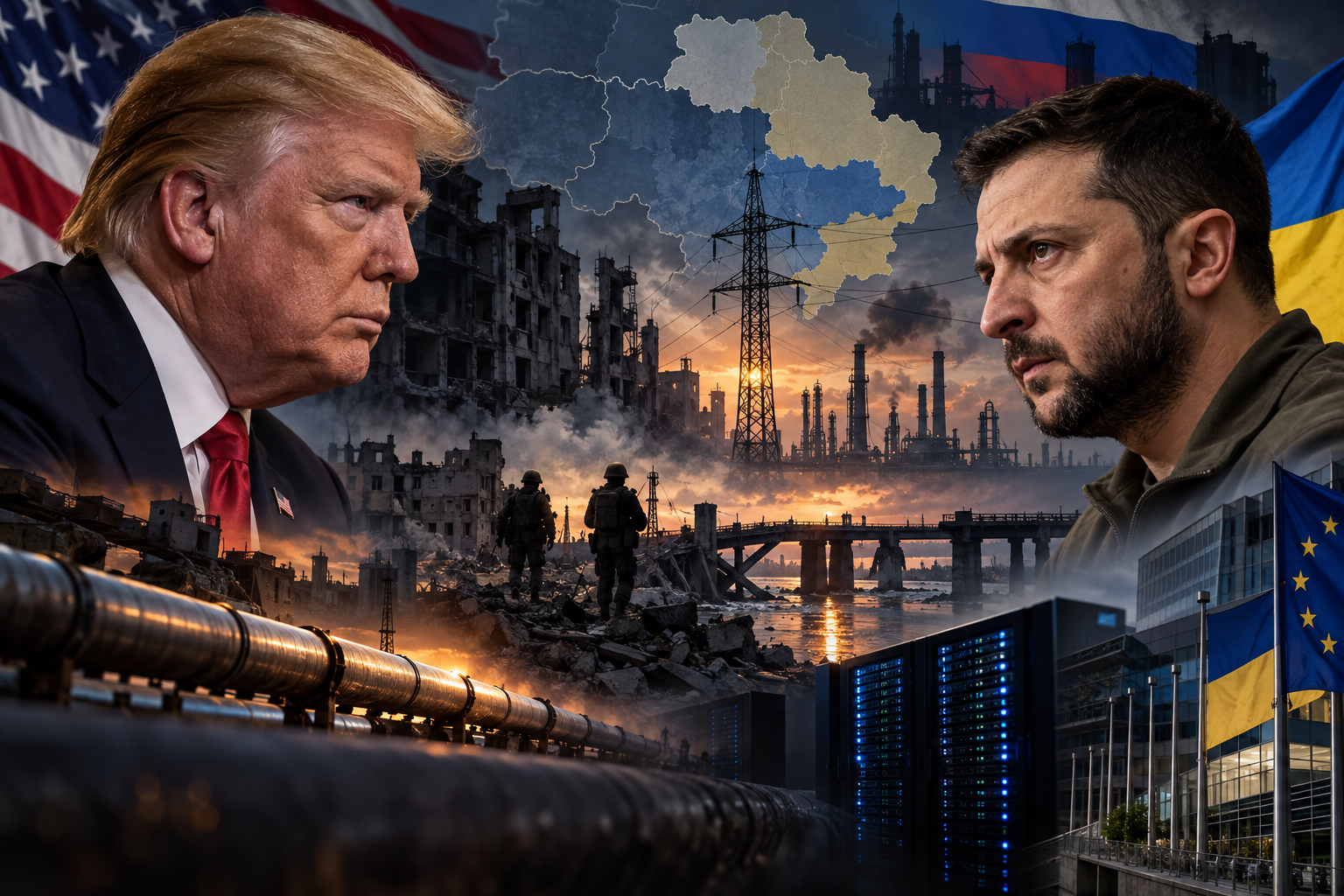
National sovereignty, energy diplomacy and European security amid tensions between Donald Trump and Volodymyr Zelensky

Abstract: The Russo-Ukrainian conflict is entering a phase characterised by intensifying diplomatic pressure, the growing strategic importance of energy and technological infrastructure, and emerging tensions in relations between Washington, Kyiv and the major European capitals. Statements by US President Donald Trump calling for a change in Ukraine’s leadership, accompanied by the announcement of an energy ceasefire with Russia, highlight the difficulties of reconciling economic interests, diplomatic objectives and the principles of national sovereignty. President Volodymyr Zelensky’s response, centred on Ukraine’s right to political self-determination and the demand for reciprocity in suspending attacks, comes against a backdrop in which continuing military operations and the vulnerability of civilian infrastructure make any prospect of negotiations particularly complex. This article examines the political, economic and legal implications of these developments, focusing on the role of the European Union, the security of strategic infrastructure and the need to distinguish diplomatic announcements from agreements that can be independently verified.
Keywords: #Ukraine #Russia #DonaldTrump #VolodymyrZelensky #NationalSovereignty #EnergyCeasefire #EuropeanSecurity #CriticalInfrastructure #InternationalDiplomacy #InternationalHumanitarianLaw #CristinaDiSilvio #EthicaSocietas #EthicaSocietasReview #ScientificJournal #Humanities #SocialSciences #EthicaSocietasUPLI
versione italiana
Ukrainian leadership between national sovereignty and international pressure
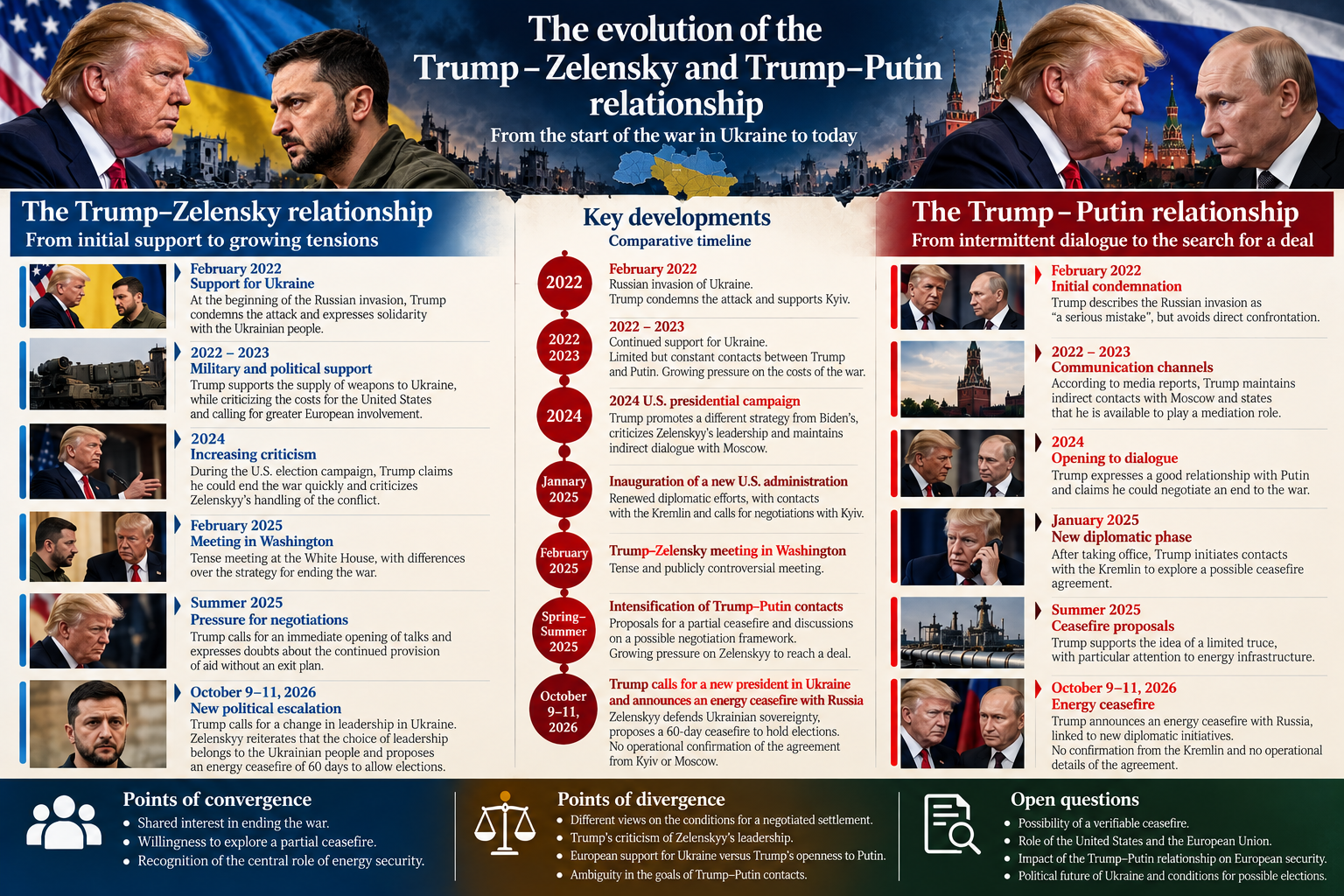
The diplomatic debate surrounding the Russo-Ukrainian war has acquired a new political dimension following statements by US President Donald Trump calling for a change in Ukraine’s leadership and attributing to President Volodymyr Zelensky responsibility for failing to seize previous opportunities to negotiate an end to the conflict. The remarks, discussed during the 11 October 2026 edition of ABC News’s This Week, introduced a further source of tension into relations between Washington and Kyiv, raising questions not only about the prospects for a diplomatic settlement but also about the relationship between national sovereignty, external political pressure and democratic legitimacy in wartime.
Zelensky’s response, delivered during the same programme, focused on asserting the exclusive right of Ukrainian citizens to choose their political representatives. He emphasised that holding elections during an armed conflict presents legal, logistical and institutional difficulties that cannot be overcome merely through a request from abroad. In particular, the Ukrainian President highlighted the impossibility of guaranteeing adequate conditions for security, participation and electoral integrity in a country subjected to continuous bombardment, with millions of citizens internally displaced or living abroad and part of its territory still under Russian military occupation.
The electoral question therefore extends beyond the personal confrontation between the two presidents, engaging one of the fundamental principles of the contemporary international order: the determination of a state’s representative institutions must reflect the will of its population and cannot be subordinated to the political preferences of foreign governments. At the same time, the question of democratic continuity during wartime raises practical concerns about reconciling institutional legitimacy with the extraordinary circumstances imposed by national defence.
Zelensky indicated that elections could be organised if Russia agreed to a general sixty-day suspension of hostilities, identifying such a period as a necessary condition for establishing electoral procedures and ensuring a minimum level of security. This, however, represents a conditional political willingness dependent on an effective ceasefire, rather than an acknowledgement that the conditions required for voting already exist. Organising elections would, in any event, require specific legal and administrative assessments.
The controversy was further amplified by public comments from Elon Musk, who criticised Ukraine’s leadership, contributing to the extension of the dispute from the strictly diplomatic sphere into international political communication. The growing influence of economic and technological actors in geopolitical debate is, in this respect, a significant feature of contemporary transformations in the relationship between political power, digital communication and the formation of public opinion.
The energy ceasefire between diplomatic announcements and the absence of operational guarantees
One of the most significant aspects of the diplomatic developments of 11 October concerned President Trump’s announcement, through the Truth Social platform, of an energy ceasefire between Russia and Ukraine, presented as an understanding to halt attacks against their respective energy infrastructure.
The American announcement, however, was not accompanied by the publication of a formalised agreement, a definition of the categories of infrastructure covered or the identification of mutually agreed procedures for verifying compliance with the commitments undertaken. The Associated Press reported the absence of operational details and consistent confirmation from the parties involved, while The Kyiv Independent reported that Kyiv had stated it possessed no information about the agreement announced by the American President.
During his interview with ABC News, Zelensky expressed Ukraine’s willingness to suspend attacks against Russian oil refineries if Moscow ceased targeting Ukrainian energy infrastructure. His proposal was based on the principle of reciprocity and the need to prevent a unilateral suspension of operations from creating strategic advantages for either party.
The distinction between a political announcement and a diplomatic agreement is of substantial importance in this context. A ceasefire, even one limited to specific categories of targets, requires a precise identification of prohibited activities, a clear definition of the agreement’s territorial and material scope, the establishment of communication channels between the parties and, potentially, independent monitoring mechanisms. Without these conditions, the suspension of hostilities risks remaining dependent on unilateral declarations, open to divergent interpretations and lacking effective instruments for establishing whether violations have occurred.
The central importance of energy infrastructure also reflects the transformation of production, refining and distribution facilities into essential components of economic capacity and national resilience. Attacks against such facilities can compromise fuel availability, continuity of electricity supplies and the functioning of essential services, producing consequences that extend far beyond the immediate physical damage caused by military operations.
An energy ceasefire could therefore provide a possible basis for negotiating common ground, but it would not amount to a general cessation of hostilities or automatically guarantee the protection of civilians, particularly while attacks against populated areas, transport infrastructure and other strategically significant facilities continue.
The economic dimension of energy diplomacy
The confrontation between Washington, Kyiv and Moscow takes place within a framework in which energy resources simultaneously serve as instruments of international pressure, factors of economic stability and essential components of the capacity to sustain military operations.
The strategic importance of the energy sector derives from its dual function. On the one hand, it ensures the continuity of productive activities and essential services; on the other, it contributes to public revenues and the availability of resources needed to finance government policies. In Russia’s case, oil and petroleum-product exports are particularly important in the international debate concerning the effectiveness of sanctions and the possibility of restricting the economic resources available to sustain the conflict.
From an economic perspective, these developments illustrate the complexity of the relationship between energy security, price stability and instruments of international pressure. Economic sanctions pursue political and strategic objectives, but they also affect global markets, supply chains and the costs borne by businesses and consumers, sometimes generating tensions between foreign-policy priorities and domestic economic requirements.
The issue cannot, however, be reduced to an exclusively commercial confrontation. The political significance of energy trade with Russia depends on the circumstances in which such exchanges are authorised, any exemptions from the sanctions regime and the ability of the states concerned to maintain a consistent approach to their stated objectives.
The interaction between diplomatic initiatives and energy interests demonstrates particularly clearly how the management of strategic resources has become an essential component of international policy, with efforts to achieve a negotiated settlement having to accommodate economic interests that do not always coincide, even among allied countries.
Civilian casualties and the gap between diplomacy and military reality
Diplomatic initiatives are unfolding while the conflict continues to inflict particularly severe consequences on the civilian population, with bombardments of urban areas, damage to essential infrastructure and increasing difficulties in maintaining the continuity of public services.
According to the figures reported by the Associated Press on 11 October, a Russian attack on Zaporizhzhia resulted in twenty-three casualties, including four children, confirming the serious humanitarian consequences of military operations and the vulnerability of populated areas exposed to bombardment. Casualty figures must be understood in relation to the time at which they were released, since rescue operations and subsequent verification may lead to revisions of initial reports.
Ukrainian authorities have also reported an intensive campaign of attacks against civilian and energy infrastructure, involving aerial bombs, missiles and drones. Information released by the parties to the conflict must nevertheless be distinguished from independent assessments, particularly where it concerns the number of attacks, military losses and the extent of the damage caused.
The continuation of military operations demonstrates the difficulty of translating diplomatic declarations into an effective reduction in violence. It also illustrates how an agreement limited to particular categories of infrastructure would not necessarily lead to a general improvement in security conditions.
Under international humanitarian law, the protection of civilians is an obligation that does not depend on the existence of a ceasefire agreement. Rather, it derives from the rules governing the conduct of hostilities, particularly the principles of distinction between military objectives and civilian objects, proportionality in attack and the obligation to take feasible precautions to minimise incidental harm.
The existence of an armed conflict does not entail a general suspension of the protections established by international law. The legal assessment of individual attacks requires an examination of the specific circumstances, the nature of the targets and the information reasonably available at the time of the operations.
The war against digital infrastructure and the new technological dimension of the conflict
Alongside the energy dimension, the Russo-Ukrainian conflict is increasingly extending military operations to technological and digital infrastructure, whose strategic significance derives from its role in data processing, the management of economic services and the development of advanced artificial intelligence systems.
On 11 October, Reuters reported that the Russian technology company Yandex had announced the suspension of operations at its data centre in the Vladimir region following a drone attack that damaged the facility’s infrastructure. The incident formed part of a series of attacks against facilities belonging to the same company in the preceding days.
The involvement of infrastructure used to develop artificial intelligence systems is particularly significant because data centres constitute essential resources not only for the commercial activities of technology companies but also for computational capacity, the management of complex digital services and the continuity of communications.
Damage to such facilities can have indirect consequences for a wide range of actors, causing disruptions to services used daily by citizens, businesses and public administrations. The concentration of substantial quantities of data and computing capacity within a limited number of facilities also makes technological resilience and the development of business-continuity systems particularly important.
These developments also require legal consideration, since the growing economic and strategic importance of data centres does not automatically make them legitimate military objectives. Under international humanitarian law, the assessment must consider whether the infrastructure makes an effective contribution to military action and whether its destruction or neutralisation, in the circumstances prevailing at the time, offers a definite military advantage.
The possibility that digital infrastructure may simultaneously perform civilian and military functions makes such assessments particularly complex, requiring careful consideration of risks to civilians and the consequences of service disruption.
The targeting of technological infrastructure therefore represents one of the most significant manifestations of the evolution of contemporary warfare, in which the ability to disrupt information systems, energy networks and digital platforms can affect a state’s economic and social resilience without necessarily producing effects immediately associated with conventional battlefield operations.
Europe between support for Ukraine and continental security
Tensions between Washington and Kyiv have reignited debate over Europe’s role in managing the conflict and the ability of European institutions to maintain a consistent position on Ukrainian sovereignty, economic sanctions and the continent’s security requirements.
The German government reaffirmed its support for Zelensky, confirming the continuity of European engagement despite differences with the US administration. Berlin’s position forms part of a broader framework in which political, economic and military support for Kyiv remains a significant component of European security policy, notwithstanding differing national perspectives on the management of the conflict and the prospects for negotiations.
The question of sanctions is particularly important because the effectiveness of restrictive measures also depends on the ability of the countries adopting them to limit opportunities for circumvention and maintain sufficiently stable coordination over time.
At the same time, Ukraine’s European integration process constitutes a separate but closely related issue in the broader prospect of the country’s political and institutional stabilisation. Accession to the European Union requires compliance with specific criteria and procedures, which cannot be replaced by the immediate demands of international politics, even though the geopolitical context may influence the process.
A further source of concern involves the security of European defence industries. According to the Financial Times on 11 October, officials from Western intelligence agencies reported alleged Russian activities targeting executives of European companies involved in producing and supplying military equipment to Ukraine.
Such information, attributed to intelligence sources, must be assessed according to its specific nature, distinguishing intelligence assessments from publicly available evidence and any subsequent judicial findings. Nevertheless, the significance of these reports lies in the possibility that the confrontation between Russia and European countries may extend to indirect pressure, intimidation and clandestine activities directed against economic actors considered strategically important.
Continental security cannot therefore be understood exclusively in terms of territorial defence. It requires a broader assessment of industrial, technological, energy and information-related vulnerabilities, whose protection is essential to ensuring the continuity of economic and institutional functions.
The credibility of diplomacy and the conditions for de-escalation
The developments of October 2026 demonstrate the close interdependence between military operations, diplomatic pressure, economic interests and competition for control over strategic infrastructure in the Russo-Ukrainian conflict, within a context in which political initiatives do not always correspond immediately to actual conditions on the ground.
Trump’s statements concerning Ukraine’s leadership have brought the relationship between national sovereignty and the influence of allies back to the centre of the debate, while Zelensky’s response has emphasised the need to ensure that any electoral process takes place under conditions compatible with democratic principles and the security requirements of the population.
The announcement of an energy ceasefire opened up the possibility of reducing hostilities against certain categories of infrastructure, without initially providing sufficient evidence to establish that an operational and verifiable agreement had been reached. The debate over energy resources also demonstrated the extent to which economic interests can influence diplomatic strategies and the consistency of international pressure measures.
Continuing attacks against populated areas, energy facilities and technological infrastructure confirm that the consequences of the war are increasingly extending into essential sectors of economic and social life, making civilian protection and the resilience of strategic systems central concerns for national and international security.
Within this framework, Europe’s role extends beyond immediate support for Ukraine to encompass the ability of European institutions to develop common security instruments, preserve the consistency of their economic policies and contribute to the establishment of sustainable diplomatic conditions.
Ultimately, the credibility of any negotiating initiative will depend on the ability to transform political announcements into precise, reciprocal and verifiable commitments, supported by monitoring mechanisms and sufficient guarantees to reduce the risk of further violations. A limited ceasefire may constitute an initial step towards de-escalation, but its effectiveness must be assessed on the basis of tangible results rather than the media prominence of the statements accompanying its announcement.
References
ABC News. (2026, 11 October). ‘This Week’ transcript 10-11-26: Ukrainian President Volodymyr Zelenskyy, Majority Whip Tom Emmer & Kansas Democratic Senate Candidate Adam Hamilton. ABC News.
https://abcnews.com/Politics/week-transcript-10-11-26-ukrainian-president-volodymyr/story?id=137165082
Binkley, C., Blann, S., & Morton, E. (2026, 11 October). Trump says Russia and Ukraine reach ‘energy ceasefire’ but gives no details. Associated Press.
https://apnews.com/article/f621fa788196f204448e7f75fcc78c68
Financial Times. (2026, 11 October). Russia steps up bid to kill European defence chiefs, spy agencies warn. Financial Times.
https://www.ft.com/content/5da2dd05-9583-4a75-b018-2c5024383ec4
Reuters. (2026, 11 October). Germany backs Ukraine’s Zelenskiy after Trump’s call for his removal. Reuters.
https://www.reuters.com/world/germany-backs-ukraines-zelenskiy-after-trumps-call-his-removal-2026-10-11/
Reuters. (2026, 11 October). Russia’s Yandex says data centre in Vladimir area shut down after drone attack. Reuters.
https://www.reuters.com/world/europe/russias-yandex-says-data-centre-vladimir-area-shut-down-after-drone-attack-2026-10-11/
Zadorozhnyy, T. (2026, 11 October). Trump claims Ukraine-Russia agreed to energy ceasefire — Kyiv has no information about it. The Kyiv Independent.
https://kyivindependent.com/trump-claims-ukraine-russia-agreed-to-energy-ceasefire-kyiv-has-no-information-about-it/
LATEST 5 CONTRIBUTIONS BY THE SAME AUTHOR
The Freedom to Choose the Future: Demography, the Body and the Limits of Power
When Climate Change Reshapes Global Strategy
Ceuta, When the Border Becomes a Weapon
FIVE LAST CONTRIBUTIONS ON GEOPOLITICS
Islam, Radicalization, and Global Security
The State of the Global and National Economy in the Governor’s Final Considerations
Destroying Images, Governing Memory: Jihadist Iconoclasm and Cognitive Warfare
LATEST 5 CONTRIBUTIONS
Oriana Fallaci, Twenty Years Later
Who Decides When a Woman Is Free?
International Week of Deaf People: From Accessibility to Full Citizenship
Free to Offend or Free from Offence?
Ethica Societas is a free, non-profit news publication published by a non-profit social cooperative.
Copyright Ethica Societas, Human&Social Science Review © 2026 by Ethica Societas UPLI onlus.
ISSN 2785-602X. Licensed under CC BY-NC 4.0