

The Massacre Perpetrated by Hamas, the Hostages, the War in Gaza and the Problem of Memory in an Ongoing Conflict

Abstract: Three years after 7 October 2023, the attack carried out by Hamas and other Palestinian armed groups against Israeli territory continues to represent one of the most significant events in the recent history of the Israeli-Palestinian conflict, both because of the scale of the deaths and abductions and because of the political, military and social consequences that followed. More than 1,200 Israelis and foreign nationals were killed and 251 people were abducted and taken to the Gaza Strip, while subsequent international investigations documented the killing of civilians, hostage-taking, ill-treatment and sexual violence. Israel’s military response led to a prolonged war in the Gaza Strip, resulting in tens of thousands of deaths, widespread destruction and a profound humanitarian crisis. This article offers a sociological interpretation of the commemoration of 7 October, focusing on the relationship between memory, historical context, political responsibility, the narrative construction of the conflict and the representation of victims. Its purpose is neither to establish a hierarchy of suffering nor to formulate political judgements, but to examine how different traumatic events are incorporated into collective narratives that contribute to defining identities, responsibilities and perceptions of the conflict.
Keywords: #7October #October7 #Hamas #Israel #Gaza #Hostages #MiddleEast #IsraeliPalestinianConflict #Memory #CivilianVictims #PoliticalViolence #NovaFestival #HumanRights #InternationalLaw #CollectiveNarratives #CollectiveMemory #EthicaSocietas #EthicaSocietasReview #ScientificJournal #Humanities #SocialSciences #EthicaSocietasUPLI
7 October as a historical rupture
7 October 2023 constitutes one of the most significant ruptures in the recent history of the Israeli-Palestinian conflict. The attack began in the early hours of the morning when, under cover of a large-scale rocket barrage, armed members of Hamas and other Palestinian groups breached the barrier separating the Gaza Strip from Israel at several points and attacked military installations, civilian communities, roads, homes and locations where large numbers of people were gathered.
Among the places that became symbolic of that day was the Nova music festival, near Re’im, where large numbers of people attending the event were attacked. Other attacks targeted kibbutzim and communities close to the border with Gaza.
More than 1,200 Israelis and foreign nationals were killed, while 251 people were abducted and taken to the Gaza Strip, including women, children, elderly people and citizens of several nationalities.
Subsequent international investigations reconstructed various aspects of the attack, documenting the killing of civilians, abductions, ill-treatment and sexual violence, while distinguishing between established facts, evidence considered highly probable and allegations that could not be independently verified.
The hostages as a central element of the conflict
From the first hours after the attack, the taking of hostages became a central factor in the subsequent development of the conflict. The detention of Israeli and foreign civilians in the Gaza Strip shaped negotiations, military operations, Israel’s domestic political debate and the pressure exerted by the international community.
Over the following months, some hostages were released through negotiated agreements, others were recovered during military operations, while others died in captivity or during the conflict.
The hostage issue also acquired a powerful symbolic dimension, becoming one of the principal elements through which Israeli society constructed its memory of 7 October and through which families, civil society movements and organisations exerted pressure on the political authorities to ensure that securing their release remained a priority.
The question of historical context
Any analysis of 7 October inevitably forms part of a much longer history. The Israeli-Palestinian conflict encompasses more than a century of political, territorial and demographic transformations, including the events of 1948 and the Palestinian Nakba, the establishment of the State of Israel, the Arab-Israeli wars, the occupation of the Palestinian territories since 1967, the expansion of Israeli settlements in the West Bank, the Intifadas, attacks against Israeli civilians, Israel’s withdrawal from Gaza in 2005, Hamas’s electoral victory in 2006 and its subsequent takeover of the Gaza Strip in 2007.
Since then, Gaza has been subject to extensive restrictions and an Israeli blockade, with Egypt also controlling access through its southern border, while Hamas has continued to develop its political and military structures and to launch rockets towards Israel.
7 October cannot therefore be understood in isolation from this broader historical context. At the same time, that context cannot substitute for a specific analysis of what occurred on that day.
From a sociological perspective, the distinction between context and responsibility is particularly important, because historical reconstruction and the interpretation of a specific event operate at different levels of analysis.
Gaza after 7 October
Israel’s response to 7 October led to a prolonged war in the Gaza Strip, characterised by aerial and ground operations, extensive destruction of infrastructure, the displacement of a very large proportion of the population and substantial loss of life.
Gaza’s health authorities have reported tens of thousands of Palestinian deaths, while international organisations have documented severe difficulties in accessing food, water, medicines, healthcare and other essential services.
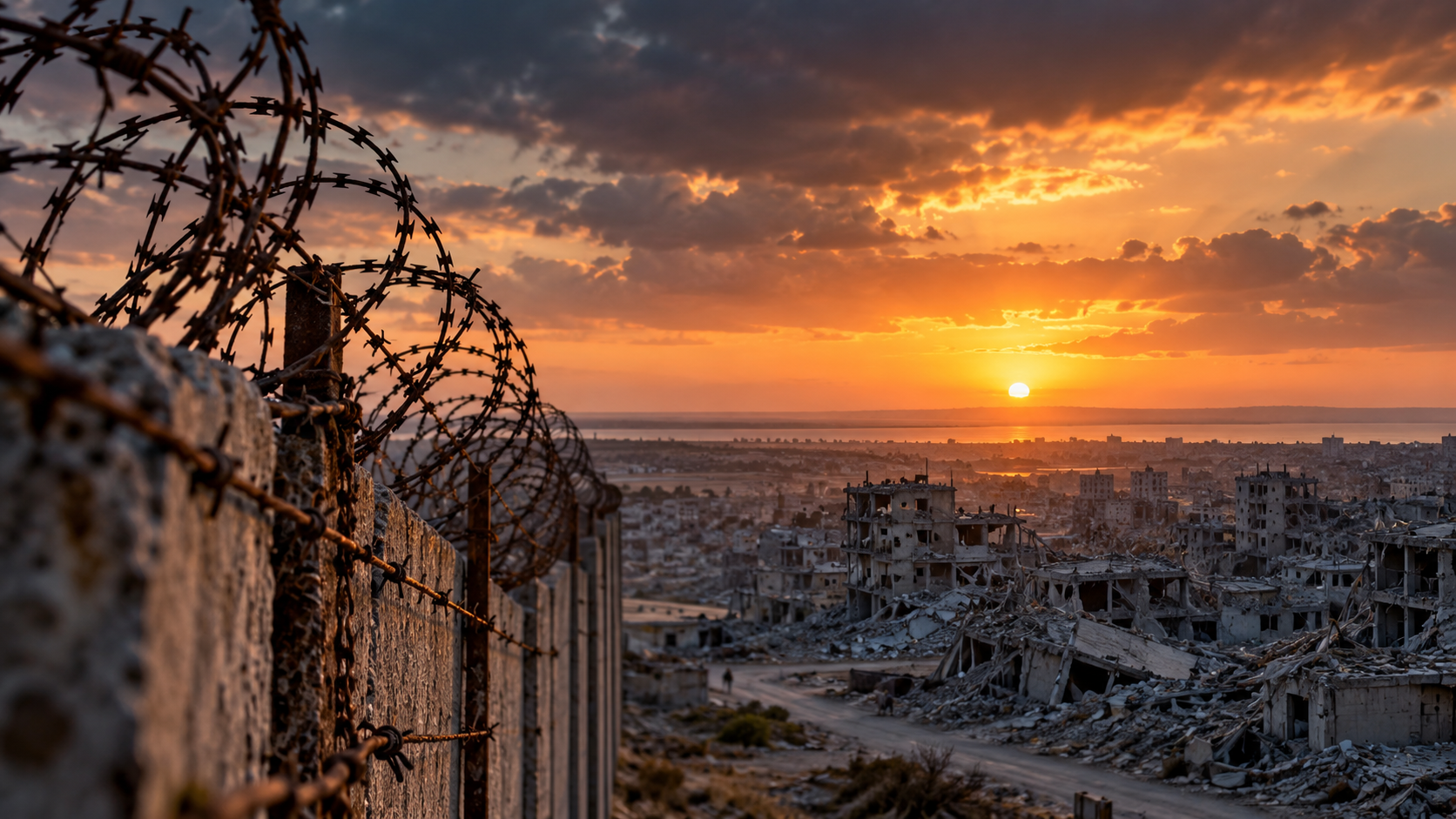
The war has also profoundly transformed the urban landscape of the Gaza Strip, with entire neighbourhoods and civilian infrastructure destroyed. At the international level, it has generated an extensive debate concerning the proportionality of military operations, the protection of civilians and compliance with international humanitarian law.
These developments have contributed to reshaping global perceptions of the conflict, producing different and often opposing narratives in which the memory of 7 October and that of the Palestinian victims of the subsequent war are sometimes presented as mutually exclusive.
Memory and the construction of public narratives
The commemoration of traumatic events does not consist solely in reconstructing the chronology of what happened. Societies select events, symbols, images and testimonies through which collective memory is constructed, transmitted and reinterpreted.
In Israel, 7 October rapidly entered public memory as one of the most traumatic moments in the country’s recent history. Among Palestinian communities, meanwhile, the subsequent war has become a central frame through which the destruction of Gaza and the human cost of the conflict are represented and remembered.
These two forms of collective memory can coexist, yet they are frequently incorporated into competing political narratives. Memory therefore becomes not merely an instrument of remembrance, but also a space in which collective identity and political legitimacy are constructed and contested.
This phenomenon is common in protracted conflicts, in which representations of the past contribute to defining relationships with the present and perceptions of the other group.
The problem of generalisation
One of the most significant social effects of protracted conflicts is the progressive tendency to conflate individuals, groups and institutions.
Within such a process, “Israel” may come to be treated as synonymous with every Israeli citizen, while “Hamas” may be extended to encompass the Palestinian population as a whole. Such generalisations simplify the complex social and political realities of the societies involved.
The sociology of conflict demonstrates how the construction of opposing collective identities can progressively erode distinctions between individuals and encourage a binary interpretation of reality.
Yet neither Israelis nor Palestinians constitute homogeneous blocs. Both societies encompass different political, religious and cultural orientations, as well as widely divergent positions regarding the war, their respective political authorities, armed organisations and possible solutions to the conflict.
7 October in the international debate
The commemoration of 7 October rapidly acquired a global dimension. Commemorations, demonstrations, institutional statements and political initiatives have taken place in numerous countries, while the conflict itself has generated intense polarisation within international public opinion.
The debate has encompassed Hamas’s responsibility, the conduct of the Israeli government, conditions facing the population of Gaza, the hostage issue, Israel’s security and the prospect of a Palestinian state.
In many contexts, however, public discussion has progressively assumed a binary structure in which recognition of the victims on one side is perceived as a denial of the victims on the other.
From a sociological perspective, this dynamic illustrates how difficult it can be to maintain a multi-layered understanding of a conflict when identities, affiliations and collective memories themselves acquire a political function.
Three years later
Three years later, 7 October remains central to understanding the contemporary crisis in the Middle East.
Its memory is intertwined with the war that followed, with political transformations within Israel, with the humanitarian situation in the Gaza Strip, with the role of Hamas, with the hostage issue and with changing regional geopolitical dynamics.
Remembering 7 October therefore means confronting an event that does not yet belong solely to history, because its consequences continue to shape the present.
From the perspective of social analysis, perhaps the most significant question concerns precisely the ways in which different memories are constructed, transmitted and contested. The events of 7 October, the Israeli victims, the hostages, the subsequent war, the Palestinian victims and the destruction of Gaza now form part of the same historical sequence, yet they continue to be narrated and remembered from different perspectives.
Understanding this plurality of narratives does not mean equating them, nor does it require establishing a hierarchy between them. Rather, it means examining how conflict produces not only victims and political transformations, but also memories, symbols and representations that continue to shape perceptions over time.
Three years later, 7 October therefore remains simultaneously a historical event, a collective trauma and an active element in the political and social construction of the Israeli-Palestinian conflict.

LATEST 5 CONTRIBUTIONS BY THE SAME AUTHOR
Emma Bonino: Freedom Against the Morality Imposed by Others
The Italian Republic’s Longest-Serving Government Faces the Test of the Economy
“Love That Moves Sun and Other Stars”: the Theme of the 2026 Meeting [WITH VIDEO]
The Eightieth Anniversary of the Italian Republic
The State of the Global and National Economy in the Governor’s Final Considerations
LATEST 5 CONTRIBUTIONS ON POLITICS
The Italian Republic’s Longest-Serving Government Faces the Test of the Economy
When Climate Change Reshapes Global Strategy
Draghi in Aachen: Europe Alone Before the Test of Sovereignty
Holocaust Remembrance and Contemporary Antisemitism
LATEST 5 CONTRIBUTIONS
Who Decides When a Woman Is Free?
International Week of Deaf People: From Accessibility to Full Citizenship
Free to Offend or Free from Offence?
Emotions in the Age of Social Media
Ethica Societas is a free, non-profit review published by a social cooperative non-profit organization
Ethica Societas è una testata giornalistica gratuita e no profit edita da una cooperativa sociale onlus
Copyright Ethica Societas, Human&Social Science Review © 2026 by Ethica Societas UPLI onlus.
ISSN 2785-602X. Licensed under CC BY-NC 4.0