

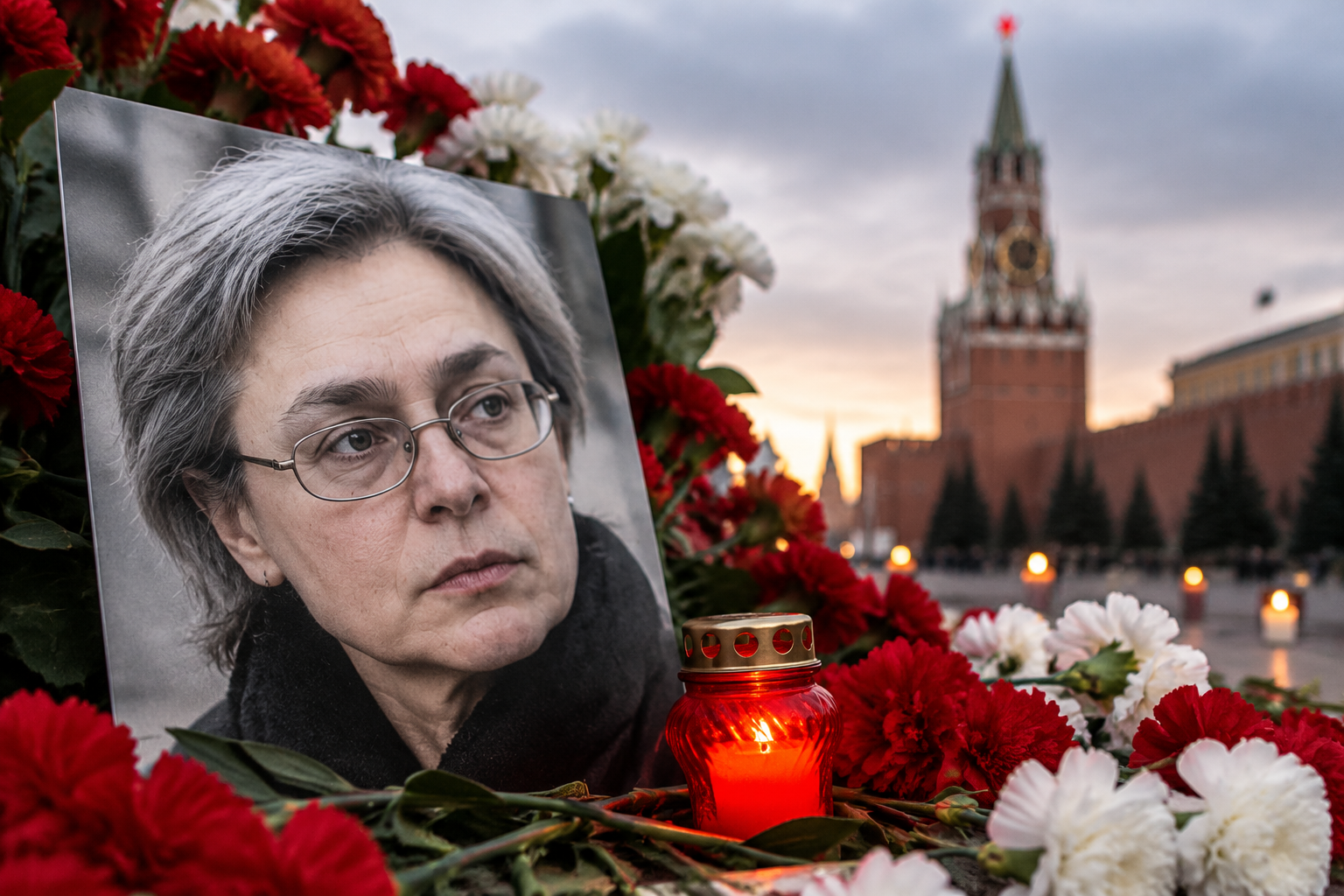
The journalist murdered in Moscow in 2006 and the legacy of her denunciation of abuses of power, impunity and the repression of fundamental freedoms

Abstract: The twentieth anniversary of the murder of Anna Politkovskaya, which took place in Moscow on 7 October 2006, provides an opportunity to reflect on the relationship between freedom of information, political violence, institutional accountability and the progressive erosion of democratic safeguards in the Russian Federation, through an examination of the journalistic work of one of the most authoritative witnesses to human rights violations committed during the Second Chechen War. Her investigations, characterised by a methodology grounded in direct observation, the collection of testimonies and the documentation of responsibility within the coercive apparatus of the state, helped expose the contradictions of a political system in which the strengthening of executive power was accompanied by the progressive marginalisation of independent voices and the weakening of mechanisms of democratic oversight. The analysis examines the historical and legal significance of her testimony, the circumstances of her murder, the responsibilities established by judicial proceedings and the persistent investigative shortcomings also recognised by the European Court of Human Rights, considering the contemporary relevance of her legacy in the light of Russia’s invasion of Ukraine and restrictions imposed on press freedom. Politkovskaya’s memory is therefore interpreted not merely as the necessary recognition of an individual tragedy, but as a basis for reflection on the capacity of democratic institutions and the international community to combat impunity, protect human dignity and guarantee the effective exercise of the right to truth.
Keywords: #AnnaPolitkovskaja #AnnaPolitkovskaya #PressFreedom #HumanRights #Russia #VladimirPutin #Chechnya #WarInUkraine #InvestigativeJournalism #FreedomOfInformation #RuleOfLaw #EuropeanCourtOfHumanRights #Justice #HistoricalMemory #Democracy #FrancescoMancini #EthicaSocietas #EthicaSocietasReview #ScientificJournal #Humanities #SocialSciences #EthicaSocietasUPLI
7 October 2006, a murder that reverberates through Russian history
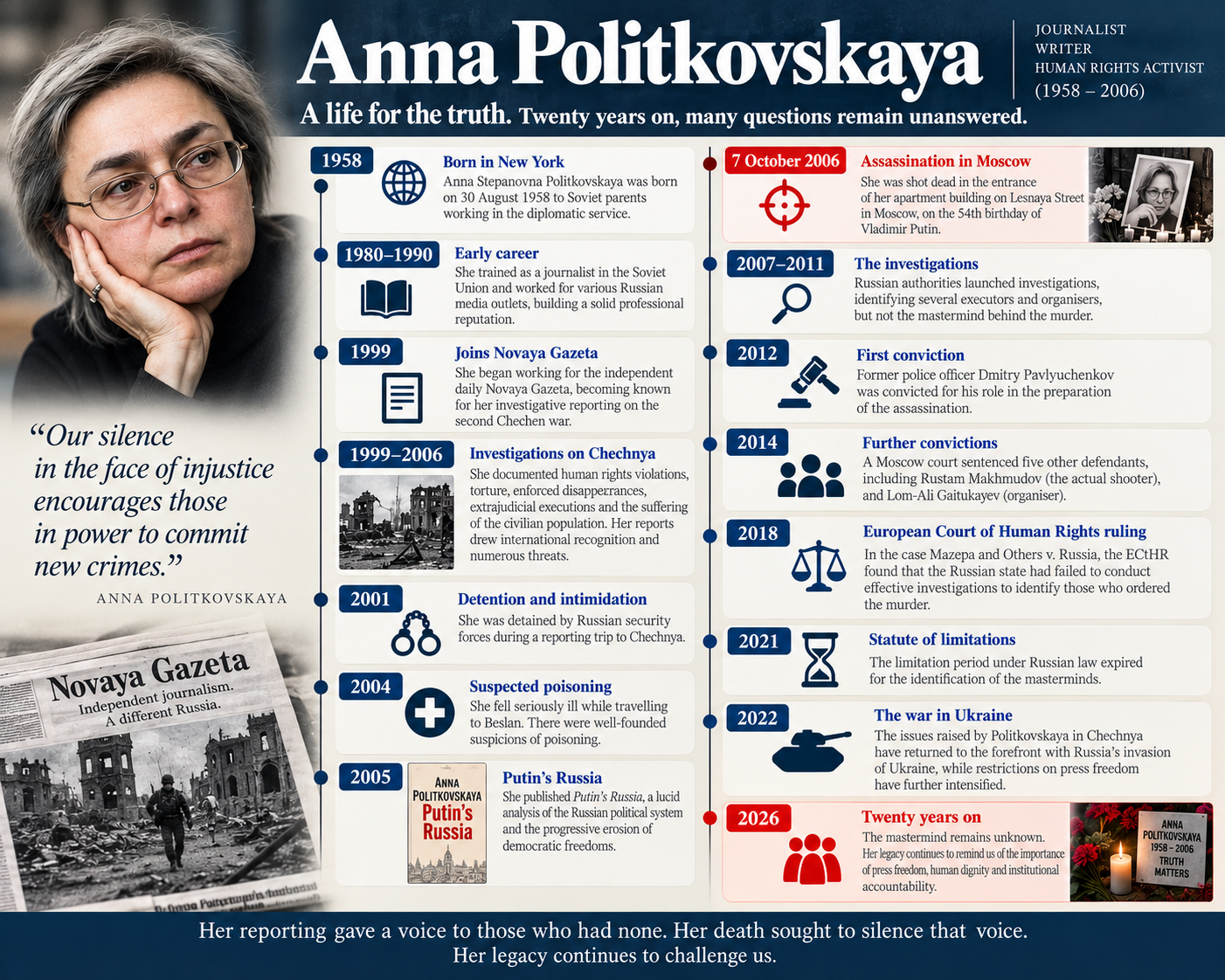
On 7 October 2006, Anna Stepanovna Politkovskaya was shot dead in the building where she lived, on Lesnaya Street in central Moscow, violently bringing to an end the work of a journalist whose investigations for the independent newspaper Novaya Gazeta had helped document some of the gravest human rights violations committed in the Russian Federation during the Second Chechen War and expose the progressive deterioration of democratic safeguards within the political system consolidated under Vladimir Putin’s presidency.
The murder, committed when Politkovskaya was forty-eight years old, coincided with the Russian president’s fifty-fourth birthday, a circumstance that immediately acquired considerable symbolic significance in international debate, without, however, constituting evidence capable of establishing direct responsibility for the crime, whose instigator has never been judicially identified. Distinguishing the political context in which the murder occurred from the establishment of criminal responsibility is essential to a rigorous reconstruction of the case, particularly given the continuing absence of a complete judicial account of the truth.
Twenty years later, the Politkovskaya case remains one of the most significant episodes in the contemporary history of freedom of information, not only because of the victim’s international prominence, but above all because of the relationship between her professional activities, her documentation of abuses committed by the security apparatus and the difficulties encountered by institutions in ensuring effective accountability for violence perpetrated against those who exercise public scrutiny of power.
The journalist had devoted the final years of her life to reporting realities that much of Russia’s official media tended to marginalise or portray primarily through military and security-related narratives, documenting torture, enforced disappearances, extrajudicial executions, arbitrary detention and violence against civilians, with particular attention to the consequences these practices had for individuals, families and communities affected by the conflict.
Her work extended beyond exposing individual incidents, developing into a broader examination of the relationship between the concentration of power, the exercise of coercion and institutional accountability, identifying impunity for those responsible for violations as one of the principal factors undermining the rule of law and progressively normalising violence.
Chechnya as a laboratory of institutional violence
Born in New York in 1958 to Soviet parents serving in the diplomatic corps, Anna Politkovskaya received her professional education in the Soviet Union and began her journalistic career before the dissolution of the Soviet system, progressively developing an investigative approach characterised by attention to social conditions, institutional responsibility and the concrete consequences of political decisions for citizens’ lives. Her arrival at Novaya Gazeta in 1999 coincided with the beginning of the Second Chechen War, which would become the principal focus of her professional activities and the setting in which she produced one of the most compelling journalistic accounts of the transformation of contemporary Russia.
While the federal authorities presented military operations as necessary measures to combat terrorism, restore constitutional order and preserve the Federation’s territorial integrity, Politkovskaya documented the consequences of the intervention for civilians, collecting testimonies from people subjected to unlawful detention, relatives of the disappeared, women who had experienced violence and communities forced to live amid permanent insecurity, in circumstances where difficulties in accessing judicial remedies further increased victims’ vulnerability.
The distinctive character of her journalism lay in her ability to connect the geopolitical and military dimensions of the conflict with individuals’ lived experiences, rescuing civilian suffering from the abstraction of institutional language and restoring prominence to experiences that, without independent reporting, might have remained unknown to national and international public opinion.
Through this approach, the exposure of violations acquired a significance extending beyond testimony, since it helped establish a public record of abuses and encouraged intervention by the competent authorities, demonstrating that the state’s exercise of force could not be exempted from the principles of legality, proportionality and accountability that underpin the rule of law.
Her work in Chechnya exposed Politkovskaya to threats, intimidation and serious personal risks, including an incident in February 2001, when she was detained by members of the Russian security forces while conducting an investigation in the region, and another in September 2004, when she became seriously ill while travelling to Beslan, where she intended to cover the hostage crisis at the town’s school. The latter incident prompted suspicions of poisoning, although its circumstances and responsibility could not be conclusively established, contributing nevertheless to an understanding of the increasingly dangerous environment in which she continued to practise journalism.
Her determination to continue working despite the intimidation she experienced reflected a conception of journalism as a civic responsibility and an instrument of democratic oversight, in which direct presence at the sites of violations, listening to victims and verifying testimonies were indispensable means of countering the invisibility of suffering and the absence of accountability within public institutions.
Putin’s Russia and the progressive erosion of democratic safeguards
Anna Politkovskaya’s investigations took place during a decisive phase in the institutional transformation of the Russian Federation, characterised by the strengthening of presidential power, the growing centrality of the security apparatus and the progressive reduction of space for independent journalism, within a process of political centralisation that the authorities presented as necessary to overcome the economic and institutional instability of the 1990s and restore the state’s capacity to perform its functions.
Vladimir Putin’s accession to the presidency in 2000 was accompanied by a reorganisation of relations between central government, regional institutions and major media organisations, while the consolidation of executive authority contributed to changing the balance between institutions and progressively restricting opportunities for independent scrutiny of public decisions.
Within this development, Politkovskaya identified Chechnya as a particularly significant setting for understanding the consequences of concentrated power, observing how impunity for violations committed during military and security operations was not merely a problem confined to the region, but an indicator of the structural difficulties faced by the Russian legal system in ensuring the effective protection of fundamental rights and subjecting the coercive apparatus of the state to the rule of law.
Her criticism of the Russian political system did not amount to opposition to Russian society or national culture, but rested on the conviction that human dignity, freedom of information and the possibility of establishing the responsibility of those in power were essential conditions for institutional legitimacy, irrespective of the demands of political stability and national security invoked to justify restrictions on freedom.
From this perspective, the journalist attached central importance to the individual responsibility of citizens and the capacity of civil society to resist the progressive normalisation of violence, implicitly maintaining through her professional activities that indifference towards human rights violations could help consolidate a system in which the absence of public scrutiny encouraged the spread of arbitrary practices.
The relationship between information and power therefore emerged as one of the fundamental elements of her thinking, since the ability to document abuses, challenge official accounts and make victims’ testimonies public represented an indispensable means of preventing state security from becoming progressively synonymous with the absence of criticism of institutions.
The murder and the incomplete judicial truth
Investigations into Anna Politkovskaya’s murder eventually led to the identification and conviction of six individuals involved in organising and carrying out the crime, allowing a substantial part of the operational responsibility to be reconstructed without, however, establishing the identity of those who commissioned the murder or the specific motives behind it.
In 2012, former police officer Dmitry Pavlyuchenkov was convicted for his involvement in preparing the assassination, while in 2014 a Moscow court found five other defendants guilty, including Rustam Makhmudov, identified as the gunman, and Lom-Ali Gaitukayev, considered one of the organisers of the crime. The judicial decisions therefore established significant responsibility for the execution and organisation of the murder, but left unresolved the question of possible higher-level responsibility, a matter of particular importance in the killing of a journalist engaged in exposing human rights violations and abuses of public power.
The distinction between perpetrators, organisers and instigators is of fundamental legal importance, since establishing the individual criminal responsibility of those who participated in carrying out a murder does not necessarily discharge the state’s obligation to conduct effective investigations into its circumstances, particularly where evidence requires further examination of a possible connection between the victim’s professional activities and the motives for the attack.
On 17 July 2018, the European Court of Human Rights, ruling in Mazepa and Others v. Russia, found a violation of Article 2 of the European Convention on Human Rights in its procedural aspect, identifying shortcomings in the investigations conducted by the Russian authorities in establishing the identity of those who had commissioned the murder.
The Court observed that, in the case of a contract killing, the obligation to conduct an adequate investigation could not be regarded as satisfied merely by identifying the direct perpetrators, since the authorities were also required to investigate those who had ordered the crime and the circumstances that had led to the decision to eliminate the victim.
The judgment has significance extending beyond the individual case, reaffirming the principle that protection of the right to life encompasses not only the state’s negative obligation to refrain from arbitrary deprivation of life, but also its positive duty to establish effective and independent investigative mechanisms capable of ensuring an adequate determination of responsibility.
The issue of impunity was further aggravated by the expiry of the limitation period under Russian legislation in 2021 in relation to the murder, while the absence of a complete judicial determination continues to prevent the identification of those who commissioned the crime.
Twenty years after the assassination, the failure to identify its instigator therefore remains one of the most significant aspects of the case, highlighting the gap that may arise between the partial establishment of criminal responsibility and the full realisation of the requirements of justice, truth and effective protection of fundamental rights.
Press freedom as a condition of the rule of law
Anna Politkovskaya’s murder raises a central question for constitutional and international law concerning the relationship between freedom of information, protection of life, institutional independence and state accountability, demonstrating that the ability to practise investigative journalism safely is an essential prerequisite for the functioning of contemporary democracies.
Article 10 of the European Convention on Human Rights recognises freedom of expression, including the right to receive and impart information without unjustified interference by public authorities, while Article 2 imposes obligations on states to protect life and conduct effective investigations into violent deaths, establishing a system of safeguards in which the protection of information and personal integrity are closely interconnected.
This relationship is particularly important when journalistic activities concern the exercise of public power, military operations, the functioning of security institutions and possible violations of fundamental rights, since democratic scrutiny of institutions presupposes that citizens can access information on matters of public interest and form opinions through independent sources.
The protection of journalists cannot therefore be regarded as an exclusively professional concern, but must be understood within the broader requirement to guarantee media pluralism and meaningful public debate, preventing intimidation, threats and violence from producing a chilling effect that restricts not only the activities of individual journalists but also the public’s right to receive information on matters of general significance.
When violence against journalists is not adequately investigated, the absence of accountability may encourage self-censorship and consolidate an atmosphere of insecurity incompatible with the independent exercise of journalism, producing consequences extending far beyond individual cases and affecting civil society’s capacity to scrutinise institutions.
The Politkovskaya case thus demonstrates that press freedom cannot be guaranteed solely through the formal recognition of freedom of expression, but requires material conditions of safety, judicial independence, protection of sources, access to information and effective mechanisms for holding perpetrators of violence accountable.
From this perspective, the failure to identify those who commissioned her murder directly concerns the credibility of institutions responsible for upholding the law, since the protection of fundamental rights requires not only the existence of legal safeguards but also the practical capacity to enforce them.
From Chechnya to Ukraine, the persistence of unresolved questions
Russia’s full-scale invasion of Ukraine, launched on 24 February 2022, brought back to the centre of international debate numerous issues that Anna Politkovskaya had addressed through her investigations into the Second Chechen War, once again demonstrating the importance of independently documenting human rights violations, protecting civilian populations and establishing accountability for conduct contrary to international humanitarian law.
Despite their different historical, territorial and legal circumstances, the conflicts in Chechnya and Ukraine present elements that permit comparative reflection on the consequences of military force, the relationship between official communication and independent reporting, and the difficulties encountered by national and international institutions in ensuring effective accountability for violations committed during armed conflict.
Politkovskaya’s testimony remains particularly relevant because it demonstrates how the documentation of abuses may precede international recognition of the gravity of certain developments by many years, helping to establish a public record of violations even when political and institutional conditions do not permit the immediate judicial determination of responsibility.
Her investigations into Chechnya had highlighted the consequences of impunity within the coercive apparatus of the state and the risk that the progressive acceptance of violence as an ordinary instrument of government could produce lasting effects on institutional functioning. Subsequent developments in the Russian Federation have made the relationship between concentrated power, control of information and restrictions on dissent increasingly apparent.
Following February 2022, restrictions on independent reporting in Russia intensified further through legislation, judicial proceedings and administrative measures that limited the possibility of presenting interpretations of the conflict differing from the official narrative, contributing to the contraction of media pluralism and making the work of journalists and organisations documenting violations more difficult.
In this context, the twentieth anniversary of Politkovskaya’s murder acquires significance extending beyond individual commemoration, drawing attention to the continuing challenges of protecting independent journalism, ensuring accountability within public institutions and preventing violence and intimidation from becoming ordinary instruments for managing dissent.
Europe between strategic interests and democratic responsibility
The memory of Anna Politkovskaya directly concerns the capacity of European democracies to recognise signs of deterioration in the rule of law and address contradictions that may arise between protecting fundamental principles, economic cooperation and international security requirements, particularly in relations with political systems characterised by increasing concentrations of power and growing restrictions on civil liberties.
During the early 2000s, relations between the Russian Federation and numerous European countries were characterised by significant energy, commercial and diplomatic cooperation, while human rights violations in Chechnya and pressure on independent journalism were being denounced by international organisations and civil society.
The coexistence of these two dimensions represented one of the principal contradictions of European policy towards Russia, highlighting the difficulty of reconciling states’ strategic interests with the need for consistency in protecting democratic principles and fundamental rights.
Politkovskaya’s experience therefore invites reflection on the limitations of an approach to international relations based predominantly on stable economic exchanges and diplomatic cooperation when these objectives are not accompanied by adequate attention to institutional transformations and the conditions under which civil liberties can be exercised within partner states.
Protecting press freedom, supporting independent journalists and demanding effective investigations into crimes committed against media professionals are, from this perspective, instruments through which democratic institutions can contribute to safeguarding principles integral to the European legal order, without disregarding the complexity of diplomatic relations and security requirements.
On the twentieth anniversary of her murder, the European Union and the Media Freedom Coalition drew attention to the continuing absence of full justice for Politkovskaya and the progressive deterioration of press freedom in the Russian Federation, reaffirming the importance of accountability for crimes against journalists and the protection of media pluralism.
The case thus acquires a dimension extending beyond bilateral relations between Russia and individual European states, forming part of a broader reflection on the international community’s capacity to combat impunity and recognise promptly the consequences that weakened democratic safeguards may have for regional stability and collective security.
Memory as a responsibility against indifference
Twenty years after her murder, Anna Politkovskaya’s legacy remains particularly relevant because it raises a question that concerns every democratic legal order: the responsibility of institutions and civil society in the face of violations of human dignity and the progressive normalisation of violence, demonstrating how the absence of a public response to abuses may contribute to consolidating practices incompatible with the rule of law.
Her journalism was founded on the conviction that reporting should not be limited to reproducing official statements, but should verify facts, listen to victims and make the consequences of political and military decisions known, exercising a function of public scrutiny indispensable to preventing the concentration of power from being accompanied by the progressive removal of institutions from accountability.
The denunciation of indifference was an essential component of her thinking, since failure to respond to violations of fundamental rights was not merely an individual attitude, but could contribute to creating social and political conditions favourable to repeated abuses, particularly when arbitrary practices were justified through appeals to security, stability or the national interest.
Her testimony therefore emphasises the need to distinguish between the legitimate protection of collective security and the use of security as a justification for indiscriminately restricting fundamental freedoms, recognising that the credibility of democratic institutions depends on their capacity to subject the exercise of power to effective oversight and guarantee mechanisms of accountability, including for institutions entrusted with protecting the state.
From this perspective, Politkovskaya’s memory cannot be reduced solely to the personal courage demonstrated during her investigations, but must be understood as testimony to the relationship between knowledge, freedom and responsibility, since the ability to document violations is indispensable to preventing their concealment and enabling institutions to intervene through appropriate legal instruments.
The failure to identify those who commissioned her murder remains an open wound in the history of press freedom, while continuing restrictions on independent journalism and persistent human rights violations demonstrate how the issues she addressed continue to challenge national and international institutions.
Remembering Anna Politkovskaya therefore means moving beyond commemoration alone and recognising that protecting freedom of information requires institutional accountability, judicial independence, effective protection for journalists and constant attention to the processes through which violence may progressively be legitimised and incorporated into the ordinary practices of power.
Twenty years after her death, Anna Politkovskaya’s testimony continues to remind us that defending freedom does not end with the proclamation of rights, but requires the capacity to recognise violations, combat impunity and prevent collective indifference from transforming arbitrary power into an ordinary condition of governance.
References and bibliography
Committee to Protect Journalists. (2006). Anna Politkovskaya. https://cpj.org/data/people/anna-politkovskaya/
Council of Europe. (1950). European Convention for the Protection of Human Rights and Fundamental Freedoms, Articles 2 and 10.
European Court of Human Rights. (2018, July 17). Mazepa and Others v. Russia (Application No. 15086/07).
European External Action Service. (2026, October 7). Russia: Statement by the Spokesperson on the 20 years since the murder of Anna Politkovskaya.
Media Freedom Coalition. (2026, October). Statement marking 20 years since the assassination of Anna Politkovskaya.
Politkovskaya, A. (2003). Cecenia. Il disonore russo. Fandango Libri.
Politkovskaya, A. (2005). La Russia di Putin. Adelphi.
Politkovskaya, A. (2007). Diario russo 2003–2005. Adelphi.
LATEST 5 CONTRIBUTIONS BY THE SAME AUTHOR
October 7, Three Years Later Between Memory, Conflict and the Construction of the Public Narrative
Oriana Fallaci, Twenty Years Later
Emma Bonino: Freedom Against the Morality Imposed by Others
Will Humans Govern AI, or Will AI Govern Humans? [VIDEO]
“Love That Moves Sun and Other Stars”: the Theme of the 2026 Meeting [WITH VIDEO]
LATEST 5 CONTRIBUTIONS ON POLITICS
The Italian Republic’s Longest-Serving Government Faces the Test of the Economy
When Climate Change Reshapes Global Strategy
Draghi in Aachen: Europe Alone Before the Test of Sovereignty
Holocaust Remembrance and Contemporary Antisemitism
LATEST 5 CONTRIBUTIONS
Geography of vulnerability and regional security in the Horn of Africa
Data: The New Capital of Organised Crime
Ukraine: The Promised Peace and the Continuing War
Beyond the Regatta, An Interview with Alessandro Leone, International PR at Yacht Club Gaeta E.V.S.
Beyond the Bubble, When Intelligence Encounters a Different Truth
Ethica Societas is a free, non-profit news publication published by a non-profit social cooperative
Copyright Ethica Societas, Human&Social Science Review © 2026 by Ethica Societas UPLI onlus.
ISSN 2785-602X. Licensed under CC BY-NC 4.0