

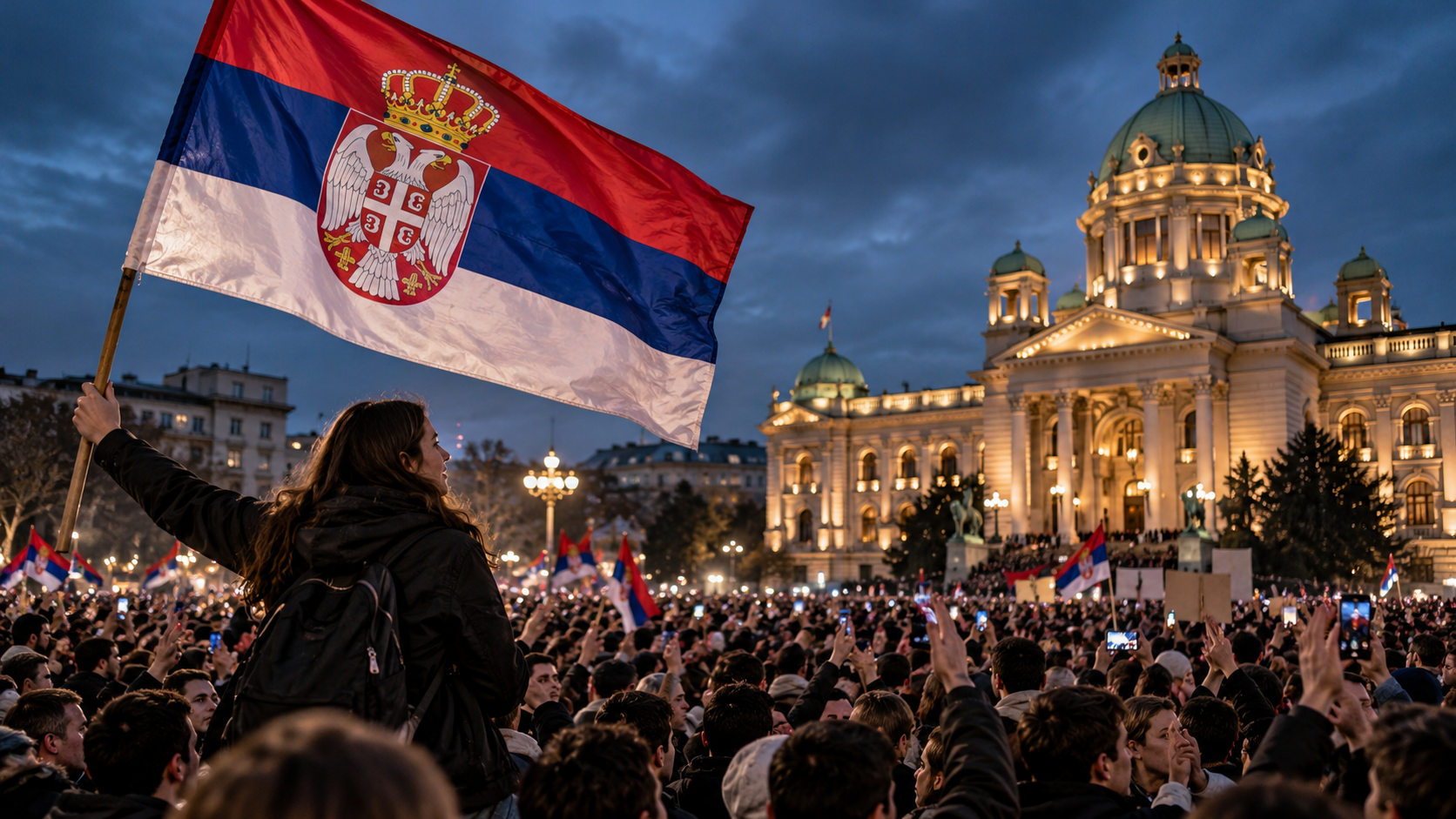
From the Novi Sad tragedy to Vučić’s defeat, youth mobilisation secures a parliamentary majority and opens a new political chapter in the Balkans

Abstract: The early parliamentary elections of 25 October 2026 mark a turning point in Serbia’s political history, bringing to an end the longstanding dominance exercised by Aleksandar Vučić and the Serbian Progressive Party through the victory of the electoral list supported by the student movement, which emerged from protests against corruption and institutional responsibility following the collapse of the railway station canopy in Novi Sad in November 2024. The result, accompanied by exceptionally high voter turnout, carries significance extending beyond the alternation between government and opposition, demonstrating the capacity of civic mobilisation to transform social dissent into political representation and bringing to an end a period characterised by the concentration of power, the weakening of pluralism and growing public distrust of institutions. Considerable challenges await the new political leadership, which must translate demands for legality and renewal into a programme of government, with geopolitical implications for a country positioned between European integration, relations with Russia and economic cooperation with China.
Keywords: #Serbia #SerbianElections2026 #AleksandarVucic #Students #Democracy #PoliticalParticipation #Balkans #EuropeanUnion #RuleOfLaw #Corruption #SocialMovements #ParliamentaryElections #FrancescoMancini #EthicaSocietas #EthicaSocietasReview #ScientificJournal #Humanities #SocialSciences #EthicaSocietasUPLI
From street protests to governing the country
The early parliamentary elections held in Serbia on 25 October 2026 represent far more than the replacement of one parliamentary majority with another, assuming a much deeper political and social significance because they mark the conclusion of a historical phase and demonstrate how even an apparently entrenched system of power can be challenged through citizens’ participation, particularly when collective mobilisation succeeds in moving beyond protest and developing into a credible proposal for change.
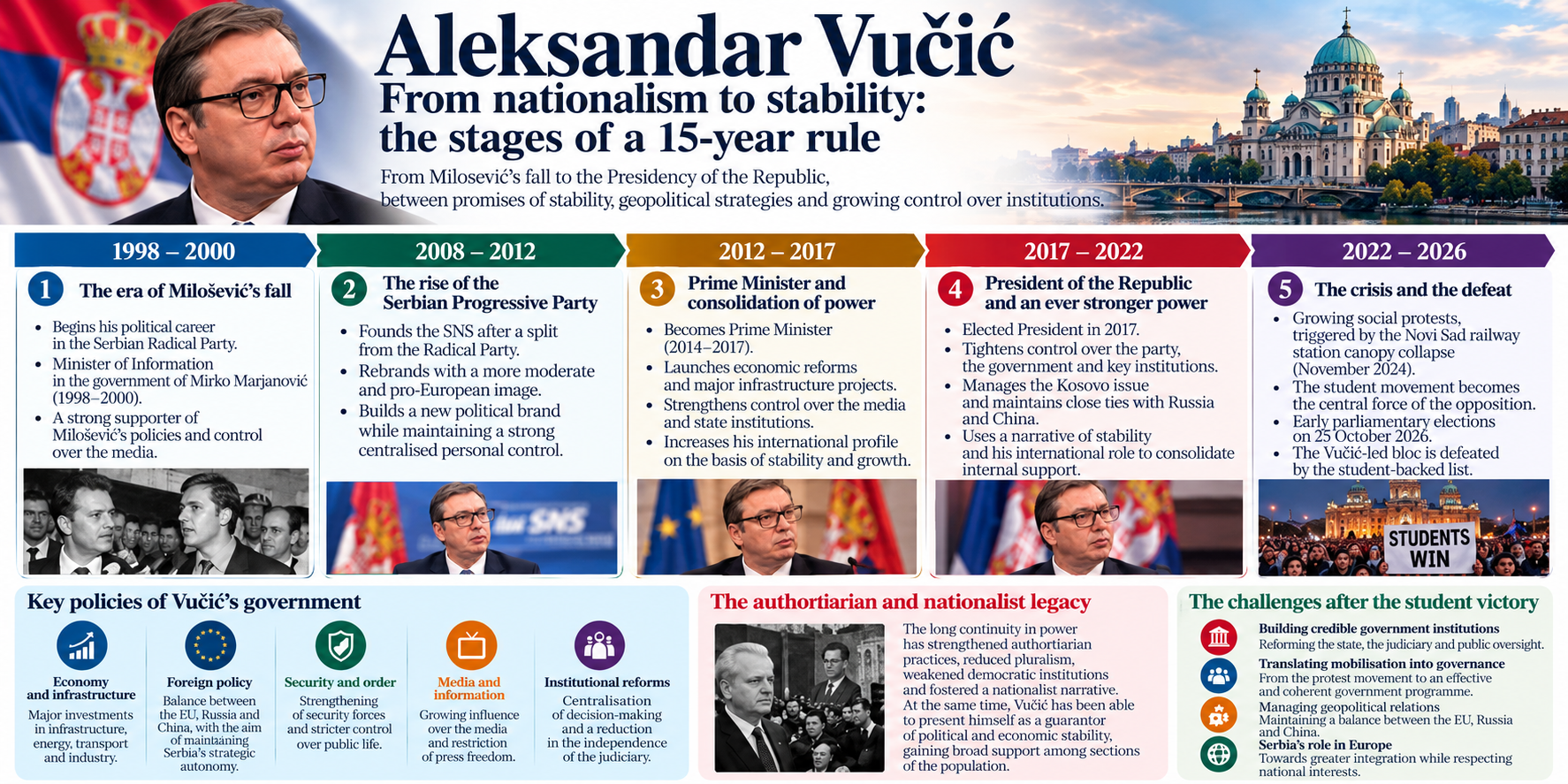
The electoral list supported by Serbian students defeated the coalition led by former President Aleksandar Vučić, who resigned from the presidency of the Republic on 27 September 2026 to participate in the parliamentary contest, thereby bringing to an end the long political period dominated by the Serbian Progressive Party, Srpska napredna stranka (SNS), which had progressively consolidated its institutional position since 2012.
According to figures released on 26 October by the Electoral Commission of the Republic of Serbia, the Studentska lista – Studenti pobeđuju (Student List – Students Win), representing the student movement, secured 2,267,615 votes, equivalent to 52.71%, winning 140 of the 250 seats in the National Assembly, while the Aleksandar Vučić – Ujedinjena Srbija (Aleksandar Vučić – United Serbia) coalition received 1,685,022 votes, corresponding to 39.17%, and obtained 104 seats, with a difference exceeding 582,000 votes and thirteen percentage points.
The significance of the vote cannot, however, be understood merely by comparing the percentages obtained by the competing lists, since the students’ victory represents the culmination of a process of social mobilisation that developed over almost two years, during which a protest initially focused on establishing responsibility for an infrastructure tragedy progressively evolved into a broader challenge to the functioning of institutions and the relationship between political power, public administration and citizens.
Serbia thus demonstrates that political participation is not necessarily confined to traditional party organisations and that a new generation, often portrayed as detached from politics or primarily concerned with the individual dimension of existence, can instead assume a decisive role when it recognises collective mobilisation as a practical means of influencing public decisions.
The Novi Sad tragedy and the crisis of trust in institutions
The popular mobilisation that led to this electoral outcome began on 1 November 2024, following the collapse of the canopy at Novi Sad railway station, which initially claimed fourteen lives, with two further victims subsequently dying from their severe injuries, bringing the total death toll to sixteen and transforming an incident concerning infrastructure safety into the starting point of one of the most significant political mobilisations in Serbia’s recent history.
The tragedy rapidly acquired a broader meaning, as demands for clarification concerning the construction and maintenance of public infrastructure became intertwined with allegations of corruption, administrative opacity and insufficient independence among the institutions responsible for scrutinising political authority, fuelling protests that found their principal organisational centre in universities and among students.
The connection between an infrastructure tragedy and a government’s crisis of legitimacy may appear disproportionate only when the incident is considered in purely material terms, without recognising that citizens’ trust in institutions also depends on the belief that public decisions are taken in the general interest, through transparent procedures and effective oversight, and that responsibility can be established without political interference.
Serbian students progressively built a movement around these demands that was capable of involving different sectors of society, extending beyond universities and attracting support from academics, professionals, workers and citizens who, despite not necessarily sharing the same ideological orientation, recognised transparency and institutional accountability as common objectives.
The movement’s strength also derived from its ability, at least during its initial phase, to avoid identification with traditional political alignments, presenting legality and the democratic functioning of institutions as matters of general interest rather than issues reducible to party confrontation, while the organisation of demonstrations, coordination between universities and development of local networks progressively transformed a protest arising from a specific incident into a nationwide movement.
The generational dimension assumed particular importance in this process, not because students constituted a socially homogeneous group or shared a single political vision, but because their mobilisation introduced forms of participation capable of escaping, at least partially, the affiliations and divisions that had characterised Serbian public life in previous decades.
Vučić’s system of power and the limits of political stability
Understanding the significance of the electoral defeat requires consideration of Aleksandar Vučić’s longstanding centrality in Serbian politics, first as head of government and subsequently as President of the Republic, during a period in which the Serbian Progressive Party exercised decisive influence over national political direction, constructing a model of government based on promises of stability, economic development and the ability to represent the country’s interests within a particularly complex international environment.
During this period, Serbia did experience infrastructure investment, economic transformation and increasing integration into international trade networks, developments that helped consolidate support among a substantial proportion of the population and cannot be disregarded in any overall assessment of Vučić’s political record.
At the same time, however, civic organisations, international observers and opposition parties repeatedly raised concerns about media pluralism, electoral competition, institutional independence and the relationship between political authority and the administrative apparatus, fuelling debate about the progressive concentration of decision-making power and the effectiveness of democratic oversight mechanisms.
The problem emerging from this experience concerns a recurring contradiction in political systems characterised by particularly strong leadership, in which governmental stability may progressively become confused with the continued rule of a particular political class, until democratic alternation itself is portrayed as a threat to order and state continuity.
A democracy, however, cannot be measured solely by its ability to produce rapid decisions or maintain a stable parliamentary majority, but must also be assessed according to whether that majority can be replaced through genuinely open competition, allowing citizens to evaluate the conduct of those governing them and entrust political authority to different representatives.
Vučić’s defeat therefore assumes an institutional significance extending beyond the personal political trajectory of the Serbian leader, demonstrating that even a political system characterised by prolonged governmental continuity can be subjected to the test of popular consent, provided that social mobilisation succeeds in translating itself into sufficiently broad electoral participation.
The significance of exceptional voter turnout
One of the most significant features of the elections held on 25 October was the high level of voter participation, which, according to independent estimates by CRTA, reached approximately 69%, with a margin of error of one percentage point, representing the highest turnout recorded in the country during the twenty-first century.
This development carries significance extending beyond national borders, particularly when compared with the progressive decline in electoral participation observed in numerous European democracies, where abstention is frequently interpreted as an expression of disinterest, distrust or the inability of political organisations to represent society’s needs, whereas the Serbian vote suggests a different interpretation, demonstrating that participation can increase again when a substantial proportion of the population perceives voting as an effective instrument for changing political balances and influencing the conditions of collective life.
The Serbian result therefore demonstrates that protest and representation need not necessarily be regarded as opposing dimensions, since protest can bring visibility to social demands that have remained inadequately represented politically, while representation allows those demands to be translated into governmental responsibility, subjecting them to the test of public consent and the rules of democratic competition. This transformation constitutes one of the most significant aspects of the students’ victory, since the movement has demonstrated its ability to move beyond a predominantly oppositional role and assume responsibility for an institutional proposal, although it must still prove that it possesses the organisational and political capacity required to exercise power.
From universities to Parliament, the difficult test of government
Securing a parliamentary majority represents a major political victory, but it does not automatically translate into the ability to govern a country marked by social tensions, institutional weaknesses and complex international relationships.
The student-backed electoral list includes individuals drawn from universities, professional sectors and civil society, many of whom have no previous experience within the country’s principal national institutions, a characteristic that helped strengthen their credibility as an alternative to the existing political system but may become a source of difficulty when decisions concerning the economy, public administration, justice and foreign policy must be taken.
The predominantly horizontal and non-hierarchical character of the movement, which represented one of its principal strengths during mobilisation, will also have to confront the requirements of a parliamentary system, in which forming a government demands the identification of recognisable leadership, the definition of a political programme and the capacity to guarantee continuity and accountability in the exercise of public functions.
The transition from protest to government inevitably transforms political responsibilities, since a movement founded on demands for transparency and rejection of particular political practices must confront the need to establish priorities, allocate resources, negotiate compromises and take decisions that are unlikely to satisfy simultaneously every social constituency that supported its mobilisation.
Combating corruption, in particular, cannot be reduced to replacing officials associated with the previous majority, but will require measures capable of strengthening the independence of oversight bodies, transparency in public procurement, judicial autonomy and professionalism within public administration, preventing the promise of renewal from becoming merely a different form of political control over institutions.
The credibility of the new majority will therefore also depend on its ability to distinguish the legitimate need to establish responsibility from the temptation to use state institutions to settle political scores, since genuinely democratic transformation cannot be limited to changing those who exercise power, but must also change the conditions that ensure its accountability and oversight.
The students’ success will consequently be measured not only by their ability to bring a prolonged political period to an end, but above all by their capacity to build more transparent and pluralistic institutions, in which political alternation is no longer perceived as an exceptional event but as an ordinary component of democratic life.
From electoral success to the next presidential elections
Serbia’s political transformation also assumes considerable geopolitical significance, since it concerns a country occupying a central position within the Western Balkans and which, over the years, has sought to maintain simultaneous relations with the European Union, Russia and China, pursuing a strategy of balance between international partners whose interests frequently diverge.
Serbia is a candidate for accession to the European Union, its principal trading partner, but maintains historical, cultural and energy ties with Russia, while economic cooperation with China has assumed increasing importance through infrastructure and industrial investment.
Vučić’s foreign policy developed precisely through the pursuit of equilibrium between these relationships, presenting Belgrade’s decision-making autonomy as an instrument for protecting the national interest, while frequently raising questions about the compatibility between European integration and the maintenance of privileged relations with Moscow.
The victory of the student-backed list could encourage greater attention to the institutional reforms required within the European accession process, particularly concerning the rule of law, judicial independence, media freedom and the fight against corruption, but it would be premature to interpret it as a guarantee of Serbia’s immediate geopolitical realignment.
The movement that secured the parliamentary majority emerged primarily around domestic demands concerning institutional functioning and public accountability, while international issues, beginning with relations with Kosovo and extending to Russia and China, remain shaped by political and identity-based sensitivities that cannot automatically be reduced to a confrontation between Europeanism and nationalism.
The European Union should therefore avoid treating the electoral result exclusively as a geopolitical victory, recognising that the credibility of its relationship with Serbia will also depend on its ability to support the democratic strengthening of institutions without subordinating every assessment to the new government’s international alignment.
Serbia between past and future, between the European Union, Russia and China
Serbia’s political transformation also assumes considerable geopolitical significance, since it concerns a country occupying a central position within the Western Balkans and which, over the years, has sought to maintain simultaneous relations with the European Union, Russia and China, pursuing a strategy of balance between international partners whose interests frequently diverge.
Serbia is a candidate for accession to the European Union, its principal trading partner, but maintains historical, cultural and energy ties with Russia, while economic cooperation with China has assumed increasing importance through infrastructure and industrial investment. Vučić’s foreign policy developed precisely through the pursuit of equilibrium between these relationships, presenting Belgrade’s decision-making autonomy as an instrument for protecting the national interest, while frequently raising questions about the compatibility between European integration and the maintenance of privileged relations with Moscow.
The victory of the student-backed list could encourage greater attention to the institutional reforms required within the European accession process, particularly concerning the rule of law, judicial independence, media freedom and the fight against corruption, but it would be premature to interpret it as a guarantee of Serbia’s immediate geopolitical realignment.
The movement that secured the parliamentary majority emerged primarily around domestic demands concerning institutional functioning and public accountability, while international issues, beginning with relations with Kosovo and extending to Russia and China, remain shaped by political and identity-based sensitivities that cannot automatically be reduced to a confrontation between Europeanism and nationalism.
The European Union should therefore avoid treating the electoral result exclusively as a geopolitical victory, recognising that the credibility of its relationship with Serbia will also depend on its ability to support the democratic strengthening of institutions without subordinating every assessment to the new government’s international alignment.
The crisis of Europe’s nationalist right
The Serbian elections of 25 October 2026 carry significance extending beyond national borders, since the defeat of the political system constructed around Aleksandar Vučić exposes certain weaknesses in models of government founded on the personalisation of power, the rhetoric of national sovereignty and promises of stability. This does not necessarily mark the beginning of a generalised crisis of Europe’s nationalist right, which continues to represent a significant component of the continent’s political landscape, but rather demonstrates that no leadership, however firmly established, can regard electoral support as a permanent possession.
The mobilisation of Serbian students is particularly significant because it did not develop primarily through the traditional confrontation between right and left, nor around the conflict between nationalism and Europeanism, but through demands for legality, transparency and institutional accountability, succeeding in involving different sectors of society and transforming civic protest into a parliamentary majority. The Novi Sad tragedy represented the breaking point in an already weakened relationship of trust, demonstrating how institutional quality directly affects citizens’ safety and the protection of the general interest.
The Serbian experience thus offers an opportunity for reflection for other European democracies, in which the growing prominence of nationalist and sovereigntist movements raises questions concerning the relationship between popular consent, institutional pluralism and the concentration of power. National sovereignty cannot, in fact, be equated with the continued rule of a particular political class, but must find expression in citizens’ ability to scrutinise and democratically replace those who govern.
The new student-backed majority must now demonstrate its ability to translate demands for change into more transparent, independent and pluralistic institutions, without reproducing the practices challenged under the previous political system. The lesson emerging from Serbia therefore does not consist in the definitive defeat of nationalism, but in the reaffirmation of the principle that no political authority is exempt from democratic scrutiny, since electoral victory does not represent the fulfilment of democracy, but the beginning of the responsibility to exercise it.
References and sources
Electoral Commission of the Republic of Serbia (Republička izborna komisija). (2026, 26 October). Preliminary election results from 8,187 polling stations determined. Communication of the preliminary official results of the early parliamentary elections held on 25 October 2026.
CRTA. (2026, 26 October). The CRTA Election Observation Mission Presented Its Preliminary Assessment of Election Day: Mobilization Against Electoral Engineering. Preliminary election observation report.
CRTA. (2026, 26 October). Record turnout gives Student List an absolute majority, CRTA projection shows. Analysis of electoral participation and projections.
Reuters. (2026, 25 October). Serbia’s Vučić concedes defeat to student-led movement in parliamentary election.
Reuters. (2026, 26 October). After Vučić defeat, Serbia waits to see how student-backed leaders will govern.
ANSA. (2026, 25 October). Students win elections in Serbia, announces defeated Vučić.
Government of the Republic of Serbia. (2026, 9 September). President of Republic calls parliamentary elections for 25 October.
Government of the Republic of Serbia. (2026, 27 September). President of Republic of Serbia Aleksandar Vučić resigns.
Cohen, J. L., & Arato, A. (1992). Civil Society and Political Theory. MIT Press.
Dahl, R. A. (1971). Polyarchy: Participation and Opposition. Yale University Press.
Tilly, C., & Tarrow, S. (2015). Contentious Politics (2nd ed.). Oxford University Press.
Latest 5 Contributions by the Same Author
Anna Politkovskaya: Twenty Years After Her Murder, the Truth Remains Incomplete
October 7, Three Years Later Between Memory, Conflict and the Construction of the Public Narrative
Oriana Fallaci, Twenty Years Later
Emma Bonino: Freedom Against the Morality Imposed by Others
Will Humans Govern AI, or Will AI Govern Humans? [VIDEO]
Latest 5 Contributions on Geopolitics
Geography of vulnerability and regional security in the Horn of Africa
Ukraine: The Promised Peace and the Continuing War
When Climate Change Reshapes Global Strategy
Latest 5 Contributions
We Have Gone Too Far, and Social Networks Have Become a Threat to Society
Circular Economy: The Physical Limits of an Imperfect Circle
16 October: The Return of Antisemitism
Data: The New Capital of Organised Crime
October 7, Three Years Later Between Memory, Conflict and the Construction of the Public Narrative
Ethica Societas is a free, non-profit news publication published by a non-profit social cooperative
Copyright Ethica Societas, Human&Social Science Review © 2026 by Ethica Societas UPLI onlus.
ISSN 2785-602X. Licensed under CC BY-NC 4.0