

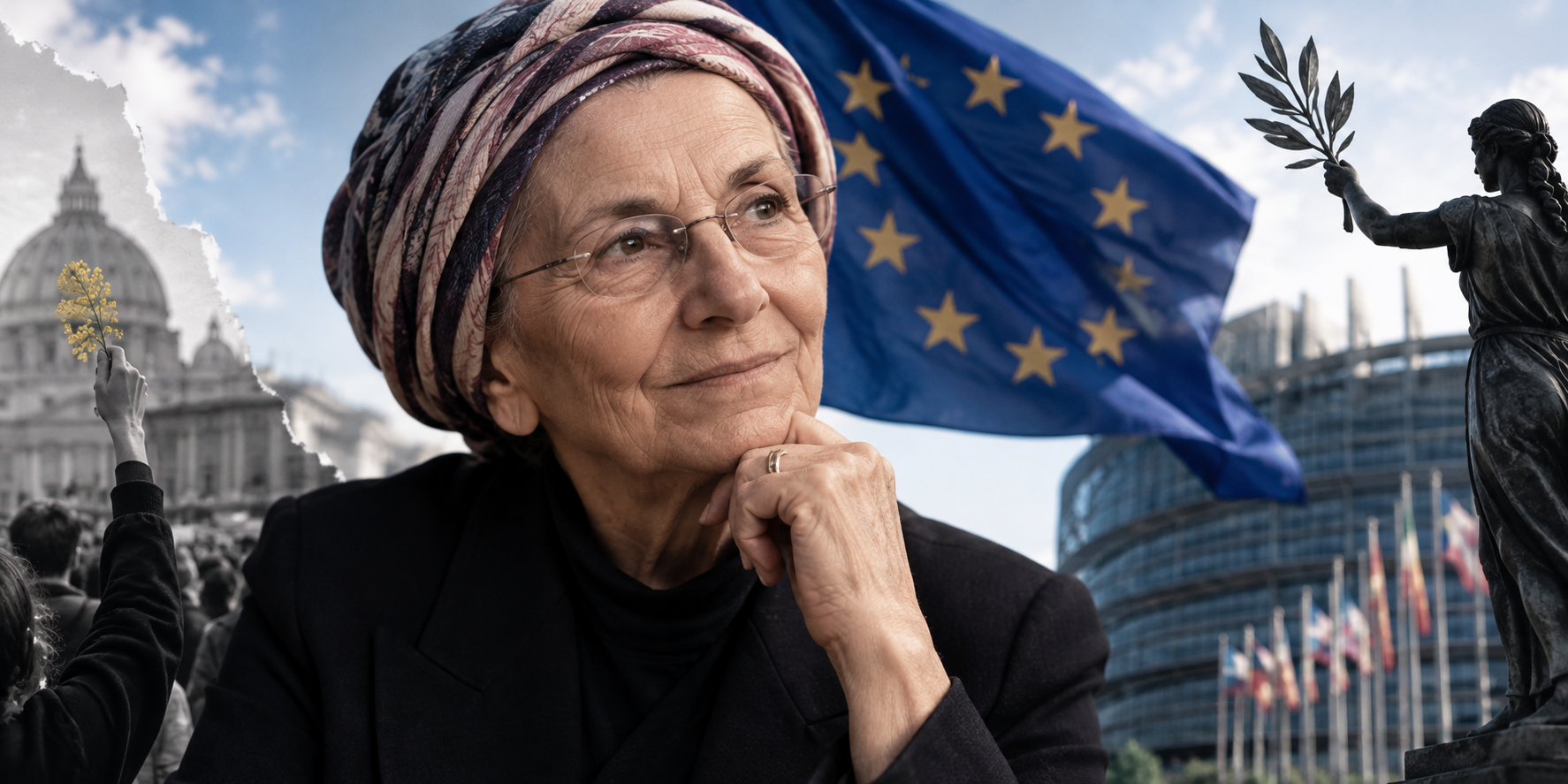
From Women’s Self-Determination to the United States of Europe: A Political Life Shaped by the Radical Idea That the State Should Guarantee Freedom, Not Impose Morality

Abstract: Emma Bonino’s political history spans half a century of transformation in Italian and European society while preserving a continuity that is difficult to separate from the Radical tradition in which she was formed: individual freedom understood as a limit on the power of the state, majorities and social conventions. From civil disobedience in support of abortion rights to campaigns against the death penalty, from opposition to female genital mutilation to the establishment of the International Criminal Court, and ultimately to the defence of European integration and the prospect of a United States of Europe, her political action often anticipated the institutional recognition of the rights for which she campaigned. Not all of her positions became majority views, and some remained deeply controversial, yet the coherence of her trajectory can be found precisely in her refusal to subordinate individual freedom to dominant morality and in her conviction that rights acquire their fullest meaning when they protect those who belong to a minority. Her Europeanism arose from the same conception: overcoming the absolute sovereignty of states through common institutions, supranational law and shared responsibilities. Her death on 11 September 2026 brings to a close one of the most recognisable experiences of Italian Radicalism, while leaving unresolved the question that accompanied her throughout her life: how far is a free society willing to recognise freedom even for those who make choices that the majority does not share?
Keywords: #EmmaBonino #Freedom #CivilRights #HumanRights #SelfDetermination #Secularism #CivilDisobedience #Abortion #DeathPenalty #InternationalCriminalCourt #Europe #Europeanism #UnitedStatesOfEurope #RadicalParty #FrancescoMancini #EthicaSocietas #EthicaSocietasReview #ScientificJournal #SocialSciences #ethicasocietasupli
Freedom When It Is Uncomfortable
Emma Bonino died in Rome on 11 September 2026 at the age of 78, after more than half a century at the centre of Italian and European public life, holding offices that took her from the Italian Parliament to the European Parliament, from government to the European Commission and, eventually, to the Ministry of Foreign Affairs. Yet the institutional dimension never entirely erased the Radical activist from whom everything had begun.
Reducing her biography to a succession of public offices would, however, tell only its most visible part, because what makes her experience politically significant is not so much that she succeeded in entering institutions as that she spent much of her life forcing those institutions to confront issues that, at the time they were raised, were often regarded as uncomfortable, divisive, morally controversial or simply premature.
There is, in fact, a clearly recognisable thread running through battles that may initially appear distant from one another, and it allows her history to be read beyond chronology: freedom acquires its deepest political meaning not when it protects choices that the majority regards as normal and acceptable, because such choices rarely require protection, but when it guarantees individuals the possibility of making choices that others consider wrong, immoral, improper or simply different from their own, up to the point at which the exercise of one person’s freedom encounters the rights and freedom of others.
This distinction is less obvious than it may appear, because it requires separating the sphere of law from that of morality without naively pretending to remove morality from society altogether. A community may continue to regard a particular form of conduct as wrong, a religious denomination may define it as sinful, and individuals may consider it incompatible with their own values. The properly political question begins, however, when we ask whether that moral judgement is sufficient to grant the state the power to prevent others from making that choice as well.
A considerable part of Emma Bonino’s political history can be read precisely within this tension between freedom, law and collective morality.
When Breaking the Law Meant Demanding That It Be Changed
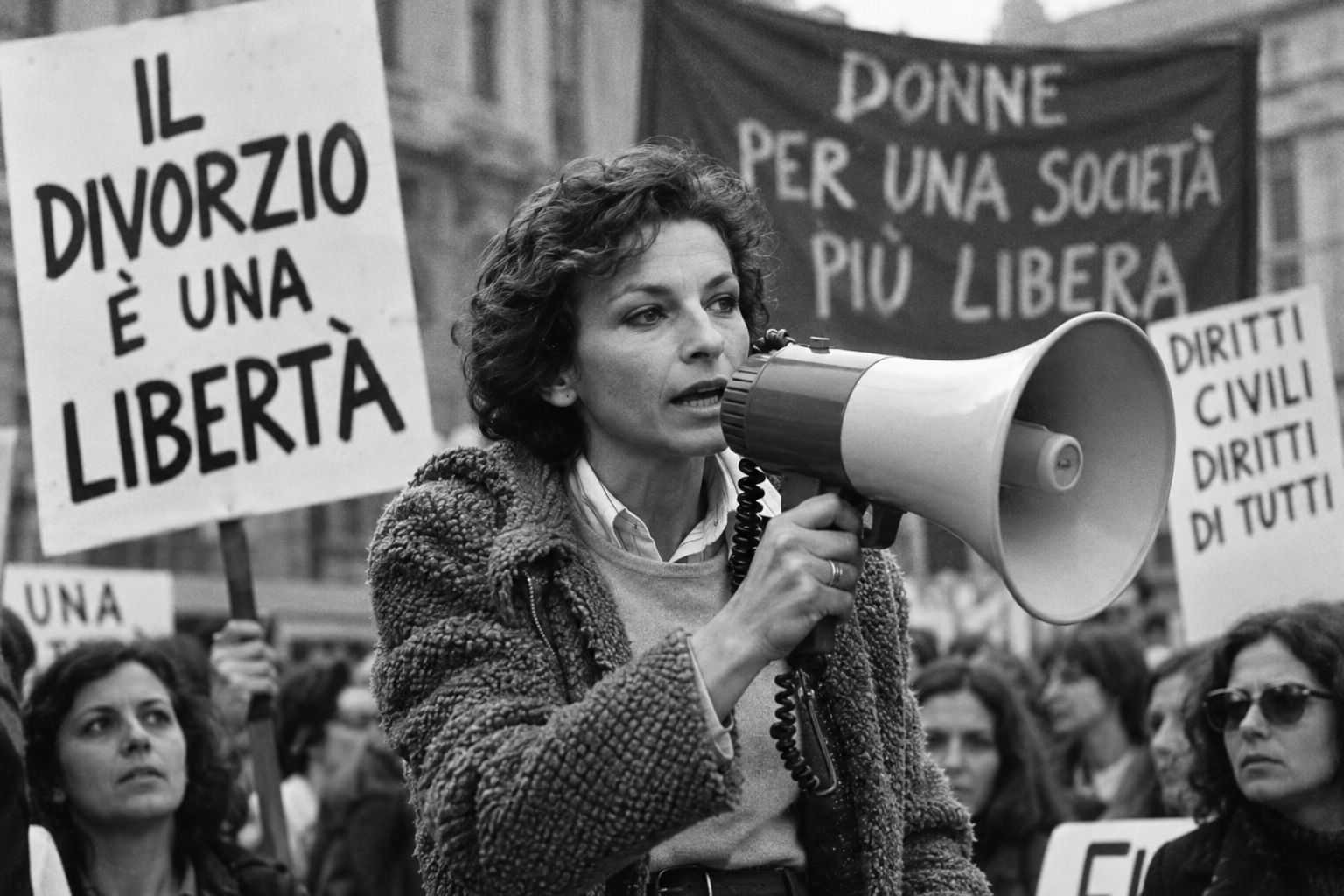
The campaign for voluntary termination of pregnancy is probably the clearest example. In the mid-1970s, Bonino took part in the activities of CISA, the Information Centre on Sterilisation and Abortion, transforming self-reporting and civil disobedience into instruments for making visible the distance between the legal order and a social reality that criminal prohibition had failed to eliminate and had instead helped confine to clandestinity.
Her personal and political experience thus converged with the campaign for the legalisation of abortion, at a time when publicly discussing termination of pregnancy still meant confronting strong social stigma and criminal repression.
Law No. 194 would eventually be adopted in 1978, at the end of a political, social and parliamentary process far broader than the Radical movement alone, in which the feminist movement, political parties, associations and wider cultural change within Italian society all played decisive roles. It would therefore be historically inaccurate to attribute the achievement of that right to Bonino alone, just as it would be reductive to erase the contribution of Radical mobilisation in transforming a private and clandestine issue into a political problem that institutions could no longer avoid confronting.
What remains especially significant in that episode, however, is not simply the question of abortion itself, but the principle of personal autonomy contained within it. Defending a woman’s right to terminate a pregnancy did not mean claiming that every woman should make that choice, nor that the choice was morally irrelevant. It meant asserting that, within the limits and safeguards established by law, the decision could not be transferred entirely to the state, a religious denomination, a political party or the social majority.
This is a more demanding conception of freedom than the one celebrated in the abstract, because it requires accepting that another person may use their autonomy to choose something that we ourselves, in the same circumstances, would not choose.
No One Is Free Only in the Choices We Approve
It is within this framework that one can understand why Radical campaigns so often crossed politically uncomfortable terrain and resisted reduction to the traditional division between right and left. Bonino campaigned for women’s self-determination, against the death penalty and female genital mutilation, against world hunger and for the construction of international criminal justice. Alongside the broader Radical movement, she also pursued campaigns on issues that continued to encounter deep cultural and political resistance.
In commemorating her after her death, the European Commission explicitly linked her European experience to the defence of human rights, women’s rights, international justice and the abolition of capital punishment.
It is not necessary to share each of these positions in order to recognise the political and cultural structure that held them together. Indeed, perhaps the least interesting way to remember Emma Bonino would be to turn her, after her death, into a figure upon whom everyone suddenly agrees, thereby erasing precisely the conflictual dimension that characterised much of her public presence.
Her campaigns encountered strong political, religious and cultural opposition. Some progressively entered the legal order and social custom; others remained minority positions, while still others continue to divide public opinion. Yet it is precisely this conflict that reveals the meaning of her political experience, because a Radical conception of freedom does not arise from the need to produce consensus around every individual choice, but from the determination to protect the space in which dissent and difference can continue to exist.
From this perspective, the issue is not to construct a society without morality—an idea that would be sociologically impossible before even becoming politically questionable—but to prevent a particular morality, merely because it is dominant at a given historical moment, from automatically becoming the power to determine how everyone else must live.
If freedom means anything, it must also apply when it becomes uncomfortable.
Rights Without Borders
Over the years, this conception of freedom increasingly moved beyond Italian borders, because the campaigns against the death penalty, against female genital mutilation, the attention devoted to humanitarian crises and the support for international criminal justice all began from the same premise: if fundamental rights belong to individuals as such, their existence cannot depend entirely on the passport they hold or on the government under which they happen to have been born.
As European Commissioner between 1995 and 1999, Bonino’s responsibilities included humanitarian aid, and she directly followed some of the most serious international crises of the period, from the Balkans to Rwanda and Afghanistan. At the same time, her international engagement became closely linked to campaigns for international criminal justice and against capital punishment, establishing a connection between rights, supranational institutions and international responsibility that would remain recognisable throughout the rest of her political career.
From this perspective, a further step emerges. State sovereignty is not regarded as a principle to be abolished, but neither is it treated as an absolute shield behind which any form of power may escape external limits. This conception has become particularly controversial in a historical phase in which national sovereignty has regained prominence within European and international debate, but precisely for this reason it helps explain why, in Bonino’s political biography, Europeanism and individual rights were never separate chapters.
Europe Not as Geography, but as a Political Choice
Emma Bonino was not a Europeanist simply because she supported the European Union as it existed. Her Europeanism belonged to a much more demanding federalist tradition and looked towards the prospect of a United States of Europe as a possible way of overcoming a system in which increasingly transnational problems continued to be governed through predominantly national political structures.
After her death, Sergio Mattarella specifically recalled the unity and deeper integration of the European Union as one of the priorities that had characterised the final years of her public engagement.
Europe, therefore, was not contemplated as a completed project, but rather precisely through its incompleteness: highly integrated economies, a common currency across much of the Union, interconnected legal systems and a space in which millions of citizens study, work and move across borders that have lost much of the meaning they held for previous generations continue to coexist with foreign policy, defence policy and decision-making capacities that remain largely dependent on national sovereignties.
In Bonino’s vision, European federalism therefore became, on a different scale, an extension of the same distrust of the absolute concentration of power that had informed her campaigns on individual rights: first, preventing the state from absorbing the freedom of the individual entirely; then, preventing national sovereignty from becoming the insurmountable horizon of European politics.
This solution can of course be contested. One may prefer a more confederal Europe or attach greater value to state sovereignty. What remains historically recognisable is the consistency with which Bonino defended her alternative, even when the federalist project appeared far removed from the political priorities of the time.
Coherence Does Not Mean Remaining Still
To describe a political life lasting fifty years as coherent should not mean constructing an artificial retrospective linearity, as though it had been free of contradictions, errors, defeats, compromises or changes. No real political experience could meet such a standard, and stripping Bonino of this complexity would paradoxically impoverish her biography at the very moment one sought to celebrate it.
Her history crossed different alliances, institutional offices, transformations within Italian Radicalism, divisions and also the painful break with Marco Pannella during the final years of his life. Yet Bonino continued to acknowledge how profoundly that encounter had shaped her political formation, recalling as recently as 2026 that Pannella had marked her life “like no one else”.
The most interesting form of coherence, after all, is not that of someone who repeats the same formulas for half a century before a changing society, but that of someone who preserves a number of fundamental criteria and attempts to apply them to new problems.
In Bonino’s case, those criteria remained broadly recognisable in individual self-determination, the secular character of institutions, the rule of law, the protection of minorities, personal responsibility, the universalisation of rights and the prospect of a more politically integrated Europe.
In this sense, her ability to occupy major institutional positions without ever fully identifying with establishment politics represents one of the most distinctive features of her trajectory. The activist who had used civil disobedience to challenge a law would later become European Commissioner and Foreign Minister, yet the transition from protest to institution did not erase the conviction that institutions themselves can and should be challenged when they cease to protect individual freedom.
The Right to Be a Minority
Perhaps there is one word capable of interpreting Emma Bonino’s political life better than any other: minority.
Many of the causes to which she devoted herself began as minority positions, unpopular or openly scandalous. Some would become, decades later, part of Italy’s legal and cultural normality, while others would never reach that condition. It is precisely within this distance between what a society regards as acceptable at a given historical moment and what it may regard as normal a generation later that her experience acquires significance beyond the celebration of individual victories.
A liberal democracy, in fact, is measured not only by the ability of the majority to govern—an essential principle of any democratic system—but also by the amount of freedom that same majority is willing to recognise for those who do not resemble it, do not share its values or choose to live differently.
If freedom continues to be recognised only so long as it is exercised in ways we consider morally correct, what is being granted is not really freedom, but permission conditional upon conformity.
Bonino carried this conception to positions that many Italians contested and that others will continue legitimately to contest. Yet precisely this disagreement allows the central point to emerge: a liberal political culture does not require everyone to approve the same individual choices. It requires, rather, that the distinction remain politically intelligible between “I do not agree with what you do” and “I want the state to prevent you from doing it”.
This is probably one of the aspects of her legacy most at risk of disappearing if collective memory reduces her to the reassuring image of a great campaigner for rights, because the rights that now appear reassuring are often those for which there is no longer any need to fight, while the true measure of a free society continues to lie in the rights that divide, disturb and compel the majority to confront those who do not resemble it.
Continuing Without Turning Her into a Monument
At the state funeral held on 15 September 2026, conducted in secular form in the Sala della Protomoteca at the Capitoline Hill in the presence of the highest offices of the state, the public memory of Emma Bonino inevitably brought together within a single figure experiences that had been far more conflictual during her lifetime: Radicalism, Europeanism, civil rights, international justice, minority campaigns and that conception of freedom which had taken an activist arrested in the 1970s and turned her, decades later, into one of the most recognisable Italian figures within European institutions.
Such is the fate of figures who enter collective memory: once they are gone, they tend to become less controversial than they were when they could still intervene, disturb, contradict and divide.
For Emma Bonino, however, this would be a particularly striking paradox, because remembering her should not mean retrospectively attributing absolute correctness to her, nor transforming all her campaigns into truths removed from debate. It should mean preserving the political question that made those campaigns possible: how much power are we prepared to grant the majority over the lives of those who are not part of it?
She lived long enough to see some campaigns move from scandal to public debate, from debate to law and, ultimately, from law to social normality. She did not, however, live to see the federal Europe towards which she continued to look.
It is perhaps precisely in the distance between these two outcomes that the most interesting dimension of her consistency can be identified, because to engage politically for a freedom that does not yet exist means accepting the possibility of fighting without knowing whether that battle will be won, whether it will be understood, or even whether one will live long enough to see its effects.
It is a conception of politics far removed from the contemporary immediacy of consensus, metrics and instant communication, because it does not ask only what the majority thinks today, but what kind of society is being built for those who today remain outside that majority.
And perhaps this is the youngest, and at the same time the most Radical, question that Emma Bonino’s history continues to leave to a generation that grew up taking for granted freedoms which, for the previous generation, were still crimes, scandals or political battles:
how willing are we, really, to defend freedom when the person exercising it chooses differently from us?
LATEST 5 CONTRIBUTIONS BY THE SAME AUTHOR
Will Humans Govern AI, or Will AI Govern Humans? [VIDEO]
“Love That Moves Sun and Other Stars”: the Theme of the 2026 Meeting [WITH VIDEO]
The Eightieth Anniversary of the Italian Republic
The State of the Global and National Economy in the Governor’s Final Considerations
LATEST 5 CONTRIBUTIONS ON POLITICS
The Italian Republic’s Longest-Serving Government Faces the Test of the Economy
When Climate Change Reshapes Global Strategy
Draghi in Aachen: Europe Alone Before the Test of Sovereignty
Holocaust Remembrance and Contemporary Antisemitism
LATEST 5 CONTRIBUTIONS
From Rights to Practice: When the Community Takes Responsibility for the Future
2001–2026: Twenty-Five Years of the War on Terror
Ethica Societas is a free, non-profit review published by a social cooperative non-profit organization
Copyright Ethica Societas, Human&Social Science Review © 2026 by Ethica Societas UPLI onlus.
ISSN 2785-602X. Licensed under CC BY-NC 4.0