

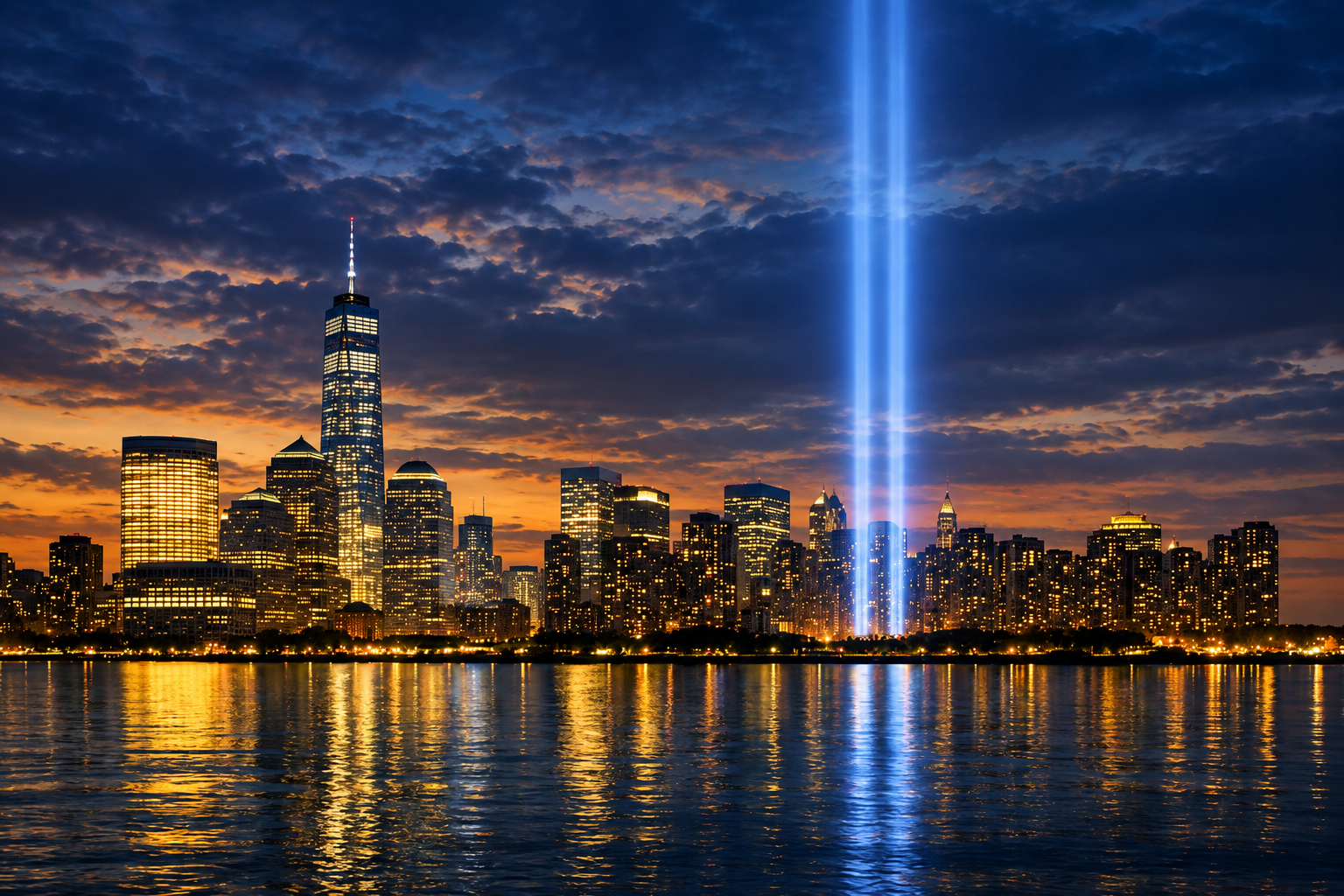
Twenty-five years later, who tells the story of what happened to those who remained alive?

Abstract: The attacks of 11 September 2001 transformed not only geopolitical balances and security policies, but also the social meaning of Muslim identity. For millions of people, religious belonging progressively became an object of scrutiny, explanation, suspicion and demands for public dissociation from terrorism. Islamophobia, discrimination, stigmatisation and identity-related tensions represent some of the less explored dimensions of the legacy of 9/11. Without establishing any automatic relationship between exclusion and radicalisation, conditions of marginalisation, humiliation and fragile belonging may constitute vulnerabilities that terrorist organisations can exploit through promises of recognition, meaning and community. Twenty-five years after the attacks, one question therefore remains: what does it mean to live within an identity that the world has learned to interpret, in part, through the lens of security?
Keywords: #September11 #Islamophobia #Muslims #Identity #Memory #Discrimination #Stereotypes #Belonging #SocialPsychology #ReligiousIdentity #Stigma #Security #Terrorism #Radicalisation #Education #EuropeanMuslims #Vulnerability #ElhemBeddouda #EthicaSocietas #EthicaSocietasReview #ScientificJournal #Humanities #SocialSciences #EthicaSocietasUPLI
versione italiana
The living victims
Every year, when the calendar returns to 11 September, collective memory inevitably turns to the people who lost their lives in the 2001 attacks, to the destroyed buildings, the hijacked aircraft, the first responders, the affected families and, subsequently, to the wars, military operations and geopolitical transformations produced by the new international era inaugurated by those events.
Remembering is necessary, because memory constitutes a form of responsibility towards the victims and prevents death from being progressively absorbed into statistics and stripped of its human dimension. Yet precisely because memory must be complete, a further question arises: what happened to those who remained alive?
The question does not concern only those who physically survived the attacks. It also concerns millions of individuals who bore no responsibility whatsoever for the events of 11 September, yet found themselves living in a world in which the social meaning of their identity had changed.
Among them are millions of Muslims.
They had not organised the attacks, had not chosen al-Qaeda, had not developed jihadist doctrine and had not decided the wars that followed. Yet, in many Western contexts, Muslim identity progressively entered a new semantic field in which religion, immigration, integration, extremism and security were frequently associated.
The point is not to claim that every Muslim came to be regarded as a terrorist. Such a statement would plainly be false and would fail to reflect the complexity of Western societies. The more significant phenomenon lies instead in the transformation of Muslim identity into an identity that, in certain contexts, had to be explained, interpreted and rendered reassuring.
The Muslim did not necessarily become an accused person. More subtly, the Muslim could become someone expected to demonstrate that they did not represent a threat.
It is within this transformation that the history of the living victims of 9/11 can be located: people who continued to live, study, work, build families and participate in society, but who did so in an environment in which part of their religious identity had suddenly been placed under a new social lens.
The problem of guilt changing ownership
One of the most significant consequences of 9/11 was the gradual perceptual shift from individual responsibility towards collective representation. The attacks were carried out by individuals belonging to specific organisations within a particular political and ideological history. Yet the symbolic power of the event helped make the association between Islam, Muslims and terrorism culturally available, even where such an association had no relevance whatsoever to individual responsibility.
This phenomenon should not be interpreted only through the most explicit forms of prejudice. The more complex issue concerns the existence of a cognitive category through which certain ordinary behaviours can be interpreted through the prism of security.
An Arabic name, the hijab, a beard, attendance at a mosque, the language spoken, family origins or even the public expression of faith may, in certain contexts, become elements subjected to an interpretation that exceeds their original meaning.
None of these elements is, of course, an indicator of terrorism. Yet in the post-9/11 world, Muslim identity has frequently been located at the intersection of religion, security, immigration and integration.
It is this symbolic overlap, more than explicit accusation itself, that deserves attention. A Muslim does not need to be directly accused in order to feel scrutinised; it may be sufficient to perceive that their identity is being read through an implicit security question.
In this sense, guilt can change ownership: responsibility for the acts of a specific terrorist group may become, within social perception, an issue that a Muslim person feels required continually to clarify, even when there is no connection whatsoever between their life and the criminal act.
From individual responsibility to the need to prove innocence
After a crime, the fundamental question should concern those responsible: who committed the act, which organisations planned it, which networks supported it and which conditions enabled it to occur.
In the case of 9/11, however, part of the Muslim population gradually encountered a different question, one that was more implicit but psychologically significant: “Which side are you on?” and, above all, “Can you prove that you are not like them?”
The distinction is far from marginal, because it means that innocence, rather than being presumed, may become something individuals feel compelled to make publicly visible. From this emerges a form of performative innocence, in which having no responsibility is no longer sufficient: one feels required to declare and demonstrate it.
The phenomenon of “Not in my name” can also be interpreted from this perspective. On the one hand, it represents a legitimate and important response by Muslims who reject the use of their religion as a justification for violence. On the other, its widespread use may also reveal social pressure: why should a Muslim person be required publicly to dissociate themselves from a terrorist attack more than a Christian, atheist, Jew or Buddhist is expected to dissociate themselves in advance from every crime committed by someone who shares their religious or cultural identity?
“Not in my name” can therefore be simultaneously an act of agency and the product of pressure. It can express freedom while also revealing the perceived need to reassure an external gaze.
Behind the statement “do not do this in my name” there may therefore be an even deeper appeal: “Please, do not think that I am one of them.”
The social construction of the “good Muslim”
One of the subtler effects of the post-9/11 environment concerns the construction of an implicitly normative figure: the “good Muslim”.
This is the Muslim who condemns terrorism, describes themselves as moderate, supports democratic principles, respects women, distances themselves from extremism and remains willing to explain their religion to the majority society.
None of these characteristics is problematic in itself. The problem arises when they become implicit conditions of social acceptability.
If a person is judged not only by what they do but also by their ability continually to demonstrate that they belong to the “right side”, identity can become a space of self-monitoring. A Muslim may begin to ask not only what they think, but how what they think will be interpreted by others. They may wonder whether a political criticism will be read as extremism, whether a religious position will be interpreted as backwardness, whether defending Palestinian rights will automatically be associated with an extremist position, or whether simply being deeply religious will be regarded as incompatible with full membership in Western society.
In this sense, the external gaze may become internalised.
Concrete surveillance is no longer necessary if individuals learn to monitor themselves.
When the external gaze enters identity
The most consequential form of discrimination is not necessarily expressed through an explicit insult. It may take the more discreet form of being constantly aware that one is open to interpretation.
Social psychology has examined the processes through which stigma and social expectations can influence self-representation and the individual’s relationship with group belonging. For Muslims, this can generate a paradox.
The more society asks a person to demonstrate that their identity poses no danger, the more that person may be forced to think about their identity through the category of danger itself.
This does not necessarily amount to self-hatred, nor does it automatically lead to an identity crisis. Individual experiences may generate very different responses: stronger religious identification, increased civic engagement, rejection of identity, assimilation, silence, activism or simple indifference.
The sociologically relevant point, however, is that identity may become more reflexive and more dependent on the gaze of others.
The individual no longer asks only, “Who am I?” but also, “How am I being read?”
The body as a social document
This dynamic becomes particularly visible among people whose religious identity is outwardly recognisable.
For many Muslim women who wear the hijab, for example, religion is not merely an internal dimension but becomes an immediately legible feature within the social environment. The body consequently acquires a semiotic function: the veil, the name, the beard, the language or other elements may become signs through which an observer constructs an image of the person before knowing anything about their history.
The issue therefore extends beyond individual prejudice. It concerns the transformation of religious identity into a public sign subject to interpretation.
Some people can move through social space without their religious belonging becoming immediately relevant. Others visibly carry that belonging on their bodies.
This produces a fundamental distinction between being Muslim and being perceived as Muslim.
The second condition introduces into social interaction an element that the individual may never have chosen to make central, but which is rendered central by the gaze of others.
Discrimination as a structure of possibilities
Islamophobia is sometimes reduced to incidents of physical violence or verbal abuse, but discrimination can take much more widespread and less visible forms. It may affect access to employment, housing, education, services and social opportunities.
Research by the European Union Agency for Fundamental Rights on Muslims in the European Union shows that experiences of discrimination significantly affect employment and housing in particular, and that certain groups, including young women wearing religious clothing, face especially high levels of exposure.
These findings do not justify portraying European society as a uniformly hostile bloc towards Muslims. Such an interpretation would be as simplistic as its opposite: the image of a society entirely free from prejudice.
Reality consists of the simultaneous presence of stigma and solidarity, exclusion and belonging, discrimination and recognition.
It is precisely this ambivalence that requires a more careful scientific approach. European Muslims are not a homogeneous group and do not respond identically to discriminatory experiences. Yet the fact that discrimination can affect structural dimensions of life means that the issue cannot be confined to the individual sphere.
The invisible economy of fear
There is also an economic dimension that is rarely connected directly to the transformation produced by 9/11.
Fear has economic consequences, as does the perception of being under scrutiny or having continually to demonstrate trustworthiness. A person who avoids particular environments, professions, discussions or behaviours for fear of being misunderstood may experience indirect consequences for social mobility.
It would be methodologically incorrect to attribute every economic disadvantage experienced by a Muslim to 9/11. Inequality has multiple causes and interacts with social class, gender, family background, migration status, education and territorial conditions.
Nevertheless, the post-9/11 environment contributed to creating an additional context in which Muslim belonging became more frequently associated with questions of security, trustworthiness and integration.
When an identity is subjected to this type of association, the economic dimension cannot be entirely separated from the symbolic one.
The generation born after 2001
An even more complex question concerns those born after 11 September.
For this generation, 2001 is not an autobiographical memory but an inherited one. It is a photograph, a documentary, a page of history, a collection of family and school narratives and, above all, an event that shaped the world in which they grew up.
The transition from lived memory to historical memory necessarily changes the way an event is processed.
The post-2001 generation inherited a particular political grammar in which terms such as terrorism, security, radicalisation, extremism, Islam, immigration, integration, mosque, hijab and surveillance have frequently been placed within the same semantic field.
This does not mean that young Muslims automatically internalise this association. It means, rather, that they grow up in a context in which their religious identity has frequently been discussed through the language of security.
Responses are inevitably diverse. Some strengthen their religious identity; others keep it private; others reject it; still others transform it into civic activism.
There is no single Muslim experience of the post-9/11 era, but rather a plurality of individual experiences that must be analysed without reducing them to a single model.
The wound of over-representation
The relationship between Muslims and public representation contains a further paradox.
For many years, Muslim communities criticised their invisibility in the media. After 9/11, however, their presence in public discourse increased significantly, often through themes connected to terrorism, integration, extremism and security.
Being represented is not necessarily the same as being recognised.
It is possible to be continuously present in public discourse while simultaneously not being represented in one’s complexity. A Muslim may be invited to explain terrorism, comment on an attack, discuss integration or interpret Ramadan, while being asked far less often a seemingly simple question: how has your life changed?
The difference is fundamental.
A person is not simply the representative of a religion, a community or a geopolitical issue. They are also an individual with a biography, a family, a profession, aspirations, fears and contradictions.
The question “What do you think about terrorism?” belongs to public debate. The question “How has being Muslim after 9/11 changed your life?” belongs to social history.
The aim is not to replace one simplistic narrative with another, but to create space for all possible answers to emerge.
The Muslim as an involuntary ambassador of their own innocence
One of the less visible legacies of the post-9/11 era is the transformation of some Muslims into involuntary ambassadors of their own innocence.
Every attack may create an expectation that they dissociate themselves from it; every extremist statement may generate demands for explanation; every terrorist incident may produce questions addressed to the Muslim community.
This dynamic presents a fundamental problem: a community of almost two billion people cannot be held collectively responsible for the actions of particular individuals or organisations, which are themselves marginal minorities.
Responsibility must remain individual and, where appropriate, organisational. It cannot automatically be transferred from the perpetrator of a crime to the entire religious group to which that person claims to belong. Doing so would, paradoxically, grant greater credibility to the declaration of a criminal than to the ordinary existence of a Muslim as a human being.
This does not mean denying problems that may exist within Muslim communities, nor excluding the need for programmes aimed at preventing and countering radicalisation. It means distinguishing clearly between individual responsibility, organisational responsibility and religious belonging.
When these levels are conflated, identity risks becoming a presumption of guilt.
When stigma becomes fuel: the mirror paradox
It is at this point that radicalisation becomes a particularly delicate issue.
Experiencing discrimination does not automatically produce extremism, and it would be scientifically incorrect to establish a direct causal relationship between Islamophobia and terrorism. The overwhelming majority of people who experience discrimination do not develop any form of political or social violence.
Yet stigma may, in certain circumstances, constitute one of several vulnerabilities interacting with other factors: marginalisation, isolation, identity crisis, experiences of humiliation, frustration, loss of points of reference, family conflict, a search for belonging and the absence of meaningful relational alternatives.
The question becomes particularly important when individuals begin to internalise the external gaze.
A person who has long perceived themselves as being regarded as potentially dangerous may eventually ask why they must continue proving that they are not. In extreme circumstances, this dynamic may generate a form of identity reversal: if society considers me a potential enemy, why should I continue demonstrating the opposite?
It is within this subtle but profound fracture that recruiters from extremist organisations may find space.
Recruitment does not necessarily begin with a request to commit violence. It may begin with recognition.
A recruiter may offer the individual precisely what they feel is absent elsewhere: understanding, attention, identity, meaning and belonging.
The decisive point is that ideology may enter through a relationship.
The recruiter does not necessarily need to create anger from nothing; they can give meaning to anger that already exists. They do not need to create a wound; they can interpret it. They do not necessarily need to create the need for belonging; they can appropriate it.
From frustration to identity-based revenge
The possible response to stigmatisation is not necessarily immediate revenge against society. It may initially take a more inward, identity-based form.
A person who has spent years feeling that they are not fully accepted may develop a conflicted relationship with their own belonging. They may feel too Muslim in some environments and not Muslim enough in others. They may perceive their religiosity as an obstacle to full social acceptance or, conversely, become increasingly rigid in defending their identity.
Under such conditions, an extremist organisation may offer an apparently simple solution to a complex crisis. It may propose a total identity in which there is no longer any need continually to negotiate belonging: there is no longer any requirement to explain oneself, reassure others, prove one’s innocence or adapt to external expectations.
The individual receives an entirely different message: “You already belong to us.”
It is precisely in this transition that recruitment becomes predominantly relational and identity-based.
Radicalisation does not necessarily involve the sudden replacement of a peaceful personality by a violent one. In some cases, it is a process through which genuine human needs are progressively reinterpreted within an extremist narrative.
“If you never believed me, then perhaps they were right”
One of the most dangerous transformations occurs when the need to prove one’s innocence is replaced by the temptation to accept the image that others have projected onto the individual.
A young person experiencing exclusion may not initially be seeking violence. They may be searching for an explanation of their experience. They may want to understand why they feel different, why they are perceived differently and why certain doors seem harder to open.
The recruiter can then offer a narrative capable of organising that frustration and transforming a collection of individual experiences into a coherent story in which the person is no longer someone struggling to find their place but a member of a persecuted community; no longer someone searching for belonging but someone with a mission; no longer someone required to prove that they are harmless but an individual recast as a protagonist in a struggle.
At this point, a particularly dangerous psychological inversion may occur: someone who has spent years trying to demonstrate “I am not what you think I am” may come to think, “Then I will become exactly what you thought I was.”
It is essential to reiterate that this process does not concern everyone who experiences discrimination. The relationship between stigma and radicalisation is complex and mediated by multiple factors. Yet understanding recruitment requires recognising that extremists can exploit pre-existing vulnerabilities and transform them into ideologically organised identities.
انقلب السحر على الساحر — “The magic has turned against the magician”
Arabic contains a particularly effective expression for describing the paradox through which an action produces consequences contrary to its original intention: انقلب السحر على الساحر (inqalaba al-siḥr ʿalā al-sāḥir), literally, “the magic has turned against the magician”.
Applied with considerable caution to the post-9/11 context, the expression allows us to formulate an uncomfortable but necessary question: can a particular way of combating terrorism unintentionally contribute to creating some of the vulnerabilities that extremist organisations subsequently exploit?
The answer cannot be absolute.
Security and counter-terrorism are essential functions of the state and cannot be dismissed through a simplistic interpretation of their consequences. Yet the quality of security policy also depends on its ability to distinguish genuine threats from identity itself.
A strategy that identifies individual responsibility, disrupts criminal networks, protects vulnerable communities and builds institutional trust can strengthen prevention. By contrast, a strategy that transforms an entire religious identity into a permanent object of suspicion risks producing a paradoxical consequence: providing extremists with precisely the narrative material they need.
Discrimination can become “evidence” for their narrative. Exclusion can become “evidence”. Humiliation can become “evidence”. The perception of surveillance can become “evidence”.
Different and individual experiences can be reorganised by the extremist into a single story: that of a society which, according to propaganda, has never truly accepted Muslims and never will.
In this sense, انقلب السحر على الساحر does not equate terrorism with counter-terrorism policies. It means recognising the risk that a response to a threat, when constructed indiscriminately, may become material that the propaganda of that very threat can exploit.
Al-Qaeda sought to strike the West, but the consequences also struck Muslims
This reflection necessarily raises questions about an internal contradiction within al-Qaeda’s strategy.
The organisation declared that it sought to strike the West, its institutions, its geopolitical presence and what it regarded as its enemy. Yet the consequences of 9/11 profoundly affected Muslim populations as well.
Al-Qaeda claimed to defend Islam, but its actions contributed to making Islam an object of global suspicion. It claimed to speak on behalf of Muslims, yet helped create a context in which millions of Muslims found themselves repeatedly stating that such organisations did not speak for them. It sought to strengthen Muslim identity against the West, but contributed to placing that very identity under intensified political, media and security scrutiny.
There is therefore a profound historical paradox: al-Qaeda sought to strike the West, but it also contributed to harming Muslims around the world. It claimed to defend Islam, yet produced consequences that made it more difficult for many Muslims simply to be perceived as Muslims without their identity immediately being associated with terrorism.
This does not mean attributing every manifestation of Islamophobia after 2001 to al-Qaeda. Such an interpretation would be historically inaccurate. It means recognising that the organisation had an interest in producing global polarisation and that 9/11 contributed, in some contexts, to making the distinction between “us” and “them” more rigid and expansive.
The contradiction is therefore radical: in claiming to defend Muslims, al-Qaeda helped create an environment in which Muslims themselves bore a substantial part of the social, geopolitical and identity-related consequences of its actions.
The mirror the extremist offers the wounded individual
The extremist organisation can, in this sense, function as a distorting mirror.
If society implicitly communicates to a person that their identity is suspicious, the extremist can reflect back an opposite image in which that same identity becomes a source of pride and exceptionalism.
If society makes them feel compelled to prove that they belong, the extremist group can promise immediate and absolute belonging.
If individuals experience their identity as something they must justify, the extremist can transform it into a source of strength and determination.
This dynamic is powerful precisely because it does not artificially create a need. It intercepts genuine human needs: to be recognised, to possess a narrative about one’s own life, to belong to a group and to feel that one’s existence has meaning.
Prevention therefore cannot be limited to dismantling extremist ideologies. It must also construct credible relational and identity-based alternatives.
If someone seeks belonging, belonging must be available. If they seek recognition, recognition must be offered. If they are experiencing an identity crisis, educational tools must enable them to process it without reducing their options to a binary choice between assimilation and radicalisation.
Prevention, in other words, must be capable of offering a space in which a person can feel seen without being transformed into a resource for an extremist organisation.
The paradox of security without belonging
The post-9/11 era has produced increasingly sophisticated systems for detecting threats and has expanded the vocabulary of radicalisation, recruitment, propaganda, ideological grooming, echo chambers and polarisation.
Yet there is a risk that focusing on the threat may cause us to overlook a complementary question: what conditions make the narrative offered by that threat credible?
The first question is: “How do we identify a potential terrorist?”
The second is: “What conditions make a terrorist’s narrative credible to someone?”
The difference between these questions is fundamental.
The first primarily regards the individual as a possible threat. The second regards the social environment as a possible source of vulnerability.
It is at this second level that prevention acquires a genuinely educational dimension.
Security, from this perspective, is not merely the ability to identify danger. It is also the ability to reduce the conditions that make danger narratively persuasive.
Counter-terrorism must not become a self-fulfilling prophecy
It would be neither historically nor scientifically accurate to claim that the War on Terror simply “created” contemporary terrorism. Jihadist organisations have ideological, political and geopolitical genealogies predating 9/11, and radicalisation processes cannot be explained through a single cause.
It is nevertheless legitimate to ask whether some policies adopted in the name of security may, in specific contexts, have contributed to alienation, resentment or vulnerabilities subsequently exploitable by extremists.
This question does not weaken security. On the contrary, it can make security more precise.
Effective prevention should be capable of identifying threats without transforming identity categories into indicators of dangerousness. It should distinguish the Muslim from the radical, the religious person from the extremist, the conservative from the violent actor, anger from an intention to commit violence, identity crisis from terrorist ideology, protest from radicalisation and political criticism from support for terrorism.
Above all, it should distinguish belonging from threat.
When a young Muslim perceives that acceptance requires relinquishing significant parts of their identity, while an extremist group offers an immediate and absolute form of belonging, society has produced a fracture that prevention should have sought to avoid.
From the War on Terror to the prevention of vulnerability
The contemporary challenge therefore lies in moving from a predominantly reactive culture towards one that is genuinely preventive.
This does not mean becoming less uncompromising towards terrorism. It means becoming more precise in recognising the processes through which individuals may become vulnerable to extremist propaganda.
Effective prevention should take account of the social, psychological and educational dimensions of radicalisation without replacing necessary investigative and security activities.
The issue is not choosing between security and social prevention, but recognising that the two can and should reinforce one another.
A person must be able to be Muslim and a citizen, religious and democratic, deeply attached to their identity while remaining pluralistic, critical of Western policies without automatically being regarded as radicalised, and proud of their belonging without transforming that pride into hatred of others.
Genuine prevention should ensure that individuals do not perceive the only available choice as one between surrendering part of themselves and embracing an extremist identity.
Memory must not become a competition between victims
Describing the consequences experienced by Muslims after 9/11 must not become a denial of the suffering of those killed in the attacks.
There is absolutely no question of replacing one memory with another or establishing a hierarchy of suffering.
Memory should not become a competition between victims.
Those killed in New York, Washington and Pennsylvania deserve to be remembered. Equally deserving of attention are those who experienced the subsequent consequences of terrorism, wars, discrimination, stigmatisation and the social transformations produced by the event.
A genuinely mature memory does not merely preserve the initial event. It also examines what that event produced over time.
9/11 did not end when the towers fell. Its consequences moved through wars, institutions, families, communities, schools, migration policies, security practices and personal identities.
Remembering therefore also means examining what happened afterwards.
The living victims are not only Muslim
The concept of “living victims” does not belong exclusively to Muslims.
It includes first responders who developed illnesses, bereaved families, veterans, interpreters, Afghans, Iraqis, children who grew up during the wars, people living with trauma and all those who experienced direct or indirect consequences of the event and its subsequent transformations.
Recognising the Muslim experience therefore does not mean appropriating the memory of 9/11. It means expanding the field of analysis.
The objective is not to replace one victim with another, but to recognise that historical events generate concentric circles of consequences.
Some people die immediately. Others survive physically but experience years of psychological consequences. Still others undergo social and identity transformations that become visible only decades later.
9/11 belongs to all these dimensions of contemporary history.
From victimisation to agency
The post-9/11 Muslim should not be represented exclusively as a victim of Islamophobia. If absolutised, even this representation would become reductive.
Muslims are people who continued to study, work, love, raise children, build businesses, participate in politics, teach, care for others, write, conduct research and contribute to civic life.
They lived history; history did not merely happen to them.
Restoring agency to Muslims therefore means ceasing to portray them solely as a problem, a threat, a victim or an object of integration. It means recognising them as participants in society and as subjects capable of producing autonomous responses to historical transformation.
This distinction is also essential in avoiding a paternalistic approach. Prevention cannot become based on the assumption that Muslims need to be “protected” from themselves or from others. It must instead recognise Muslim communities as interlocutors, civic actors and partners in the construction of security.
Twenty-five years later: can we finally ask a different question?
In 2001, it was inevitable that the world sought immediate answers: who was responsible, how the attack had been possible, how another attack could be prevented and how the population could be protected.
Twenty-five years later, however, it is possible to formulate further and deeper questions.
What did that fear produce? How did it transform societies? What did it do to freedom and security? What did it produce in international relations? What did it mean for wars? What did it do to perceptions of Islam?
And, above all, what did it do to Muslims?
There is no single answer.
For some, 9/11 meant fear; for others, a strengthening of religious identity; for still others, a greater awareness of belonging, an experience of discrimination, a stimulus towards activism or, conversely, a decision to remain silent and privatise faith.
It is precisely this plurality that should interest research, because the legacy of the post-9/11 era is not a single Muslim experience but a multiplicity of individual trajectories constructed within a shared historical transformation.
The final mirror
A frightened society may look at a Muslim and see a possible threat.
After years of being subjected to that gaze, the Muslim may begin to see themselves partly through the eyes of others.
The extremist can then offer an alternative mirror in which that same identity is no longer a source of suspicion but becomes a source of belonging, recognition and meaning.
The question of prevention, therefore, cannot be limited to asking how to prevent someone from becoming a terrorist. It must also ask how to build a society in which a recruiter cannot present themselves as the first person who finally makes someone feel seen.
It is here that انقلب السحر على الساحر ceases to be merely a metaphor and becomes a warning.
Terrorism can be countered through intelligence, international cooperation, judicial instruments and security policies. But prevention must also examine the social and identity conditions that can make extremist narratives persuasive.
This requires acknowledging an uncomfortable truth: not everything done in the name of security necessarily produces security.
Some responses, if applied indiscriminately, can produce new forms of alienation that extremists are ready to reinterpret.
The problem is therefore not only what society projects onto individuals, but also what someone else may reflect back to them through a distorted mirror, transforming a wound into a radical narrative—not because that person was destined to become a terrorist, but because someone may have been able to offer them something society had failed to provide: a place in which to feel “at home”.
The question that remains
Twenty-five years after 9/11, perhaps it is also necessary to change the way we question Muslims.
Not only to ask whether they condemn terrorism, but to ask what they have experienced.
Not simply to ask whether they are moderate, but to understand how they have constructed their identities.
Not only to ask whether they are integrated, but whether they have ever felt compelled continually to demonstrate their integration by sacrificing parts of themselves.
Not exclusively to interrogate their relationship with Islam, but to understand how the post-9/11 experience has changed their relationship with being Muslim.
Perhaps the most meaningful question is this: when did you realise that the world saw you differently from the way you saw yourself?
It is a question that shifts attention from the event to its social legacy. It enables us to recognise that one of the deepest consequences of 9/11 concerns not only the transformation of the Western gaze upon Islam, but also the possible transformation of the Muslim gaze upon the self through the eyes of others.
It is precisely at this point that memory becomes genuinely contemporary.
Those who died can no longer tell us what their lives would have been like after that event. Those who are alive can tell us how history transformed their everyday experience, their relationship with identity, society and their own sense of belonging.
We should therefore stop asking Muslims to speak about 9/11 exclusively through the language of terrorism and begin listening to the ordinary dimensions of their lives as well. Because 9/11 did not only kill thousands of people; it altered the way millions of others learned to live in the world.
Some of them, that morning, were not in New York, Washington or Pennsylvania.
They were at home, at school, at work, in a mosque, in a university classroom, with their families, in a neighbourhood, in a European city or in a country in the Middle East.
They were simply alive.
And, without having chosen it, from that day onwards they became part of the history of 9/11.
This is the memory that is still missing: the memory of the living victims—not to replace the memory of the dead, but to understand fully how long an event can continue to live after both those who carried it out and those who died because of it are no longer able to tell its story.
Essential bibliography
Bayoumi, M. (2015), This Muslim American Life: Dispatches from the War on Terror, New York University Press.
Cesari, J. (2004), When Islam and Democracy Meet: Muslims in Europe and in the United States, Palgrave Macmillan.
European Union Agency for Fundamental Rights (FRA) (2024), Being Muslim in the EU – Experiences of Muslims.
European Union Agency for Fundamental Rights (FRA) (2024), Muslims in Europe Face Ever More Racism and Discrimination.
Said, E. W. (1997), Covering Islam: How the Media and the Experts Determine How We See the Rest of the World, Vintage.
Samari, G. (2016), “Islamophobia and Public Health in the United States”, American Journal of Public Health.
United Nations Development Programme (UNDP) (2023), Journey to Extremism in Africa: Pathways to Recruitment and Disengagement.
Verkuyten, M., & Yildiz, A. A. (2007), “National (Dis)Identification and Ethnic and Religious Identity: A Study Among Turkish-Dutch Muslims”, Personality and Social Psychology Bulletin.
Pew Research Center (2021), Two Decades Later, the Enduring Legacy of 9/11.
Pew Research Center (2026), 25 Years After 9/11, a Portrait of Muslim Americans.
LATEST FIVE CONTRIBUTIONS BY THE SAME AUTHOR
The World Nomad Games and the hierarchies of the global narrative
Islam, Radicalization, and Global Security
Beyond Courtship: Intentionality, Gift, and Gratuitousness in Love
Destroying Images, Governing Memory: Jihadist Iconoclasm and Cognitive Warfare
LATEST 5 CONTRIBUTIONS ON CRIMINOLOGY
When the investigation stops searching
Online Gambling and the New Economy of Organized Crime
Crime and the Normalization of Lower Standards
Monaco and Europe’s Security Vulnerabilities
White Jihad as a Transnational Grammar of Contemporary Violence
FIVE LATEST CONTRIBUTIONS
When Possession Is Mistaken for Love
The Italian Republic’s Longest-Serving Government Faces the Test of the Economy
The Invisible Architectures of Coherence
Ethica Societas is a free, non-profit review published by a social cooperative non-profit organization
Copyright Ethica Societas, Human&Social Science Review © 2026 by Ethica Societas UPLI onlus.
ISSN 2785-602X. Licensed under CC BY-NC 4.0