

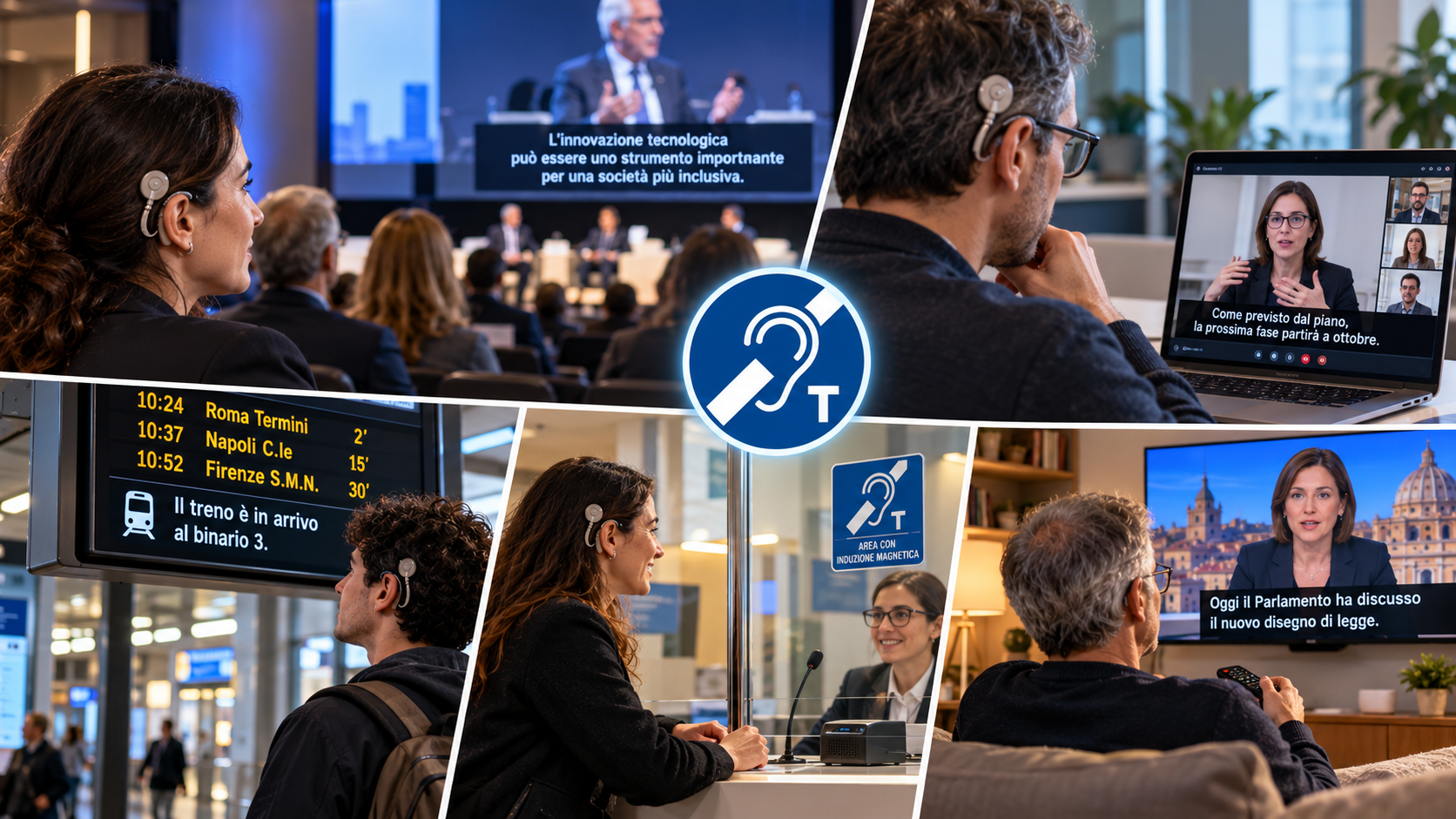
On the 75th Anniversary of the World Federation of the Deaf and Twenty Years After the UN Convention on the Rights of Persons with Disabilities: A Week Calling on Institutions and Society to Transform Accessibility, Communication and Participation from Occasional Concessions into Enforceable Rights
Abstract: The 2026 International Week of Deaf People, celebrated from 21 to 27 September under the theme Declaring Deaf People’s Human Rights, holds particular historical and social significance, as it coincides with the 75th anniversary of the World Federation of the Deaf and the twentieth anniversary of the adoption of the United Nations Convention on the Rights of Persons with Disabilities. It is not merely an occasion for raising awareness of deafness, but an opportunity to consider whether Deaf people are genuinely able to exercise, on an equal basis with others, their rights to information, education, employment, culture and social participation. The progressive consolidation of the human rights model has helped shift attention away from deafness understood exclusively as an individual impairment towards the linguistic, communicative, technological and organisational barriers that can transform a sensory difference into social exclusion. From this perspective, recognition of sign languages represents a fundamental achievement, but accessibility must also take account of the diversity of Deaf people, their different linguistic experiences and the various modes of communication they use. Italian Sign Language (LIS), subtitling, real-time transcription, assistive technologies, interpreting services and accessible digital tools belong to a single system of safeguards whose purpose should not simply be to enable a Deaf person to be present, but to ensure that they are able to understand, choose, contribute and participate fully in the life of the community.
Keywords: #InternationalWeekOfDeafPeople #DeafPeople #Deafness #SignLanguage #LIS #Accessibility #Inclusion #HumanRights #Disability #AccessibleCommunication #CRPD #NothingAboutUsWithoutUs #FedericaDarpino #EthicaSocietas #EthicaSocietasReview #ScientificJournal #SocialSciences #EthicaSocietasUPLI
A Week About Rights
From 21 to 27 September 2026, the International Week of Deaf People is being celebrated, an initiative promoted by the World Federation of the Deaf (WFD). This year holds particular significance because it marks seventy-five years since the Federation was founded and twenty years since the adoption of the United Nations Convention on the Rights of Persons with Disabilities. The theme chosen for 2026, Declaring Deaf People’s Human Rights, effectively captures the contemporary meaning of the observance: not simply to draw attention to deafness, but to affirm that the rights of Deaf people are human rights and that the fundamental challenge lies in ensuring their effective implementation in everyday life.
The Week has much older roots than the International Day of Sign Languages. The WFD recalls that the first International Week of the Deaf was organised in Rome in 1958 and that, since then, the observance has developed into an international movement through which Deaf communities promote awareness, participation and recognition of their rights. The date of 23 September has a particular significance of its own, since the World Federation of the Deaf was founded in Rome on 23 September 1951, a circumstance that would subsequently lead the United Nations to choose that date for the International Day of Sign Languages.
The 2026 programme makes clear that deafness cannot be reduced to a single issue. The 21st of September is dedicated to the twentieth anniversary of the CRPD and the recognition of national sign languages; the 22nd to the right to quality, inclusive and multilingual education; the 23rd to the declaration of Deaf people’s human rights; the 24th to accessibility; the 25th to the principle Nothing About Us Without Us; the 26th to Deaf culture as a human right; and the 27th to seventy-five years of the WFD’s international work.
It is precisely this plurality of perspectives that makes the Week particularly significant: there is no single “problem of deafness”, because the rights at stake extend across the entirety of a person’s life, from childhood to employment, from communication to culture, and from education to participation in public decision-making.
Seventy-Five Years After Rome
The coincidence with the 75th anniversary of the World Federation of the Deaf also gives 2026 particular significance for Italy. Founded on 23 September 1951, the WFD is celebrating its anniversary this year in Rome itself, where the opening ceremony took place at the Italian Parliament on 23 September 2026, hosted by the Italian National Agency for the Deaf (Ente Nazionale Sordi, ENS), in the presence of representatives of Italian and European institutions. The programme continues on 24 and 25 September with an international conference devoted to the theme Declaring Deaf People’s Human Rights, followed by a march and festival on 26 September.
The anniversary thus provides an opportunity to connect past and present symbolically. In 1951, the establishment of an international organisation led by Deaf people already represented an affirmation of the need for autonomous representation. Seventy-five years later, the principle that Deaf people must be protagonists in decisions that affect them has become one of the foundations of the modern human-rights-based understanding of disability.
From a Person to Be “Adapted” to a Society to Be Made Accessible
One of the most significant cultural changes of recent decades concerns the very way in which disability is understood. For a long time, deafness was viewed primarily through an individual medical perspective, with attention focused on hearing loss and on the means by which it might be compensated for. This dimension clearly remains important, but it cannot by itself explain the social experience of a Deaf person.
The United Nations Convention on the Rights of Persons with Disabilities (CRPD), adopted on 13 December 2006 and ratified by Italy through Law No. 18 of 3 March 2009, helped consolidate a different perspective, in which disability is also understood through the interaction between a person’s characteristics and the attitudinal and environmental barriers that hinder their full and effective participation in society on an equal basis with others.
For a Deaf person, this distinction has concrete implications. If a conference does not provide accessible means of communication, if a workplace meeting takes place exclusively through spoken communication, if a public service can be contacted only by telephone, if a video has no subtitles, or if an emergency is communicated exclusively through an audible signal, the difficulty does not arise solely from the person’s hearing condition, but from the interaction between that condition and an environment designed on the assumption that everyone can hear and communicate in the same way.
This is where accessibility ceases to be an additional service and becomes a matter of substantive equality.
The Right to Language and Communication
The central importance given to sign languages during the 2026 Week has a clear basis in the CRPD. Article 2 expressly includes sign languages within the definition of “language”; Article 9 addresses accessibility; Article 21, concerning freedom of expression and access to information, provides for the recognition and promotion of the use of sign languages; Article 24 addresses their role in education; and Article 30(4) recognises the right of persons with disabilities to recognition and support of their specific cultural and linguistic identity, including sign languages and Deaf culture.
In Italy, a fundamental step was taken through Article 34-ter of Decree-Law No. 41 of 22 March 2021, converted into law by Law No. 69 of 21 May 2021, through which the Republic recognises, promotes and protects Italian Sign Language (LIS) and Tactile Italian Sign Language (LIST), while also recognising the professional roles of LIS and LIST interpreters.
This legal recognition has a cultural significance that extends beyond the mere availability of interpreting services, because it means recognising that sign language is not a simplified gestural transposition of Italian, but an autonomous linguistic system and, for a significant part of the Deaf community, a component of both individual and collective identity. It is precisely this linguistic and cultural dimension that Deaf Studies have helped to highlight, revealing the limitations of an exclusively deficit-oriented representation of deafness (Lane, 1992; Ladd, 2003; Bauman & Murray, 2014).
There Is No Single Way of Being Deaf
Affirming the value of sign languages does not, however, mean treating the Deaf population as homogeneous. This is a point on which I believe it is necessary to insist, because even a policy motivated by the best intentions can become insufficiently inclusive when it assumes that there is a single communicative solution suitable for everyone.
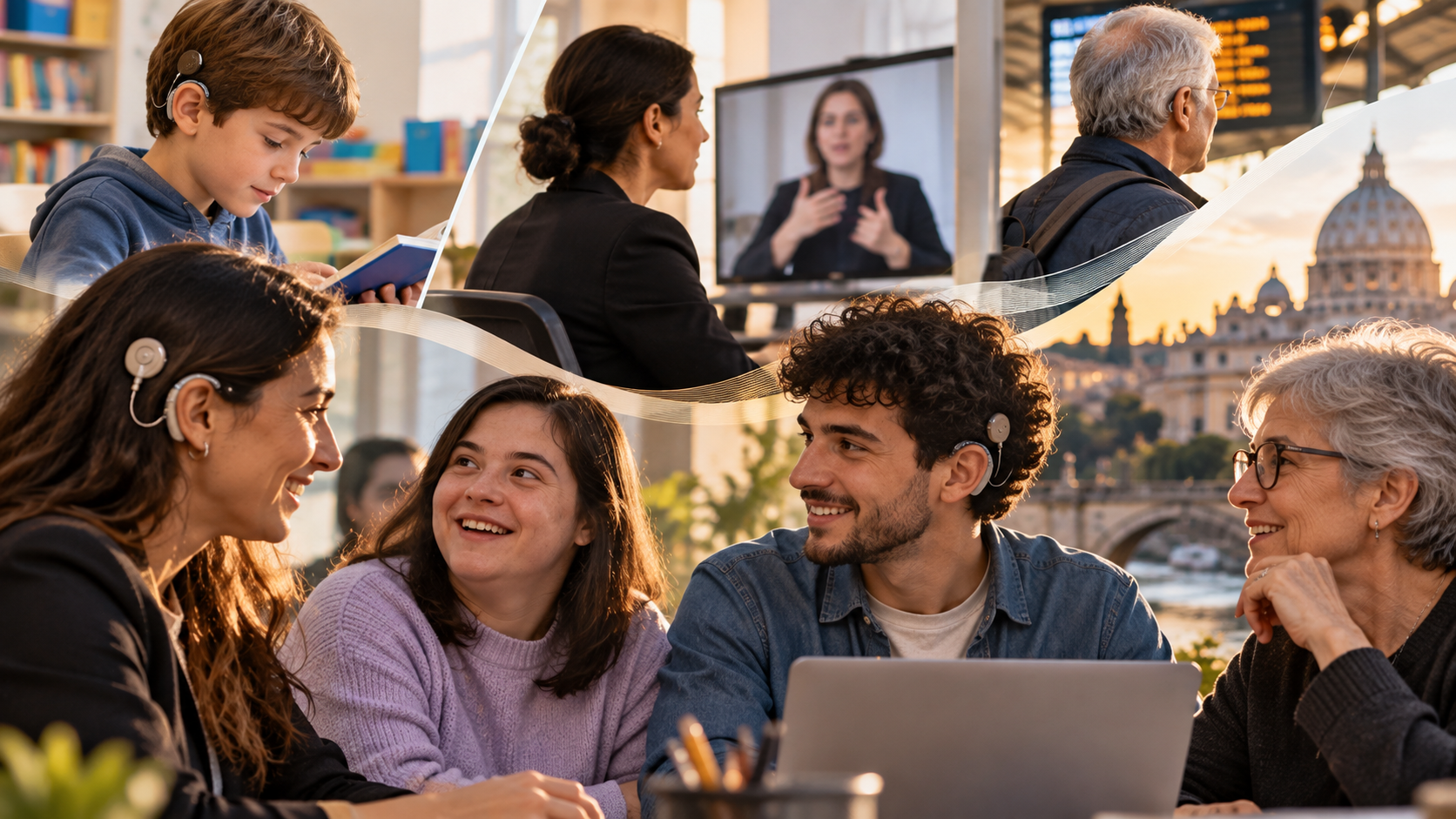
There are Deaf people who use sign language, oral communication or both; people who use hearing aids or cochlear implants; people who rely on lip-reading; others who prefer written communication, subtitling or real-time transcription; and many who combine different tools depending on the situation. Linguistic, family, educational and social backgrounds can differ profoundly, and the scientific literature has extensively demonstrated the complexity of these experiences (Lane, Hoffmeister & Bahan, 1996; Marschark & Spencer, 2010).
For this reason, accessibility should not replace one barrier with a single prescribed solution, but should create an environment in which different modes of communication are available.
LIS, interpreting services, professional subtitling, simultaneous transcription, text-based communication, assistive technologies and accessible digital platforms should not be regarded as ideologically opposed alternatives, but as instruments belonging to the same accessibility ecosystem, within which individuals can identify the mode best suited to their own needs.
Education: Accessibility Begins in Childhood
It is no coincidence that on 22 September the WFD dedicated the second day of the Week to the Right to a Quality Multilingual Inclusive Education, expressly linking it to Article 24 of the CRPD. According to the Federation, access to education through the national sign language and in linguistically appropriate environments is a fundamental element of development, identity and inclusion for Deaf students.
Education is, in fact, one of the areas in which accessibility produces consequences that can accompany a person throughout life. A child who does not have full access to communication does not merely encounter a temporary educational difficulty, because linguistic access affects the ability to acquire knowledge, build relationships, develop autonomy and participate in the educational community.
The issue of education also demonstrates why decisions concerning Deaf children cannot be reduced to a simplistic opposition between technology, oralism and sign language. What must be protected above all is the child’s right to rich, timely and appropriate linguistic and communicative access, involving families and enabling them to make genuinely informed choices.
Employment and the Invisible Burden of Communication
Article 27 of the CRPD recognises the right of persons with disabilities to work on an equal basis with others, yet here too the distinction between formal and substantive inclusion remains profound. Being employed does not necessarily mean being placed in a position to participate fully in the life of an organisation.
Meetings, training courses, telephone calls, webinars, informal conversations and everyday exchanges are a fundamental part of professional life and, when they are inaccessible, they can produce a form of exclusion that often remains invisible precisely because it does not arise from an explicit intention to discriminate.
For many Deaf people, this entails a daily communicative burden: constantly watching the speaker’s face, attempting to lip-read, shifting attention between presentation slides and the person speaking, reconstructing parts of a conversation that were not understood, asking others to repeat themselves, or discovering afterwards that important information had been communicated during a conversation to which they had not had full access.
Genuine workplace inclusion should therefore intervene before the Deaf person is forced continually to negotiate their own accessibility.
Technology and Artificial Intelligence: Opportunities, Not Universal Substitutes
Automatic subtitling, speech-to-text systems, real-time transcription, video communication and artificial intelligence-based technologies are greatly expanding opportunities for participation. It is therefore no coincidence that the WFD has also begun to devote specific attention to the relationship between artificial intelligence, sign languages and the rights of Deaf people. In its 2025 report, the Federation refers, among other initiatives, to the establishment of an ad hoc AI group tasked with developing policy positions aimed at safeguarding the inclusion and rights of Deaf people in the development of these technologies.
Technology, however, cannot automatically be regarded as synonymous with accessibility. An inaccurate transcription can alter the meaning of what is being said; an automated system may encounter difficulties with multiple speakers, background noise, accents or specialist terminology; and a solution designed without the involvement of Deaf people risks responding to an imagined need rather than an actual one.
Innovation is genuinely inclusive when it increases a person’s range of choices, not when the availability of a technology is used to restrict them.
“Nothing About Us Without Us”: From Protection to Participation
On 25 September 2026, the Week places the principle Nothing About Us Without Us at its centre, linking it to Articles 4(3) and 33 of the CRPD. The WFD explicitly emphasises the need for Deaf people to be at the heart of decisions affecting their lives and highlights the role of organisations led by Deaf people in shaping inclusive policies.
This is perhaps one of the most culturally significant aspects of the entire Week, because it marks the distance between two profoundly different models: on the one hand, the person with a disability understood as the recipient of assistance, protection and decisions made by others; on the other, the person recognised as a rights-holder possessing knowledge, experience and the capacity to contribute to decisions that affect them.
Designing a service for Deaf people without involving them, determining which communication tool they should use without listening to their needs, or regarding a solution as sufficient merely because it is technically available means perpetuating, even unintentionally, a paternalistic conception of inclusion.
Deaf Culture as Part of Human Diversity
The day of 26 September introduces another essential dimension: Deaf Culture Is a Human Right. The WFD refers to Article 30 of the CRPD and emphasises that Deaf people also belong to linguistic and cultural communities in which language, history, relationships, art, traditions and shared forms of experience contribute to the construction of identity.
This is an approach long developed within Deaf Studies. Authors such as Paddy Ladd have interpreted it through the concept of Deafhood, while Bauman and Murray have proposed the notion of Deaf Gain, provocatively shifting attention from what deafness is assumed to take away towards what the diversity of Deaf experiences can contribute to society (Ladd, 2003; Bauman & Murray, 2014).
This does not mean denying the difficulties that may accompany hearing loss, nor turning an extremely heterogeneous condition into a single compulsory cultural identity. Rather, it means recognising that a Deaf person cannot be defined exclusively by what they do not hear.
Seventy-Five Years of Rights and the Work Still to Be Done
The Week concludes on 27 September with 75 Years of Human Rights, recalling the journey begun by the World Federation of the Deaf in 1951 and now supported by 138 national member organisations. For the WFD, the founding principle that Deaf people must fully enjoy human rights is today inseparable from the CRPD, the recognition of sign languages and Deaf culture, and the participation of Deaf people in every sphere of life.
Seventy-five years is long enough to understand how much has changed, but also to see how much remains to be done.
As a Deaf woman, I believe that the point is not to ask society to decide what the best way to include us might be. The point is to build a society in which we can choose how to communicate, access information at the same time as everyone else, participate in decision-making, work, study, disagree, assume responsibilities and contribute to the community without continually having to demonstrate the legitimacy of our needs.
Being included does not mean being physically present while others communicate. It means being able to take part in the communication.
For this reason, the International Week of Deaf People should not be understood as an identity-based celebration reserved for a minority, but as an opportunity for society as a whole to reflect on the quality of its democracy. A society is genuinely accessible not when it occasionally grants a compensatory tool to those who cannot enter the system, but when it designs that system from the outset in recognition of the fact that people do not all communicate, learn and participate in the same way.
Accessibility, therefore, is neither kindness nor assistance. It is citizenship.
Legal and Institutional References
United Nations General Assembly (2006), Convention on the Rights of Persons with Disabilities, A/RES/61/106, 13 December 2006.
United Nations General Assembly (2017), International Day of Sign Languages, A/RES/72/161, 19 December 2017. The observance on 23 September was established within the broader tradition of the International Week of Deaf People.
Italy, Law No. 18 of 3 March 2009, Ratification and Implementation of the United Nations Convention on the Rights of Persons with Disabilities, with Optional Protocol.
Italy, Decree-Law No. 41 of 22 March 2021, Article 34-ter, converted with amendments by Law No. 69 of 21 May 2021, concerning the recognition, promotion and protection of Italian Sign Language (LIS) and Tactile Italian Sign Language (LIST).
World Federation of the Deaf (2026), International Week of Deaf People 2026: Declaring Deaf People’s Human Rights, 21–27 September 2026.
World Federation of the Deaf (2026), WFD 75th Anniversary, Rome, 23–26 September 2026.
Bibliography
Bauman, H.-D. L., & Murray, J. J. (eds.) (2014), Deaf Gain: Raising the Stakes for Human Diversity, University of Minnesota Press, Minneapolis.
Ladd, P. (2003), Understanding Deaf Culture: In Search of Deafhood, Multilingual Matters, Clevedon.
Lane, H. (1992), The Mask of Benevolence: Disabling the Deaf Community, Alfred A. Knopf, New York.
Lane, H., Hoffmeister, R., & Bahan, B. (1996), A Journey into the Deaf-World, DawnSignPress, San Diego.
Marschark, M., & Spencer, P. E. (eds.) (2010), The Oxford Handbook of Deaf Studies, Language, and Education, Vol. 2, Oxford University Press, Oxford.
Padden, C., & Humphries, T. (1988), Deaf in America: Voices from a Culture, Harvard University Press, Cambridge, MA.
Padden, C., & Humphries, T. (2005), Inside Deaf Culture, Harvard University Press, Cambridge, MA.
World Health Organization (2021), World Report on Hearing, WHO, Geneva.
FIVE LATEST CONTRIBUTIONS BY THE SAME AUTHOR
When Possession Is Mistaken for Love
Nabucco at the Verona Arena: When Opera Transcends into Vision
Dreaming on the Tiber Between Culture, Elegance and Solidarity
FIVE LATEST CONTRIBUTIONS ON SOCIAL TEMATICS
From Rights to Practice: When the Community Takes Responsibility for the Future
Gender-based Violence and Economic Abuse
Psychological Violence and the Instrumentalization of Children in Conflictual Family Relationships
The Brain Held Hostage: the Neurochemical Hijacking of Domestic Violence
FIVE LATEST CONTRIBUTIONS
International Week of Deaf People: From Accessibility to Full Citizenship
Free to Offend or Free from Offence?
Emotions in the Age of Social Media
Emma Bonino: Freedom Against the Morality Imposed by Others
Ethica Societas is a free, non-profit review published by a social cooperative non-profit organization
Copyright Ethica Societas, Human&Social Science Review © 2026 by Ethica Societas UPLI onlus.
ISSN 2785-602X. Licensed under CC BY-NC 4.0