

The New Grammar of NATO Security After Copenhagen

Abstract: Euro-Atlantic security is undergoing a transformation in which deterrence can no longer be measured solely in terms of the size and strength of military forces. The NATO Military Committee Conference held in Copenhagen on 18–19 September 2026 highlights the Alliance’s progressive shift towards readiness: the practical ability to prevent, absorb and respond to a crisis through available forces, infrastructure, military mobility, industrial production, emerging technologies, intelligence, civil resilience and interinstitutional coordination. This shift is particularly significant in light of the decisions taken at the 2025 Hague Summit and the subsequent 2026 Ankara Summit, which progressively transformed the objective of increased defence spending into a broader agenda centred on capabilities, production and preparedness. From this perspective, the article examines readiness as both a strategic and a legal-institutional category, highlighting the relationship between Articles 3 and 5 of the Washington Treaty, between military defence and societal resilience, and between NATO and the European Union. The argument advanced is that the new model of collective security depends not only on the ability to respond to an attack, but also on the capacity to keep institutions, infrastructure, production chains, information systems and essential services operational throughout a prolonged crisis. Preparedness thus becomes a form of collective responsibility and multilevel governance.
Keywords: #NATO #Readiness #Preparedness #Resilience #Deterrence #CollectiveSecurity #CollectiveDefence #EuroAtlanticSecurity #MultilevelGovernance #CivilResilience #CivilPreparedness #MilitaryMobility #DefenceIndustry #CriticalInfrastructure #EmergingTechnologies #CyberResilience #MultiDomainDefence #NATOEU #WashingtonTreaty #CristinaDiSilvio #EthicaSocietas #EthicaSocietasReview #ScientificJournal #Humanities #SocialSciences #EthicaSocietasUPLI
Copenhagen and the Meaning of Being “Ready”
Being ready. It is an apparently simple expression, yet in contemporary security it encompasses a profound transformation in the very concept of defence.
The NATO Military Committee Conference, held in Copenhagen on 18–19 September 2026, took place at a time when the Alliance is no longer called upon merely to define threats, nor simply to determine how much its members should invest in defence. The next question is far more concrete: how quickly can those resources be converted into capabilities that are actually available?
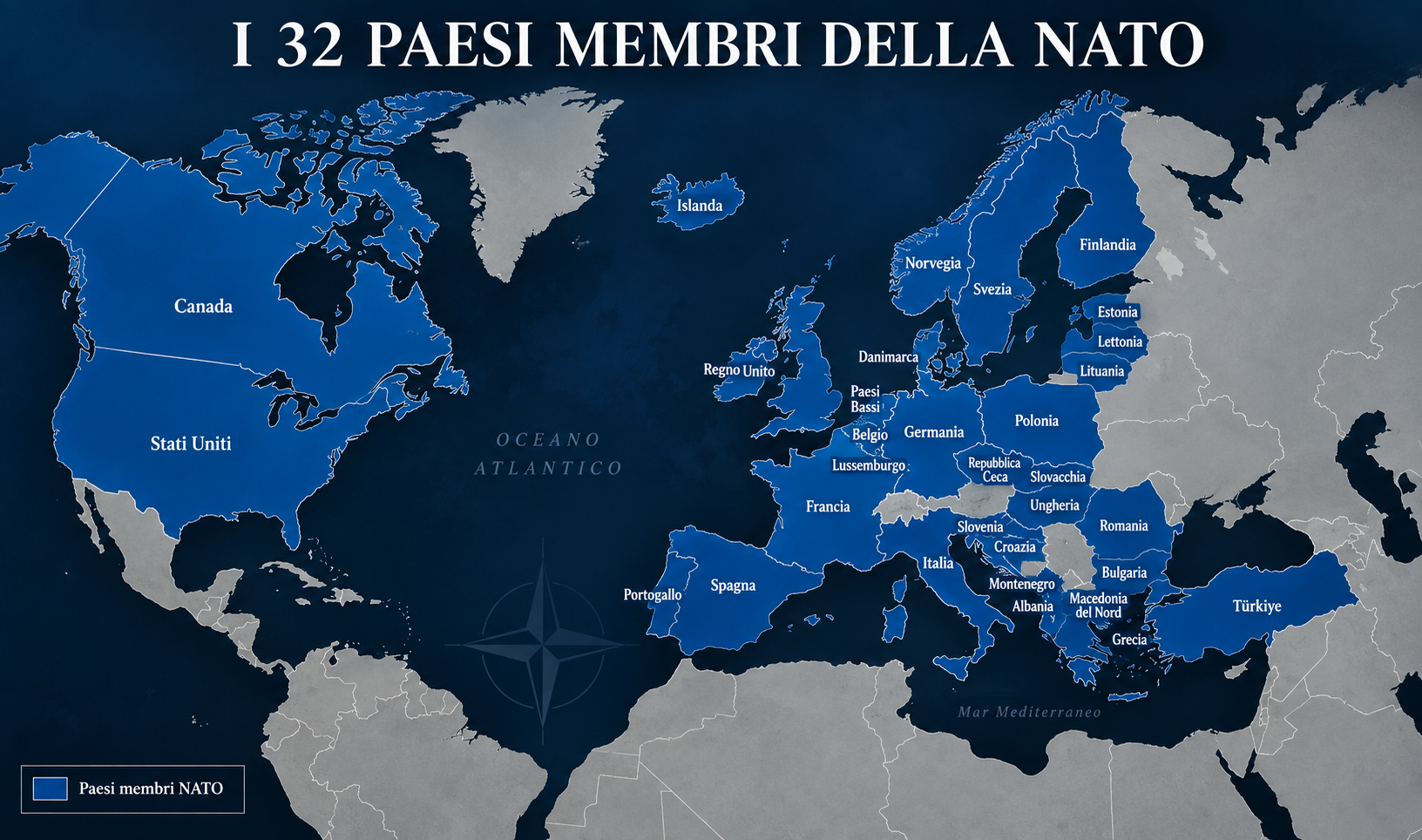
The 32 Allied Chiefs of Defence met to discuss the implementation of decisions taken at the Ankara Summit, with particular emphasis on strengthening deterrence and collective defence, technological innovation and support for Ukraine.[1] Copenhagen is also significant for another reason: it represents a kind of laboratory for the new Euro-Atlantic security environment. Denmark occupies a geographical position connecting the Baltic, the North Atlantic and the Arctic, areas in which maritime security, critical infrastructure, freedom of navigation, energy routes, military mobility and the technological dimension increasingly overlap.
The issue, therefore, is not simply to “have” armed forces. It is to be able to move, supply, protect, coordinate and sustain them under crisis conditions. The distinction is substantial. A military capability that exists on paper but cannot be rapidly deployed, supplied or integrated with other Allied capabilities does not necessarily constitute an operational capability.
Readiness arises precisely from this problem.
From Declared Deterrence to Verifiable Deterrence
NATO has built its strategic identity around deterrence and collective defence. Article 5 of the Washington Treaty remains the fundamental reference point: an armed attack against one or more members is considered an attack against them all.[2] Yet for Article 5 to be credible, it presupposes something that comes before it: the existence of a concrete capacity to respond.
This is why Article 3 of the Treaty is assuming growing importance. It commits the Allies, individually and collectively, to maintain and develop their capacity to resist armed attack.[3]
It is precisely in the relationship between Articles 3 and 5 that one of the interpretative keys to NATO’s new phase can be found. Article 5 defines collective solidarity in the face of aggression. Article 3 establishes the material conditions that enable that solidarity to become effective.
Deterrence, therefore, is not merely a political declaration. It is a system. And a system is credible only when its components function. This explains why the concept of readiness is progressively expanding to encompass dimensions that were previously treated separately: armed forces, industry, transport, energy, telecommunications, cyber resilience, infrastructure, civil protection, institutional continuity and decision-making capacity.
NATO itself now defines resilience as the capacity to prepare for, resist, respond to and quickly recover from shocks and disruptions.[4] The paradigm has therefore broadened. Security no longer coincides solely with the ability to fight. It also means being able to continue functioning while fighting.
From The Hague to Ankara: From Spending to Capabilities
The process leading to Copenhagen did not begin in Copenhagen. The first decisive step came at the Hague Summit in June 2025, when the Allies committed to reaching expenditure equivalent to 5% of GDP on defence and security by 2035, comprising at least 3.5% for core military requirements and up to 1.5% for infrastructure, resilience and other security-related sectors.[5]
This figure, however, should not be interpreted merely as an economic indicator. The central question is what that expenditure is intended to produce. Greater financial resources become strategically significant only when they translate into trained personnel, ammunition, air and missile defence, unmanned systems, space and cyber capabilities, intelligence, logistics, mobility and industrial production. It is the transition from spending capacity to capability delivery.
The Ankara Summit of 8 July 2026 reinforced precisely this approach. In their final declaration, the Allies reaffirmed their commitment to collective defence and a 360-degree approach, while simultaneously highlighting increased investment, the strengthening of the defence industrial base, new capabilities and greater responsibility on the part of European Allies and Canada.[6] According to NATO, since 2025 European Allies and Canada have increased investment in core defence requirements by more than $139 billion.[7]
Yet Ankara introduced an even more important element: the problem is no longer simply to set a target; it is to deliver what that target promises.
It is within this logic that Copenhagen must be understood.
Readiness: When Preparedness Becomes a Strategic Capability
Readiness can be understood as operational preparedness, but an exclusively military definition risks being too narrow. A genuinely ready NATO must be able to identify a threat rapidly, make timely decisions, move forces and equipment, guarantee supplies, protect infrastructure, maintain functioning communications, ensure energy and transport, support populations, guarantee institutional continuity, rapidly restore what has been damaged and coordinate states, armed forces, industry and private actors.
On 15 September 2026, NATO adopted new Resilience Baseline Requirements, explicitly emphasising the need to accelerate efforts to strengthen resilience, particularly with regard to civilian support for military operations.[8] The document identifies an especially significant problem: in an interconnected society, a national vulnerability can produce cascading effects across the Alliance’s entire operational space.
This represents a fundamental shift in perspective. If a port ceases to function, a railway network is disrupted, an energy backbone is attacked, a telecommunications network is compromised or a satellite system becomes unavailable, the problem is not necessarily “civilian” or “military”. It is both at once.
The traditional distinction between the front line and the rear thus tends to lose its meaning.
Civil Society Enters the Space of Deterrence
Perhaps the most interesting dimension of the new readiness is its civilian component. NATO identifies three essential functions of civil preparedness: continuity of government, continuity of essential services to the population and civilian support for military operations.[9]
This represents an extremely broad conception of security. A modern military depends on a network of infrastructure and services that, in most cases, belong to the civilian sphere.
Transport, ports, airports, railways, energy, telecommunications, cloud services, data centres, satellites, hospitals, logistics chains and industry can all become components of strategic security. Even the availability of water and food can acquire security significance. Contemporary warfare has also demonstrated how rapidly conventional attacks, cyberattacks, sabotage, disinformation, electromagnetic interference, economic pressure and influence operations can overlap.
For this reason, NATO increasingly refers to whole-of-government and whole-of-society approaches. Security is no longer solely a function of the Ministry of Defence. It is a distributed responsibility.
The Defence Industry as Security Infrastructure
Another consequence of this new approach concerns industry. Armed forces may possess technologically advanced systems, but if there is no industrial capacity to rapidly replace what is consumed or destroyed, their initial superiority may progressively diminish. Production therefore becomes part of deterrence.
NATO has explicitly stated that increasing budgets is not enough: the defence industry must possess the production capacity necessary to deliver the capabilities required by Allied forces.[10]
This transformation has economic implications, but geopolitical ones as well. Defence supply chains must be sufficiently robust, diversified and resilient. Strategic dependencies become vulnerabilities. Supply-chain bottlenecks can become security problems. The capacity to rapidly produce ammunition, air-defence systems, drones, sensors, electronic components and communications systems becomes part of deterrence capability.
In this sense, the defence industrial base assumes an almost infrastructural function. It is no longer merely an economic sector supplying the armed forces. It is a component of collective security.
The New Battlefield Is Multi-Domain
Contemporary readiness must also be multi-domain. Land, sea and air remain fundamental, but they no longer exhaust the strategic environment. Cyber, space, data, artificial intelligence, autonomous systems and digital infrastructure are now integral components of military capability.
The Ankara Declaration identified unmanned systems, advanced technologies, intelligence, long-range precision-strike capabilities and integrated defence against air and missile threats among its priority capabilities.[11]
This transformation also alters the relationship between time and decision-making. A cyberattack can produce effects within seconds. An autonomous system can acquire and transmit data in real time. A disinformation campaign can reshape the information environment even before the event that triggered it has been identified.
Readiness therefore also becomes cognitive readiness. It is not enough to be prepared to react physically. It is necessary to be prepared to understand.
The Human Factor: Decision, Responsibility and Control
Increasing automation nevertheless introduces a question that technology alone cannot resolve. Who decides? Who authorises? Who is accountable for an error? Who verifies information? Who determines whether an anomaly is an accident, an attack or a manipulation?
Technological progress can accelerate responses, but it can also accelerate mistakes. Readiness cannot therefore be reduced to speed. An extremely rapid decision based on incorrect information is not necessarily a good decision.
This reveals an ethical dimension of preparedness. Being ready also means having verification procedures, chains of responsibility, oversight mechanisms and criteria of legitimacy.
In a constitutional democracy, security does not eliminate the law. On the contrary, it is precisely during a crisis that law becomes one of the instruments through which society retains control over its security apparatus. Readiness must therefore be both operational and legal.
NATO and the European Union: Complementarity, Not Overlap
European security inevitably requires an increasingly close relationship between NATO and the European Union. The two organisations do not perform the same function. NATO remains the central political-military organisation for the collective defence of its members. The European Union, by contrast, possesses economic, regulatory, industrial, financial and civil-protection instruments capable of strengthening overall resilience.
The relationship between these two dimensions therefore becomes particularly important in the fields of critical infrastructure, military mobility, cyber resilience, industry, energy security, civil protection and countering hybrid threats. The 11th progress report on EU-NATO cooperation, published in June 2026, specifically highlights intensified cooperation on hybrid threats, resilience and preparedness.[12]
Complementarity, however, must not become duplication. One of the principal challenges of European security governance is to coordinate different competences without creating institutional overlap. This is fundamentally a legal and organisational question. It is also a question of efficiency.
Copenhagen and the Geography of European Security
The choice of Denmark for the Military Committee Conference is not without strategic significance. The country lies at the crossroads of the Baltic Sea, the North Sea, the North Atlantic and the Arctic.
The security of these areas is linked to the protection of maritime routes, energy and digital infrastructure, undersea communications and military mobility capabilities. The strategic landscape has also expanded northwards. The Arctic can no longer be regarded as a distant periphery of Euro-Atlantic security. Strategic competition, climate change, the opening of new routes, the presence of critical infrastructure and growing military attention are making the High North an increasingly important component of strategic planning.
Copenhagen thus becomes symbolically and geographically significant: a place where several vectors of the new European security environment converge.
Readiness as a Democratic Responsibility
The term readiness risks being interpreted exclusively through a military lens. That would be a mistake.
A prepared society is not necessarily a militarised society. It is a society capable of understanding its vulnerabilities and developing the means to address them.
Preparedness also concerns the population. It concerns the ability of institutions to communicate during a crisis. It concerns the protection of infrastructure. It concerns information security. It concerns the ability of hospitals to operate under pressure. It concerns the continuity of public administrations. It concerns the resilience of businesses. It even concerns the ability to distinguish reliable information from a campaign of manipulation.
In this sense, preparedness acquires a civic dimension. A resilient democracy is not one that eliminates risk. It is one that possesses the institutional, cultural and technological instruments to navigate risk without losing control of its own decisions.
From Reaction to Prevention
NATO’s major strategic transformation can be summarised as a shift from the ability to react to the ability to be ready before a crisis begins.
The distinction is not merely linguistic. Reaction belongs to the moment of the event. Readiness belongs to the period before it. It requires planning, exercises, stockpiles, redundancy, production, interoperability, intelligence, procedures, infrastructure, communications and accountability.
NATO’s September 2026 document on the new resilience requirements specifically emphasises the need to plan before a crisis and to regularly exercise the capabilities that have been developed.[13] Exercises therefore become a form of knowledge. Only by placing a system under stress is it possible to understand its actual vulnerabilities. A procedure that works only under ordinary conditions does not constitute a genuine crisis capability.
The Risk of False Security
There is, however, an opposite risk. The rhetoric of preparedness can generate a false sense of security. Spending more does not automatically mean being safer. Increasing technical capabilities does not automatically increase resilience. Acquiring advanced technologies does not automatically mean knowing how to integrate them.
Readiness must therefore be measurable—not through the abstract quantity of resources, but through the actual capacity to achieve defined outcomes. How long does it take to deploy a force? How quickly can stocks be replenished? How resilient is an energy network? How long can a digital infrastructure withstand disruption? How quickly can it be restored? How interoperable is a system? How reliable is the decision-making chain? How prepared is the population?
These are questions of security, but they are also questions of governance.
The New Equation of Collective Security
In light of the developments leading from The Hague to Ankara and from Ankara to Copenhagen, collective security can be represented through a new equation: deterrence, military capability, resilience, industry, technology, mobility, governance and responsibility.
None of these elements is sufficient on its own. Military power without resilience can be vulnerable. Technology without oversight can create new risks. Industry without interoperability can be inefficient. Spending without productive capacity may fail to generate results. Planning without exercises may prove merely theoretical. Political solidarity without operational capabilities may lose credibility.
The new NATO therefore appears to be moving towards a model in which security is understood as an ecosystem. This represents a significant conceptual shift.
Being Ready Means Being Able to Continue Functioning
Copenhagen is not simply another date in NATO’s calendar. It offers a snapshot of a broader transformation.
After the phase in which the Alliance redefined its spending objectives comes the phase of implementation. After capabilities are defined comes their availability. After investment comes production. After planning comes exercising. After declared deterrence comes verifiable deterrence.
The concept of readiness encapsulates this transformation. Being ready means being able to respond to an attack. But it also means being able to keep ports open, hospitals functioning, communications available, energy networks operational, digital infrastructure protected, public administrations functioning and production chains available. Above all, it means preventing a crisis from transforming a local vulnerability into systemic paralysis.
Twenty-first-century security is therefore measured not only by the ability to strike or defend. It is measured by the ability to withstand pressure without collapsing. It is here that the military dimension meets the civilian one, the technological meets the legal, and the geopolitical meets the ethical.
True deterrence is not merely the ability to prevail in a confrontation. It is the ability to make credible the proposition that, even under pressure, society will continue to function, institutions will continue to make decisions and the democratic order will continue to exist.
The new priority, therefore, is not simply to spend more. It is to be ready. And, above all, to be ready beforehand.
NOTE
[1] NATO, NATO Military Committee Conference to be held in Denmark, Media Advisory, 25 agosto 2026; NATO, Military Committee Conference, Copenhagen, 18–19 settembre 2026.
[2] NATO, The North Atlantic Treaty, Washington, 4 aprile 1949, art. 5.
[3] Ivi, art. 3.
[4] NATO, Resilience, civil preparedness and Article 3, aggiornamento 18 settembre 2026.
[5] NATO, Defence investment and NATO’s 5% commitment, aggiornamento 29 giugno 2026; NATO, The Hague Summit Declaration, 25 giugno 2025.
[6] NATO, The Ankara Summit Declaration, Ankara, 8 luglio 2026.
[7] NATO, The Ankara Summit Declaration, cit.
[8] NATO, 2026 Resilience Baseline Requirements, 15 settembre 2026.
[9] NATO, Resilience, civil preparedness and Article 3, cit.
[10] NATO, Increasing defence industrial production, aggiornamento 8 luglio 2026.
[11] NATO, The Ankara Summit Declaration, cit.
[12] Council of the European Union, EU-NATO: 11th progress report highlights sustained cooperation in light of increasing security challenges, 18 giugno 2026.
[13] NATO, 2026 Resilience Baseline Requirements, cit.
BIBLIOGRAFIA
Council of the European Union. (2026). EU-NATO: 11th progress report highlights sustained cooperation in light of increasing security challenges. Brussels, 18 June 2026.
NATO. (1949). The North Atlantic Treaty. Washington, 4 April 1949.
NATO. (2021). Strengthened Resilience Commitment. Brussels, 14 June 2021.
NATO. (2025). The Hague Summit Declaration. The Hague, 25 June 2025.
NATO. (2026). 2026 Resilience Baseline Requirements. Brussels, 15 September 2026.
NATO. (2026). Defence investment and NATO’s 5% commitment. Brussels, updated 29 June 2026.
NATO. (2026). Increasing defence industrial production. Brussels, updated 8 July 2026.
NATO. (2026). The Ankara Summit Declaration. Ankara, 8 July 2026.
NATO. (2026). NATO Military Committee Conference. Copenhagen, 18–19 September 2026.
NATO. (2026). Resilience, civil preparedness and Article 3. Brussels, updated 18 September 2026.
NATO. (2026). The Secretary General’s Annual Report 2025. Brussels, 2026.
LATEST 5 CONTRIBUTIONS BY THE SAME AUTHOR
When Climate Change Reshapes Global Strategy
Ceuta, When the Border Becomes a Weapon
Ceuta: Digital Mobilization and the Jihadist Threat
Monaco and Europe’s Security Vulnerabilities
FIVE LAST CONTRIBUTIONS ON GEOPOLITICS
Islam, Radicalization, and Global Security
The State of the Global and National Economy in the Governor’s Final Considerations
Destroying Images, Governing Memory: Jihadist Iconoclasm and Cognitive Warfare
FIVE LATEST CONTRIBUTIONS
From Rights to Practice: When the Community Takes Responsibility for the Future
2001–2026: Twenty-Five Years of the War on Terror
Care Has No Gender. Rethinking Relationships to Prevent Violence
Ethica Societas is a free, non-profit review published by a social cooperative non-profit organization
Copyright Ethica Societas, Human&Social Science Review © 2026 by Ethica Societas UPLI onlus.
ISSN 2785-602X. Licensed under CC BY-NC 4.0